Being #DistractinglySexy

So here is the summary that you have probably have already heard, Tim Hunt, a Nobel laureate scientist made some very sexist remarks to of all people, a group of female scientists and engineers. He stated men and women shouldn’t work together in the same lab because when they do, you fall in love with them, they fall in love with you, and they cry when you criticize them. I think the man thinks a bit too highly of himself that any women he works with would fall in love with him.

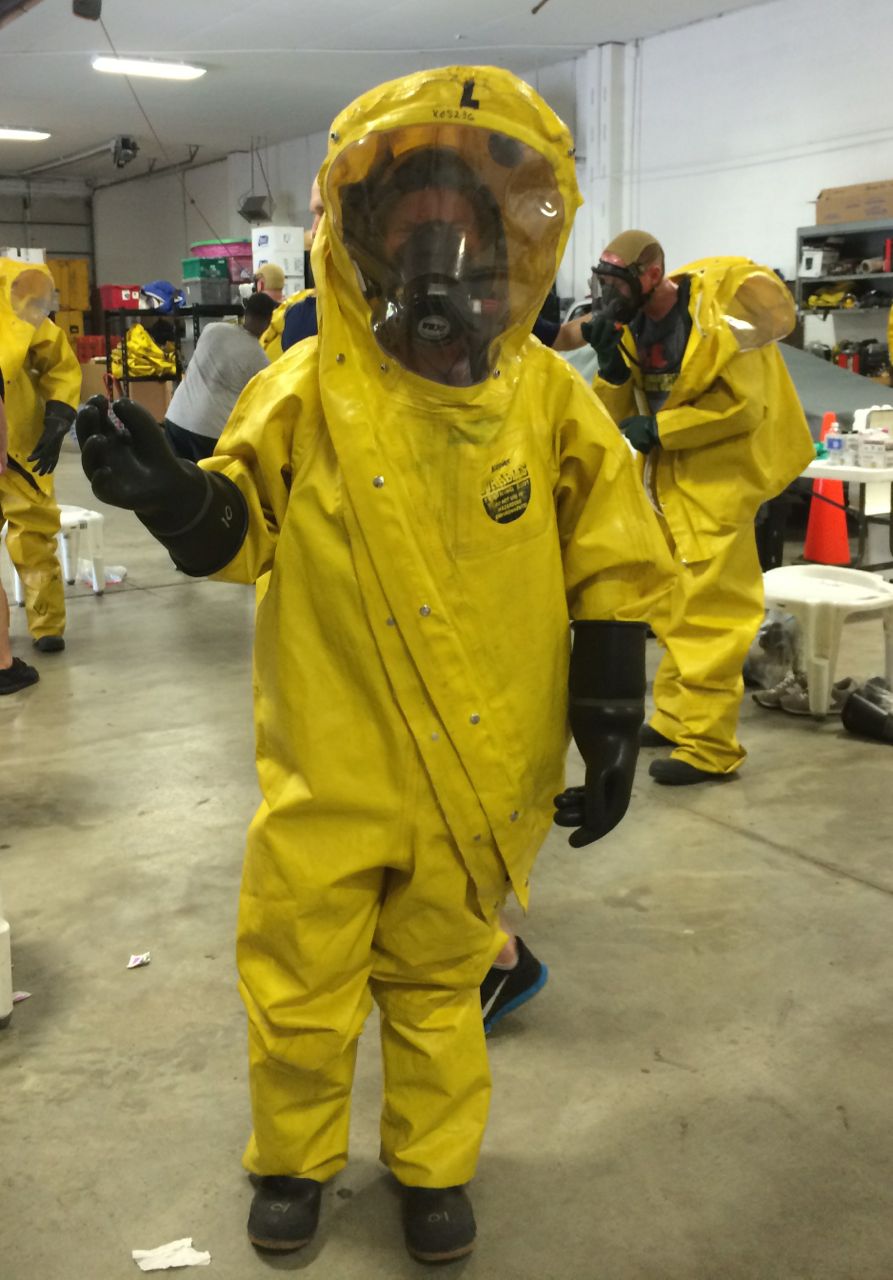
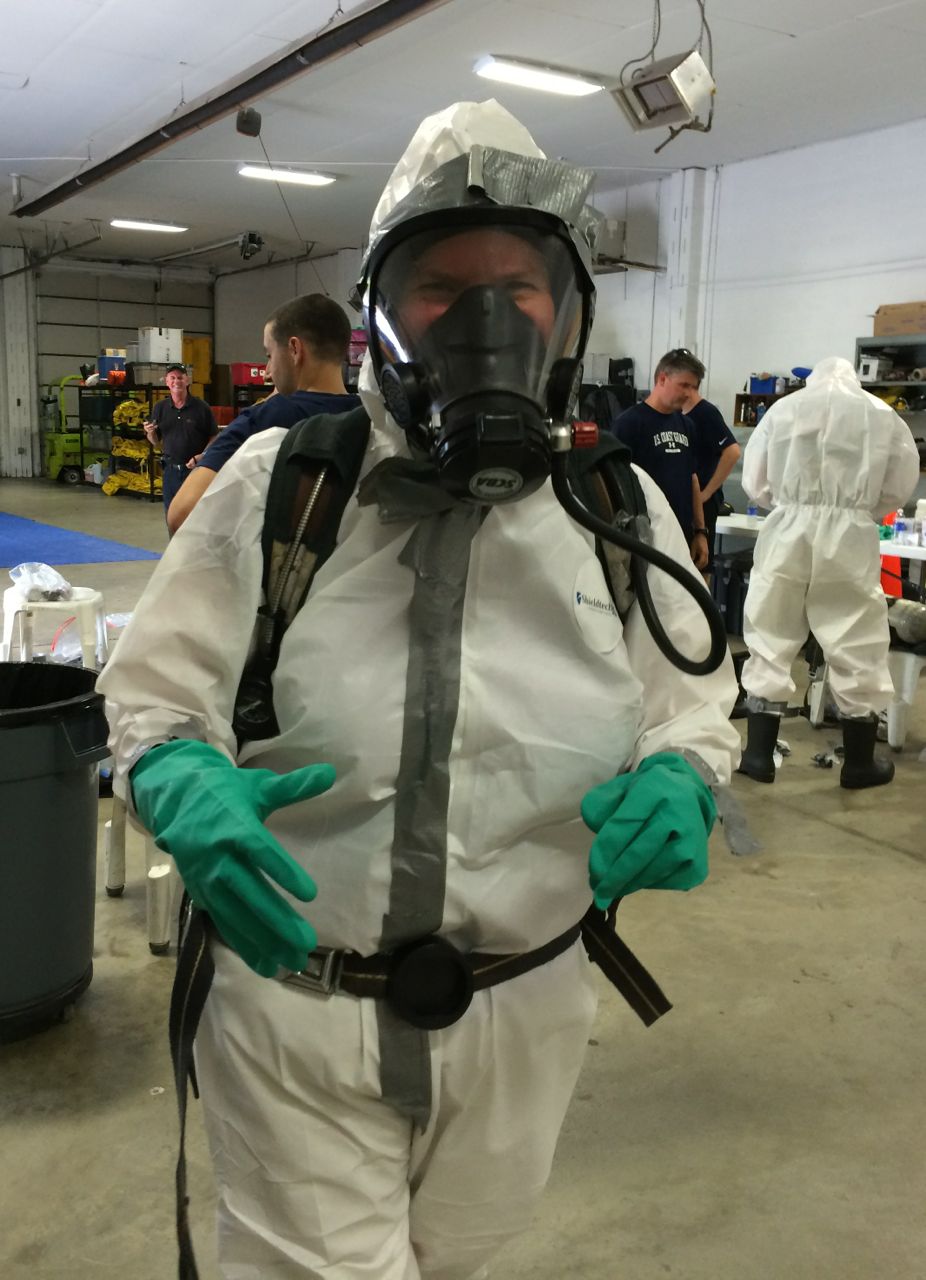
The reaction mocking him, especially on Twitter, has kept my faith in humanity. Women have been tweeting photos of themselves working in the field and lab. Showing how distractingly sexy they are. I tweeted two photos of myself from HAZWOPER training, once in Level A PPE and one in Level B PPE.


Those tweets have proved quite popular with the Level A photo thus far getting over 1100 retweets, and the Level B getting over 360 retweets. The tweets have been featured in articles in Buzzfeed, Washington Post, Salon, and Huffington Post UK. The whole thing has been rather surreal honestly. I have been contacted my media outlets to comment. I haven’t, partially because of timing and such.

I don’t even have any photos of me really working in the lab or field that would demonstrate how real work is the complete opposite of distractingly sexy. Well, I guess everyone find different things sexy, but get real. In the first part of my career I worked as a consultant. Typical field work included environmental site assessments where I was directing drillers to get soil and groundwater samples. Gloves, steel-toed boots, jeans, and a t-shirt that was likely going to get dirt on it were my “sexy” look. Then there was the time I was helping to sample a malfunctioning aeration chamber at a wastewater treatment plant in 95°F heat. [The aeration chamber is generally the start of secondary treatment, and thus there should be little to no smell. As this was malfunctioning, try to imagine the smell of raw sewage cooking in the heat.] If you find that situation sexy, well, I don’t think I want to meet you. Then there was the time I was checking on a pilot water treatment plant. Mainly it was a whole lot of sitting around, taking notes, checking valves, and taking some samples by myself. Normally field work involves a lot of sweating really. However, there was one time I was working in the field, again getting soil samples, in New Jersey in the dead of winter. There was no sweating or falling in love. There was just me freezing my butt off and making sure the security guards were in sight. That was a fun job; it was the only time I’ve ever been in a location where safety from crime was an actual issue. Normally the safety issues are the more mundane moving parts, heat, sun, fire ants, and then the one rattlesnake. God bless Texas.

When I was a Ph.D. student, we did our field work at auto body shops measuring the exposure the painters received to a chemical in the clear coat. Basically the shops were loud and smelly with really fun chemicals, and we sat around all day collecting personal air samples, tape strips from their skin after painting, all the urine we could get, and blood at the end of the day. In the hot months, there was sweating. In the cold months, there was shivering. At what point would we be distracting each other with our sexiness? Would the latex gloves and respirators, be the cause? No doubt the painters were falling in love with me because I kept trying to get them to drink more water and begging them for more urine. After the field work was done, I spent the better part of two years or possibly more in the lab analyzing all the urine samples. I analyzed over 400 urine samples, and the analysis was a three day procedure. The first part of the analysis involved adding concentrated sulfuric acid to the urine and then heating it for four hours to 100°C. Yes, nothing says distractingly sexy like urine cooked with acid. Luckily, the lab has hoods and other ventilation methods. Oh, and I shouldn’t leave out the part of asking my lab mates for their urine at times because I used that as unexposed urine from which to make my standards. How I did not fall in love with them while they handed me cups of their own urine, is anyone’s guess.

Now, I mainly work in an office. I get into the field every once in a great while. The photos I tweeted are from training, and I have never actually worn that level of PPE for real work. However a couple of weeks ago, I got into the field, and got to help sample fish, then watch a biologist sample them. I did not in fact fall in love with the biologist when he was filleting the fish.
Street Excavation

Early in my career as an environmental engineer, I sometimes did field work that involved soil and groundwater sampling. The type of soil sampling I did used shallow coring down to about 15 or 20 to obtain different depth soils to analyze for contamination. Number one rule before coring or digging for any reason, is to have all the utility marked. Most, if not all, states have a single number you can call and request the utility companies come out and mark where their underground pipes, wires, or whatever are. They would come and spray paint lines to denote their utilities, and then the drillers and I would know to avoid those areas. The sites I worked out were fairly simple, and avoiding utilities was pretty straightforward. Then there are old, densely populated cities like New York. I have never done any type of digging in New York City, and I hope I never do. The underground is a maze of pipes and wires and then below that are subways and basements and who knows what else.

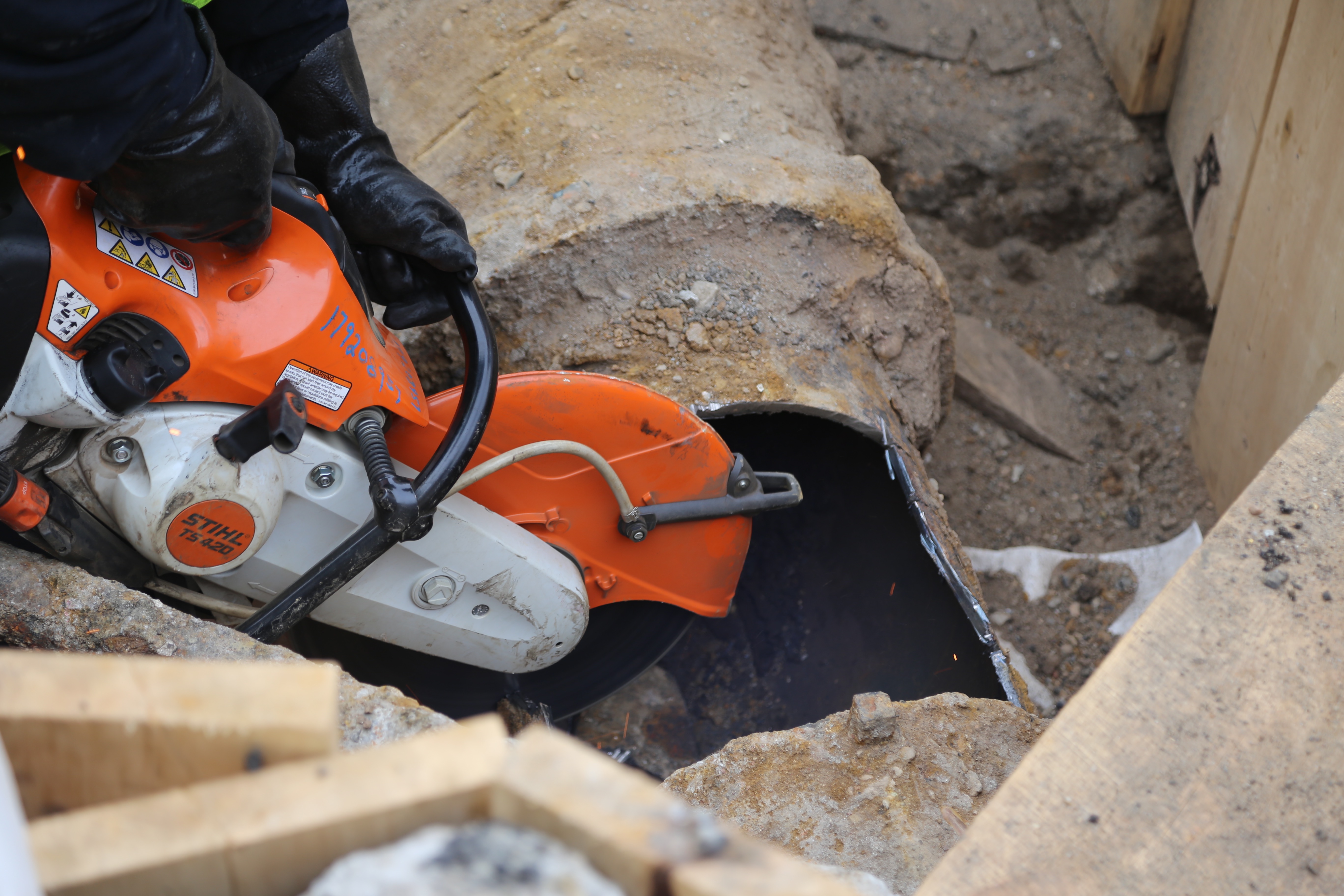
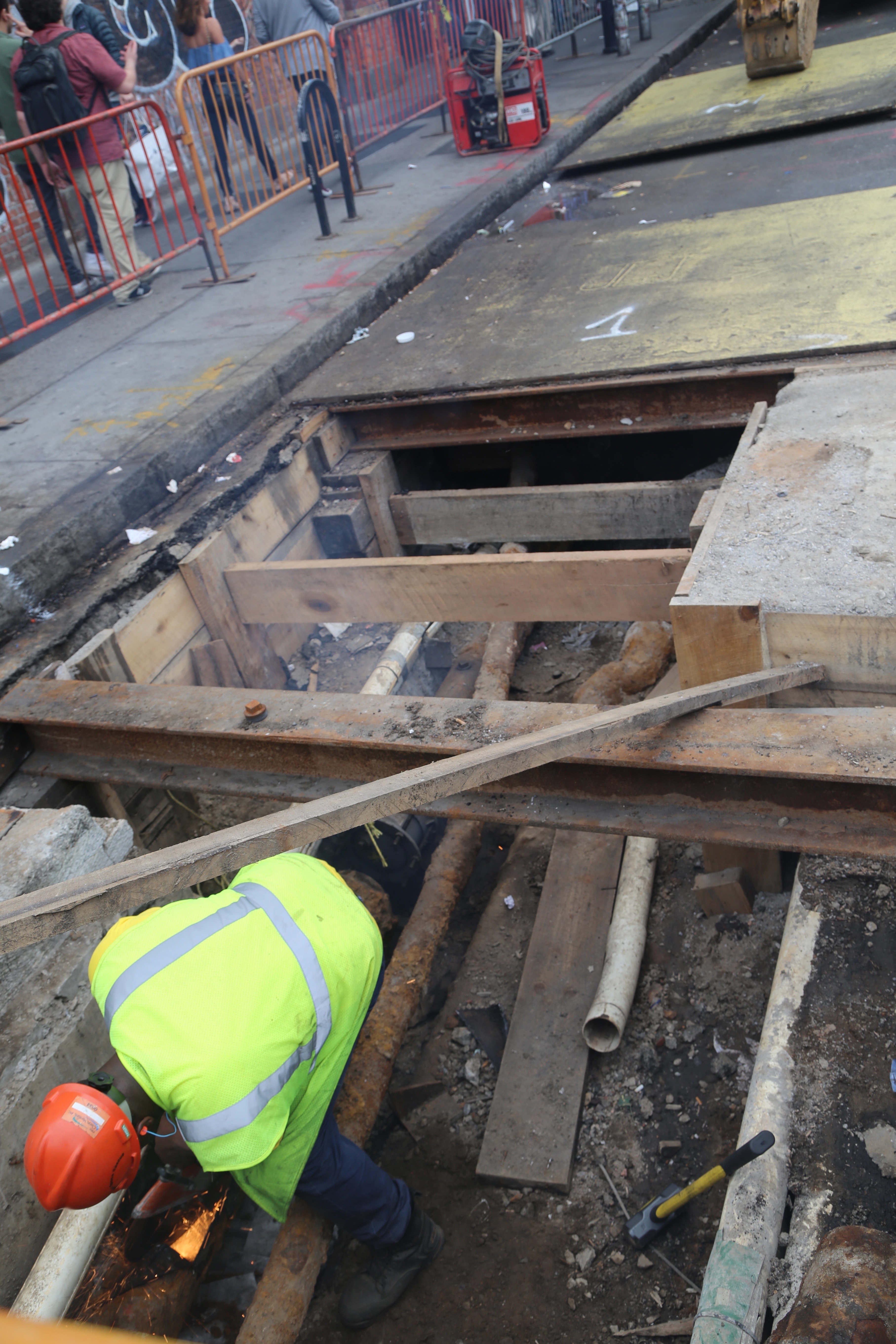
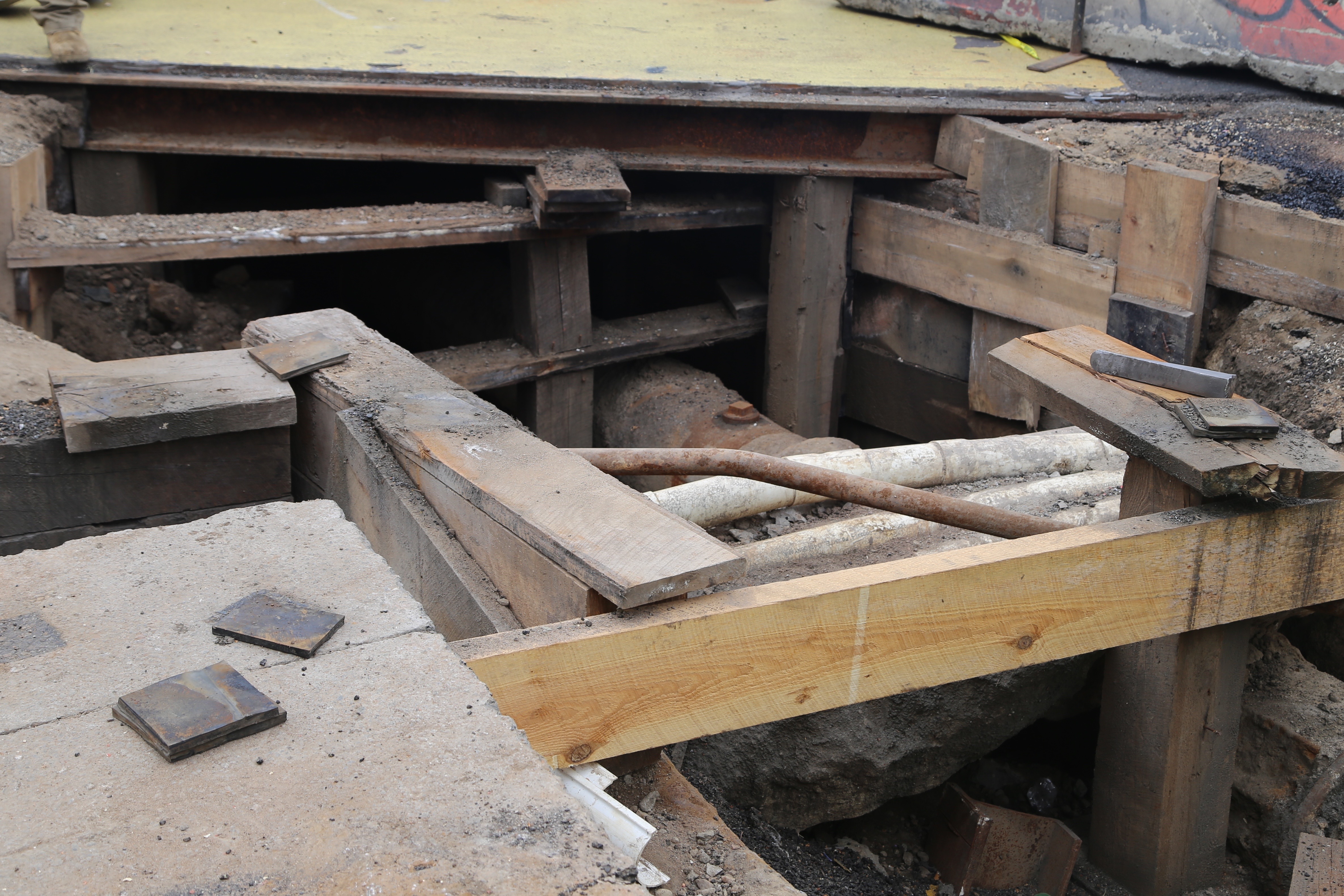
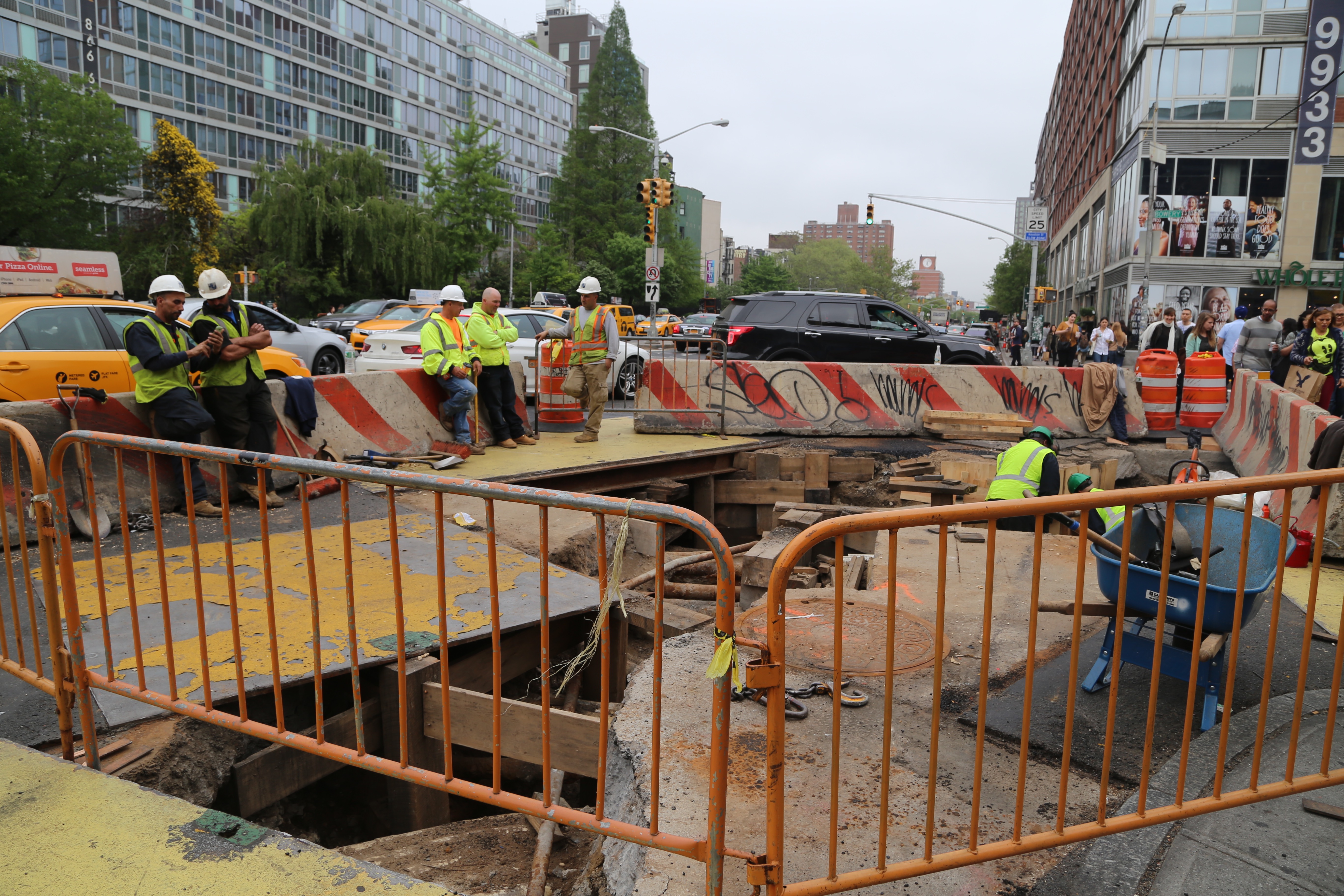
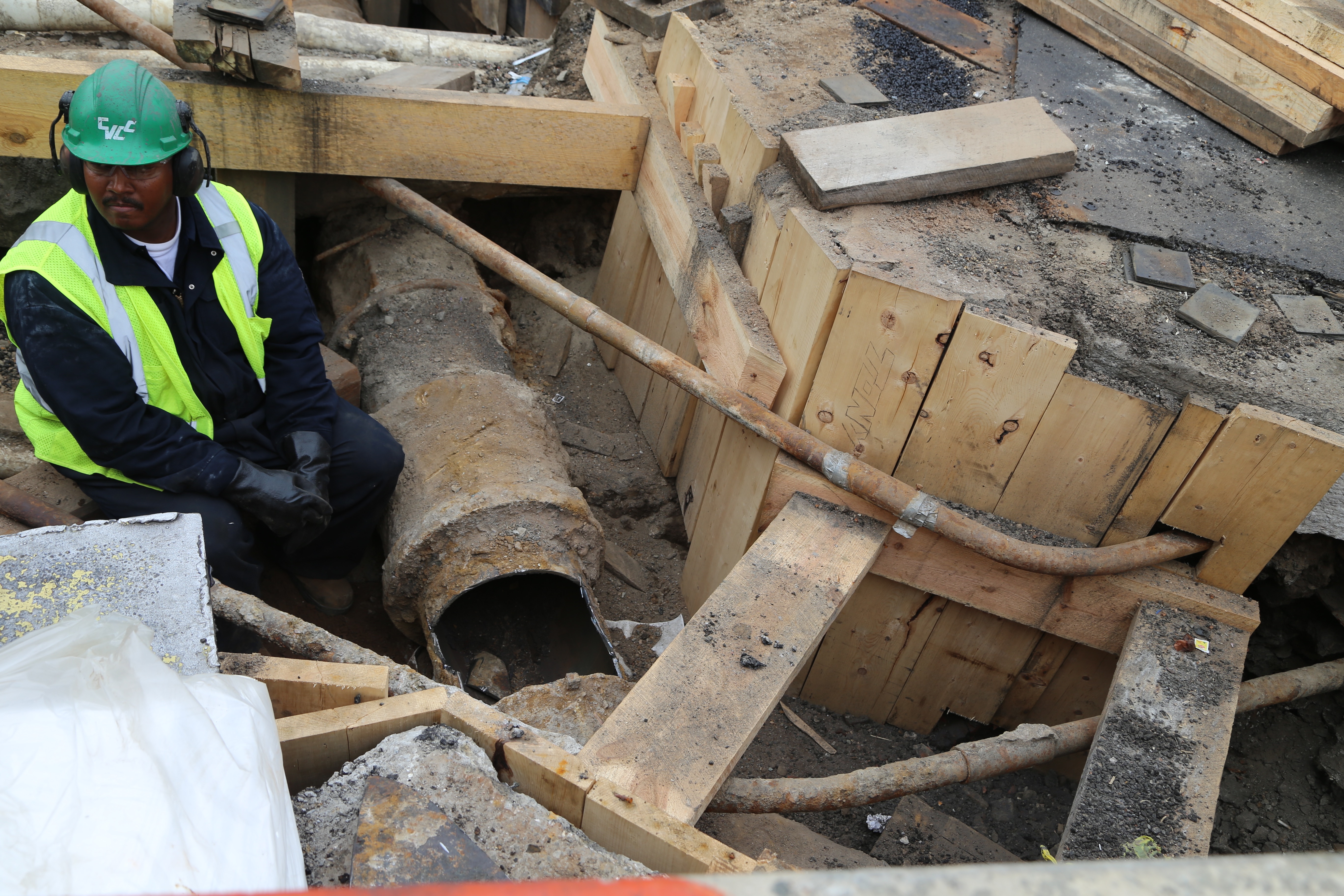
I went to New York City this past Saturday. While walking around, I passed an area where the street had been excavated for utility work of some type. There were four guys cutting holes in a large diameter metal pipe. I asked one of them what the pipe carried, and he said it was for gas, but it had not been used in a long time. Because I am an engineering nerd, I of course had to take a bunch of photos, and what I saw confirmed my desire to never do any digging work there. My hat is off to the people who do. They must have to do the digging by hand, possibly with a tablespoon to get around all the pipes. The shoring looked like some crazy Tetris scene trying to put the beams around the pipes. The guys cutting the pipes had barely any room to work and that is not mentioning how they were bending down to cut.

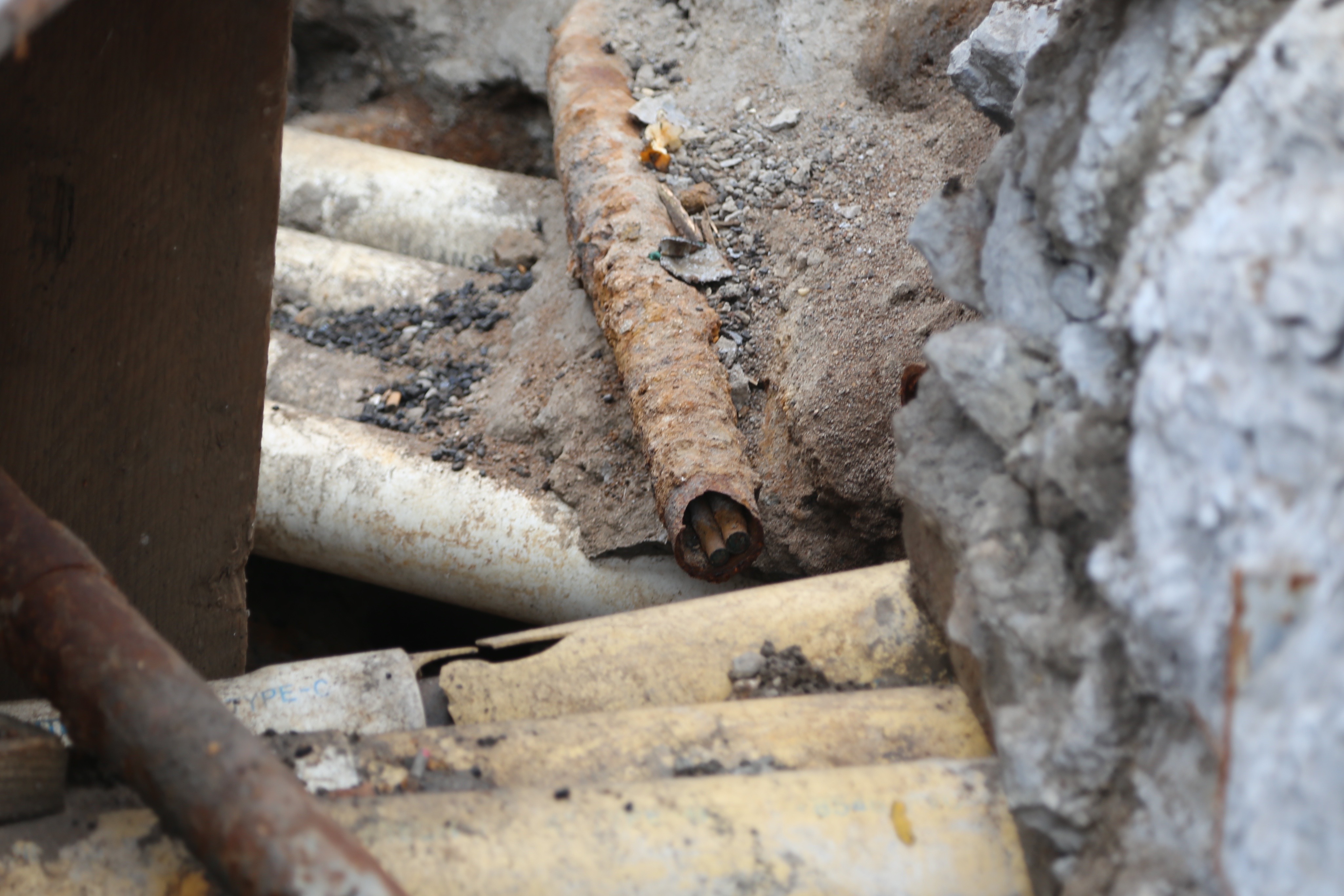
So if you were ever curious just what types of utilities are below the streets of Manhattan, see below.

Rather large excavation area with many workers

Rather large excavation area with many workers. There were four cutting the pipe, one flagging traffic, and eight standing around, evidently waiting for the next phase or supervising.

Vertical shoring on the cut sides; the pipe the worker was cutting a hole is in foreground

Vertical shoring on the cut sides; the pipe the worker was cutting a hole is in foreground

Worker cutting the large previously decommissioned gas pipe

Worker cutting the large previously decommissioned gas pipe

Worker cutting another part of the pipe in a very cramped area

Worker cutting another part of the pipe in a very cramped area

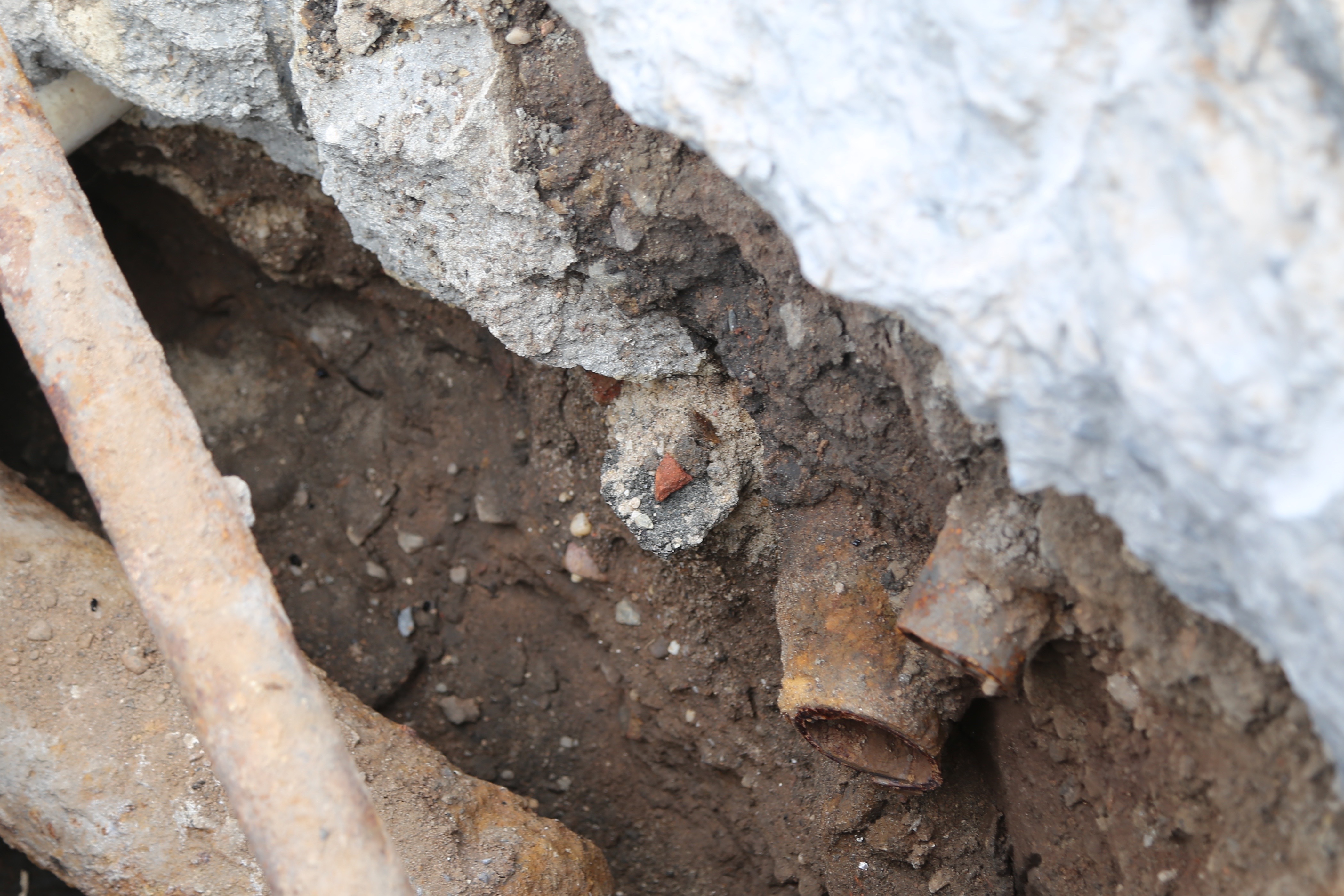
A couple of previously cut pipes in the ground profile

A couple of previously cut pipes in the ground profile

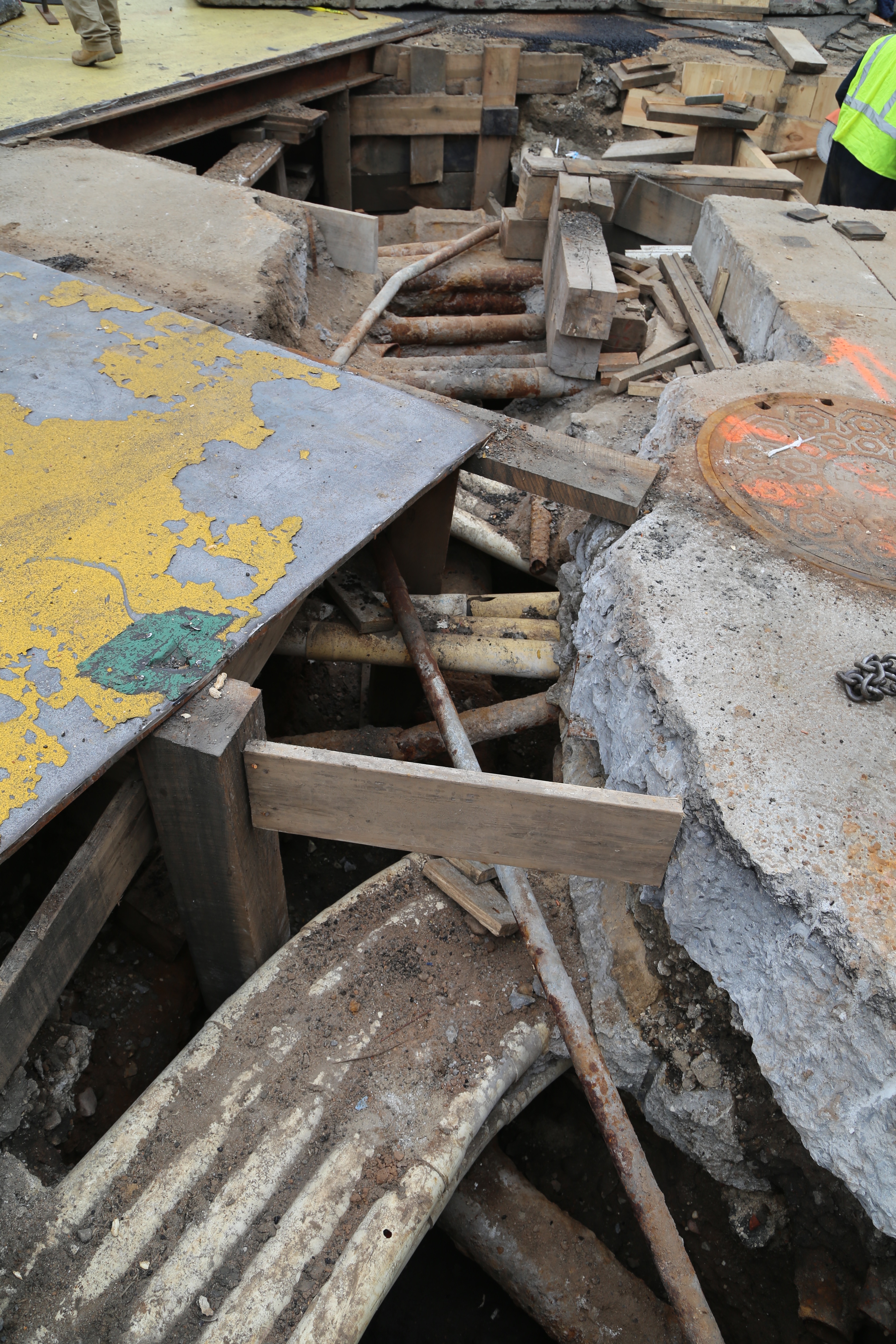
Pipes crossing everywhere

Pipes crossing everywhere

Multiple levels of horizontal shoring

Multiple levels of horizontal shoring

A conduit containing wiring

A conduit containing wiring

Waste to Energy Plant

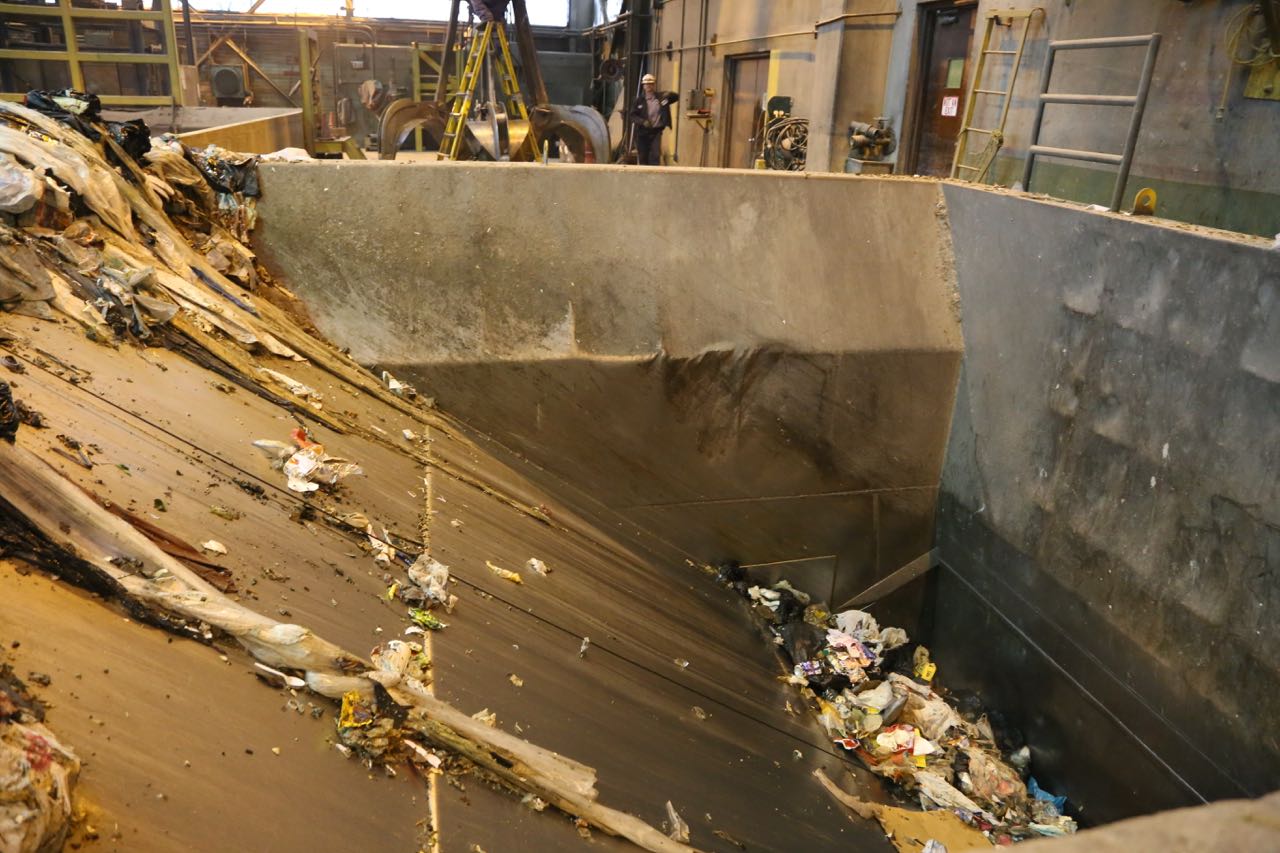
Last week I got the chance to tour a waste to energy plant. The plant receives non-hazardous, household garbage from municipalities, consumer businesses, government agencies, and international ports. It burns the waste and converts the energy given off during the burning to electricity, which is then put into the power grid. Some of the waste that comes from government agencies need secure destruction, and at the plant, the waste is put directly into the feed stream and burned, so as to allow the needed secure destruction. The waste from international ports, such as nearby airports, must be burned to prevent any pathogens entering the country that may affect agriculture, and so it also is fed directly to the feed stream. Interestingly, the municipalities that send waste to the plant discourage their residents from putting yard waste into the trash. Besides being environmentally unfriendly because yard waste can be composted and nutrients returned to the earth, the yard waste is also not good for the waste to energy process because it produces nitrogen oxides (NOx), which forces the plant to put in more pollution control.
There are 88 waste to energy plants in the US, and 45-46 are Covanta’s, the owner and operator of this plant that I toured. The plant receives about 1000 tons garbage/day and after burning it, produces about 300 tons ash/day, which is 10-15% fly ash and the rest bottom ash. Thus, the plant achieves about a 70% weight reduction and also a 90% volume reduction. The fly ash is sent to monofill, which is like a landfill but only accepts fly ash. Fly ash can be used in making concrete, so evidently there is currently research being done by both the concrete industry and various waste to energy plants as to if this fly ash can be used for concrete and thus also be reused.
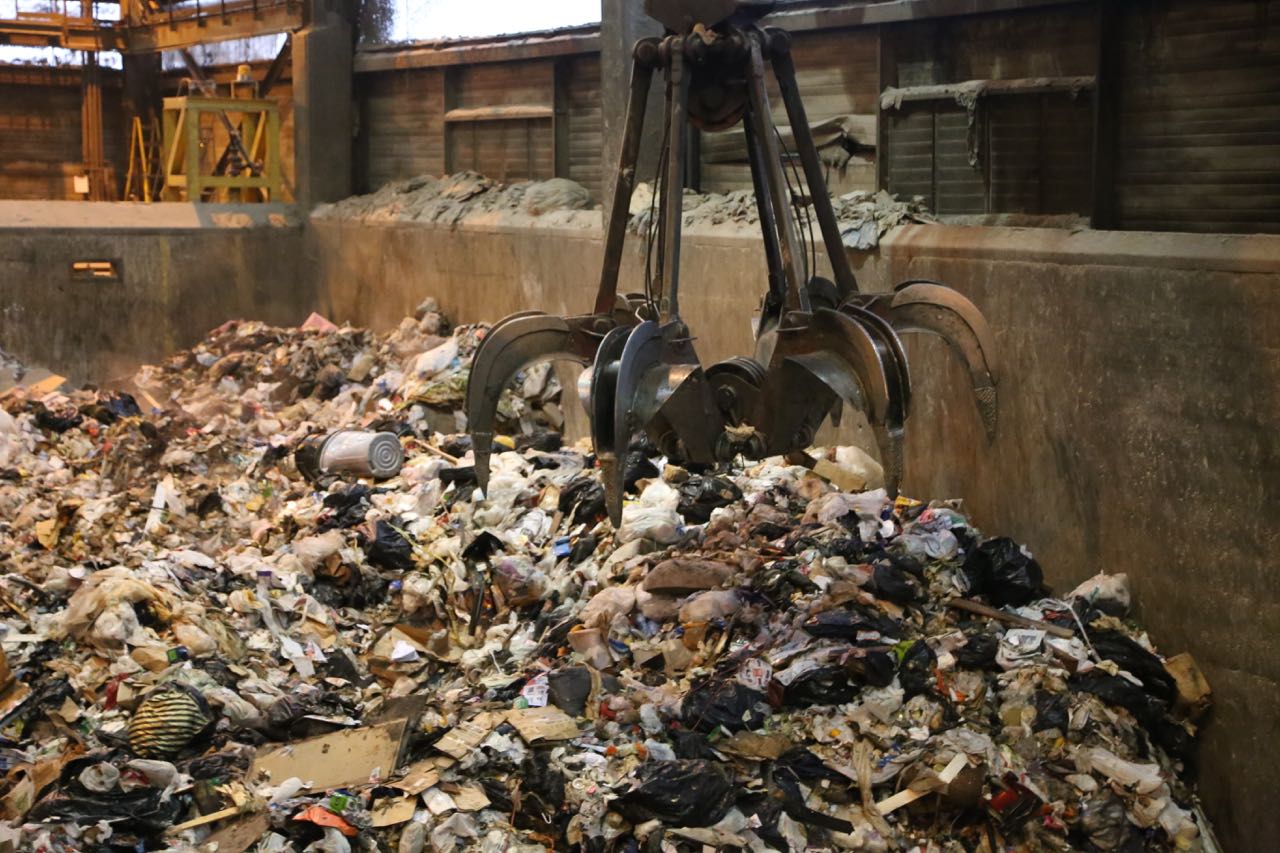
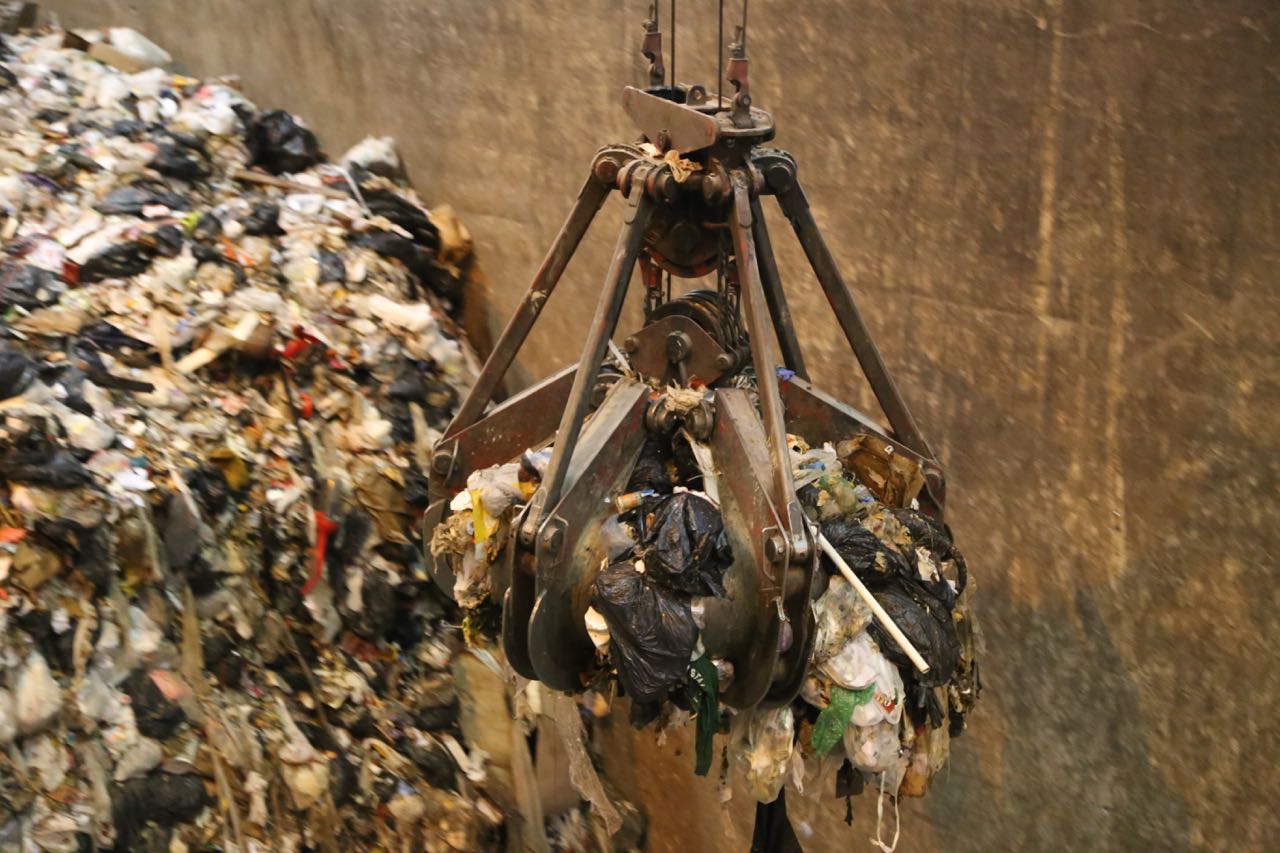
With the exception of the trash that has to go directly into the feed, when it first comes to the plant, the trash is placed on floor where humans look at trash to remove anything that should not be going into the boiler. For example, inert material shouldn’t go into the boiler because not only does it not burn, it is also a heat sink and reduces the efficiency of the process. The trash is then put into a storage pile to be eventually fed into the boiler feed. A large claw moves the trash to piles, mixes the piles, and then moves trash from the piles into the boiler feed.

Pile of trash waiting to be burned

Pile of trash waiting to be burned

Large claw picks up trash to put into feed

Large claw picks up trash to put into feed

Trash slides into the entrance to the boiler

Trash slides into the entrance to the boiler

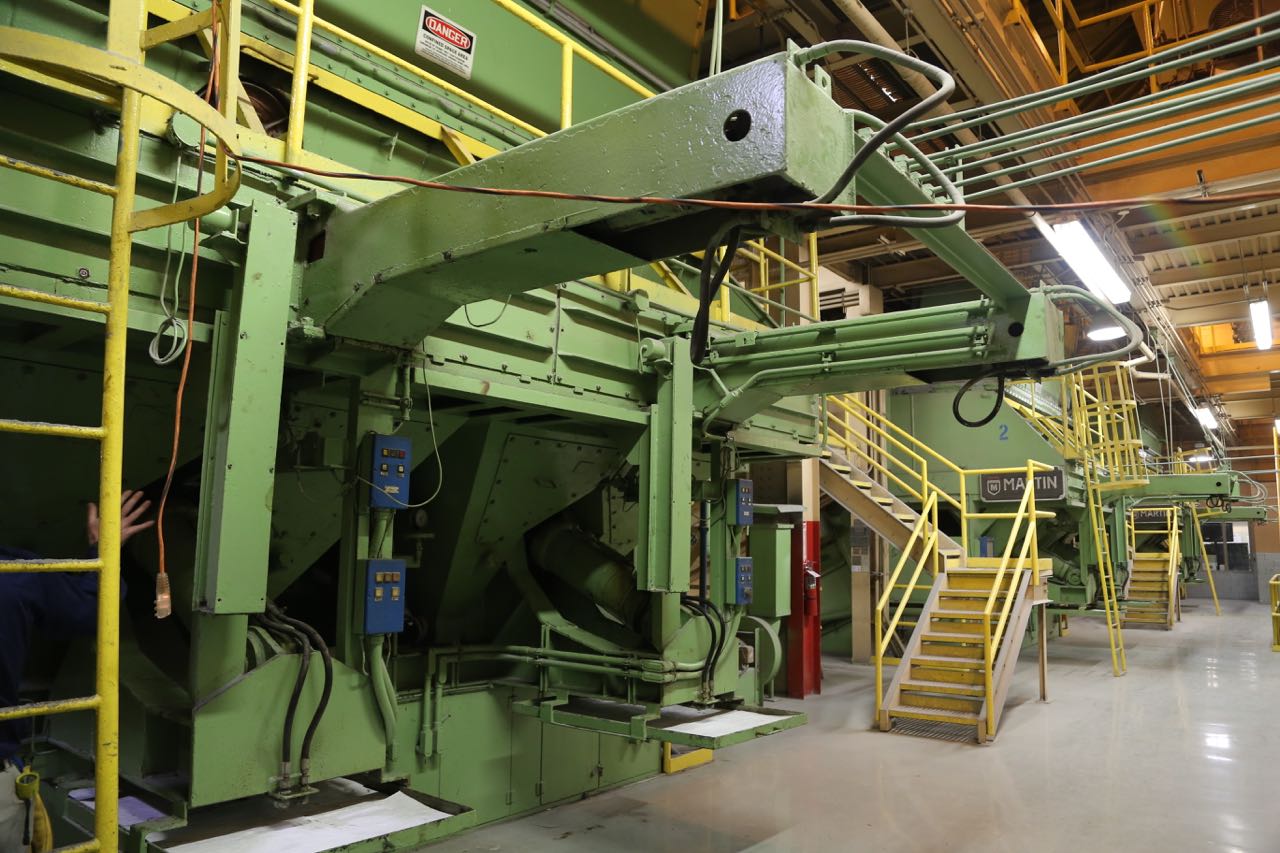
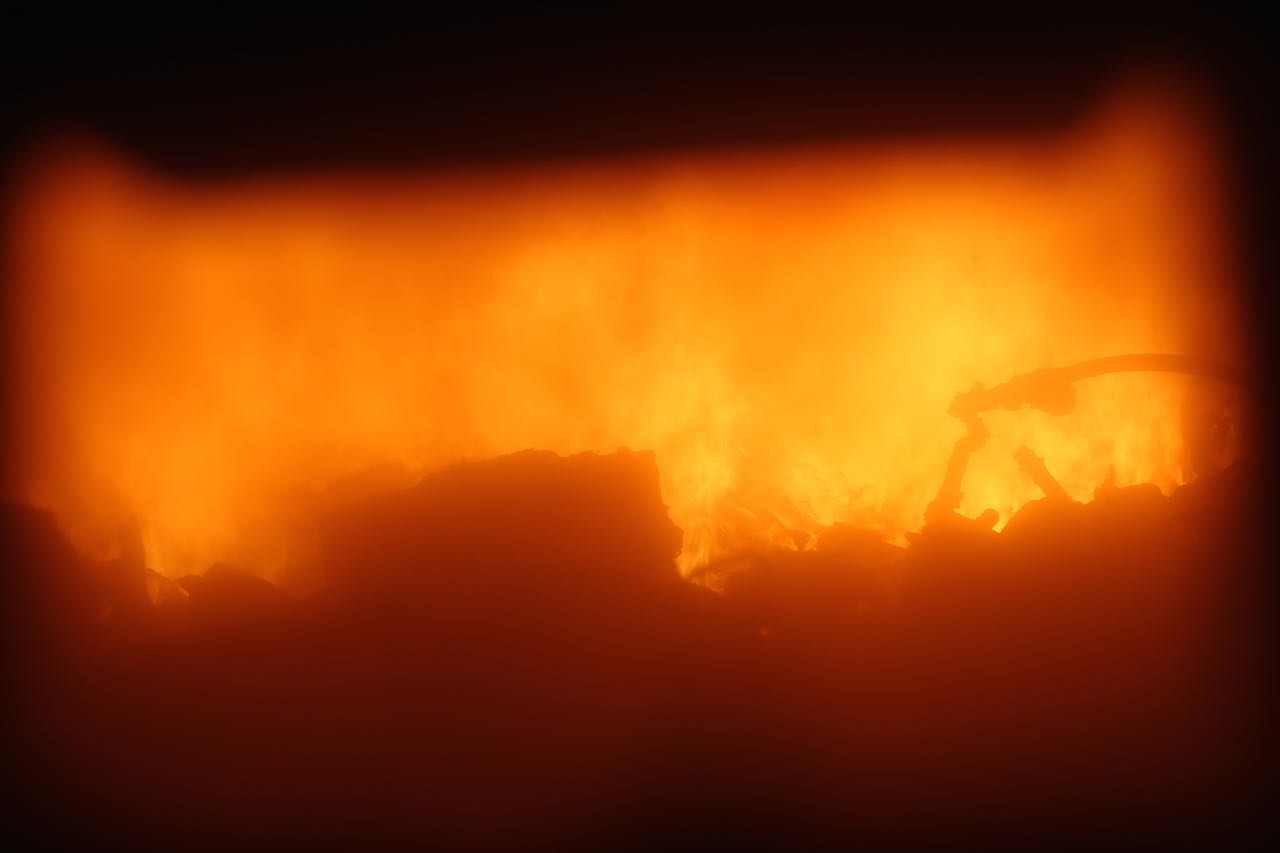
The trash is sent to one of three boilers, each of which has six cells. The boilers burn the trash at 1800-2000°F (1300K). The boilers are initially heated up with diesel fuel, but then the trash sustains the burn. However everyday diesel fuel is used to test the burn.

The boilers

The boilers

View through a boiler's window of the trash burning

View through a boiler’s window of the trash burning

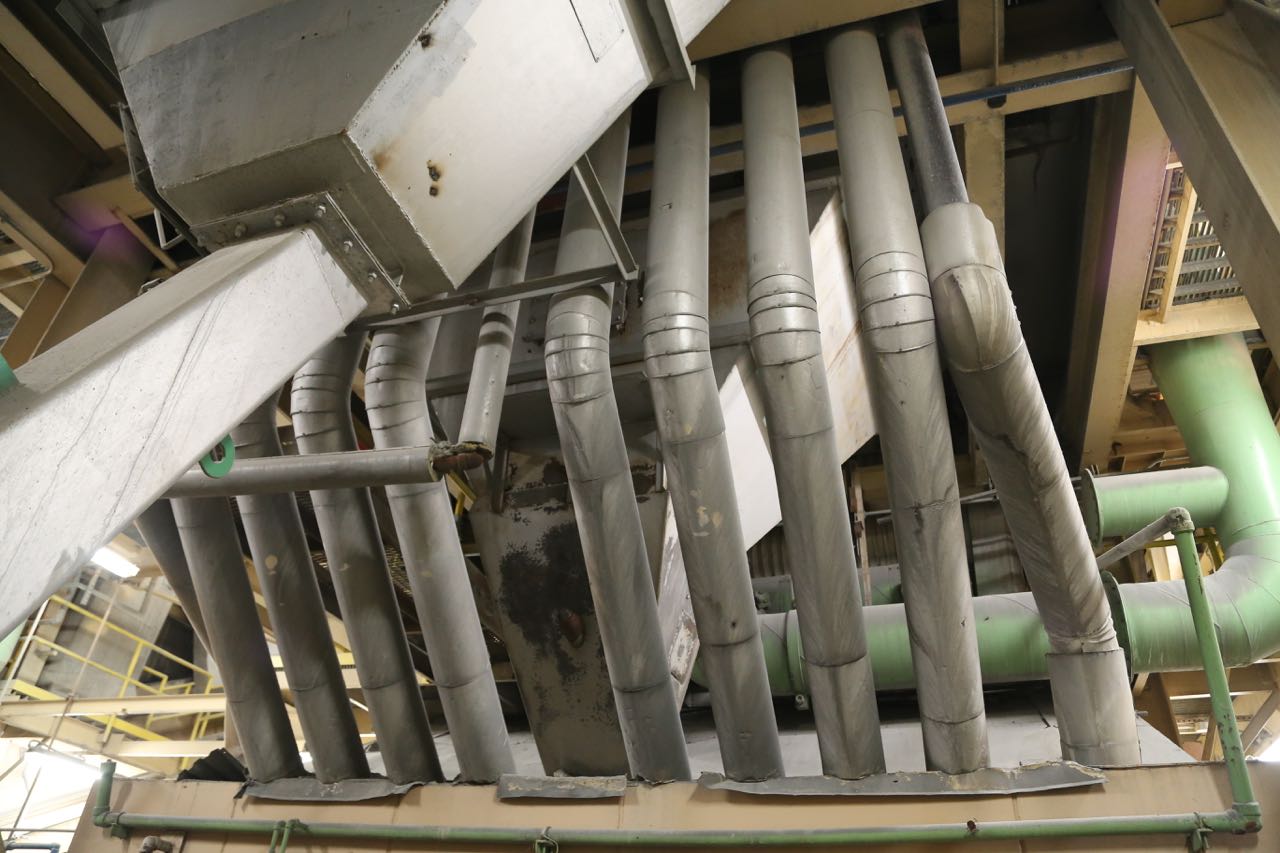
Pipes and ducts everywhere

Pipes and ducts everywhere

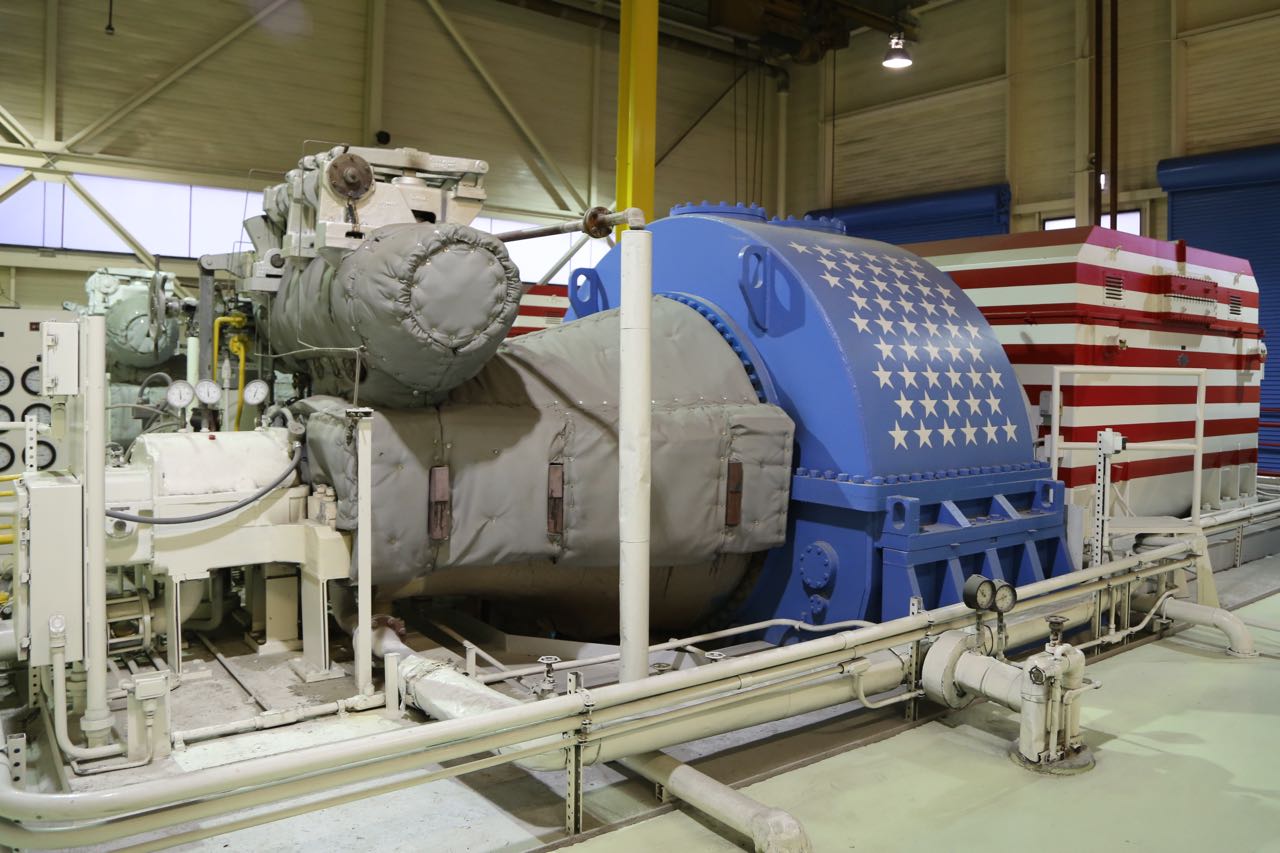
The heat from the boilers is used to heat water to turn it into steam. The water is in a closed loop system, but they use about 20-25,000 gallons of water per day due to loss. [They use another 200,000 gallons/day for the cooling tower and are exploring with the nearby wastewater treatment plant using treated wastewater for this.] The water goes through a reverse osmosis treatment for purity, so nothing damages the turbines and the rest of the system. The produced steam is superheated but drops to 700°F before entering the turbines. There are two turbines with 14 stages. The steam turns the turbines, and that motion is converted into electricity in the generator. They produce 14.5 MW per turbine. Because of the work the steam does on the turbine, the steam enters the turbine at 600 psi and leaves in vacuum in a 10 ft length.

The turbine (gray and blue) and the generator (red and white stripes)

The turbine (gray and blue) and the generator (red and white stripes)

All the gases that leave the boiler pass through a series of air pollution control units. Ammonia, lime slurry, and carbon are used for pollution control. There are probes in the system to sample flue gas for pollution control additives that are needed. The treated gas then goes to a baghouse where particulates are captured. The air is below 300°F before going into baghouse, so it has cooled quite a bit.

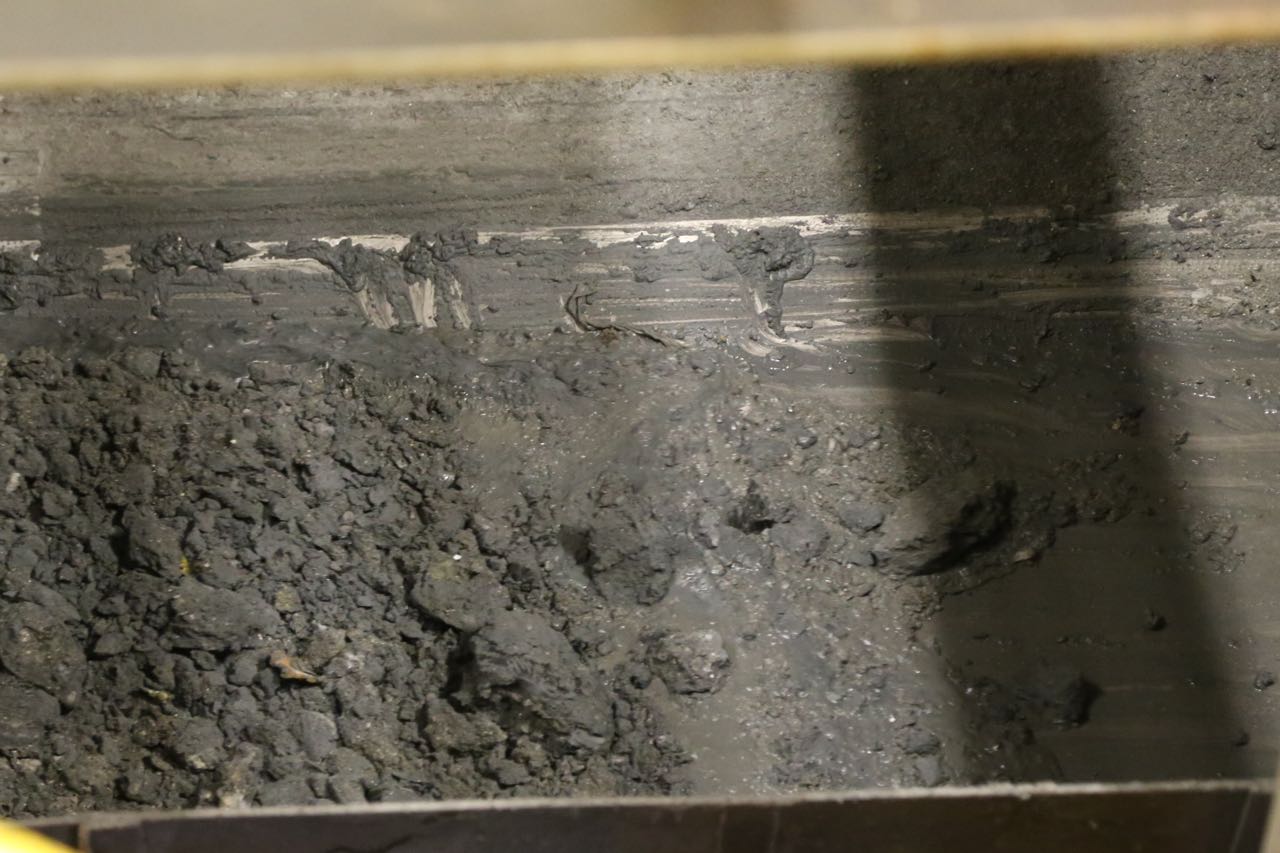
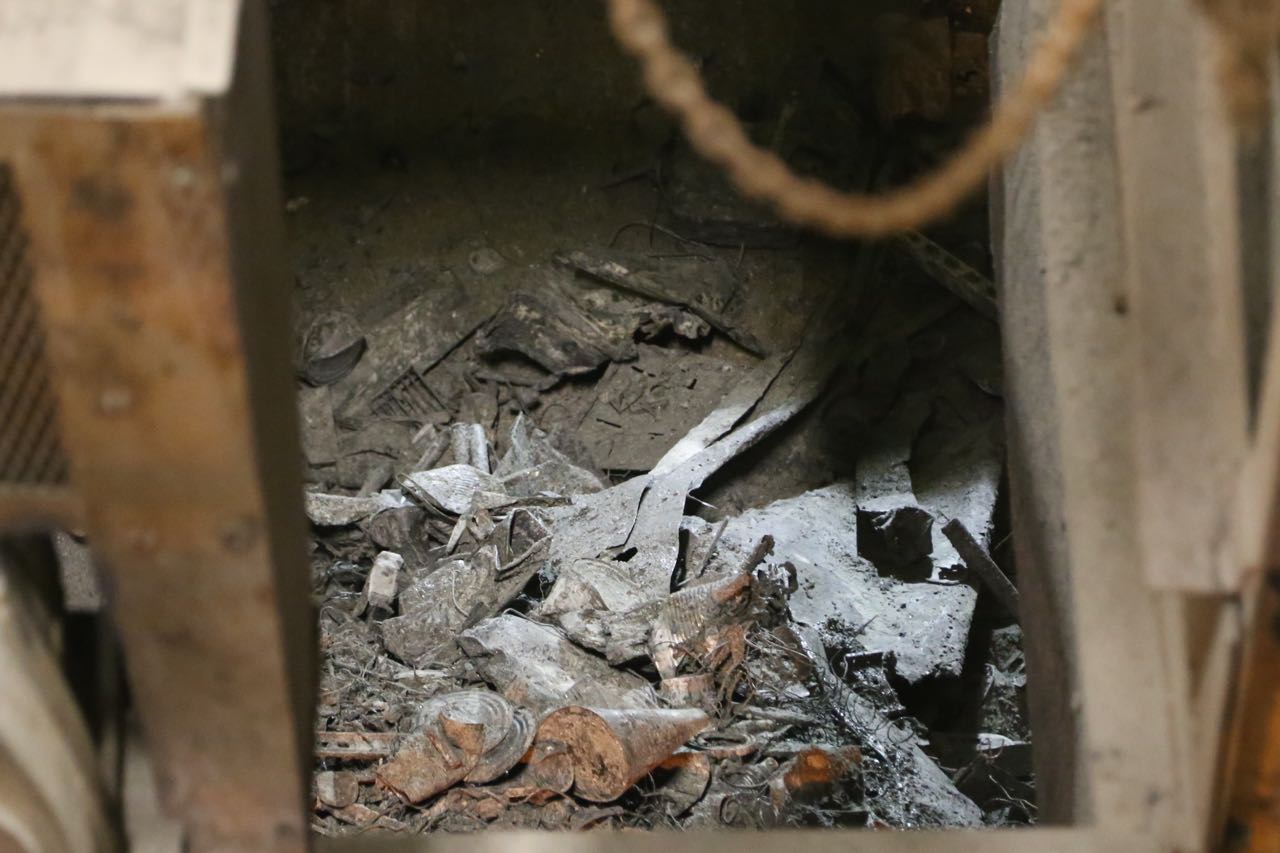
The ash from the boiler is sent through a unit to remove all metals. The ferrous metals (attracted to magnets) are separated from the rest of the metals, and all the metals are sold for scrap.

bottom ash

Bottom ash entering the separator

Metal that has been separated

Metal that has been separated

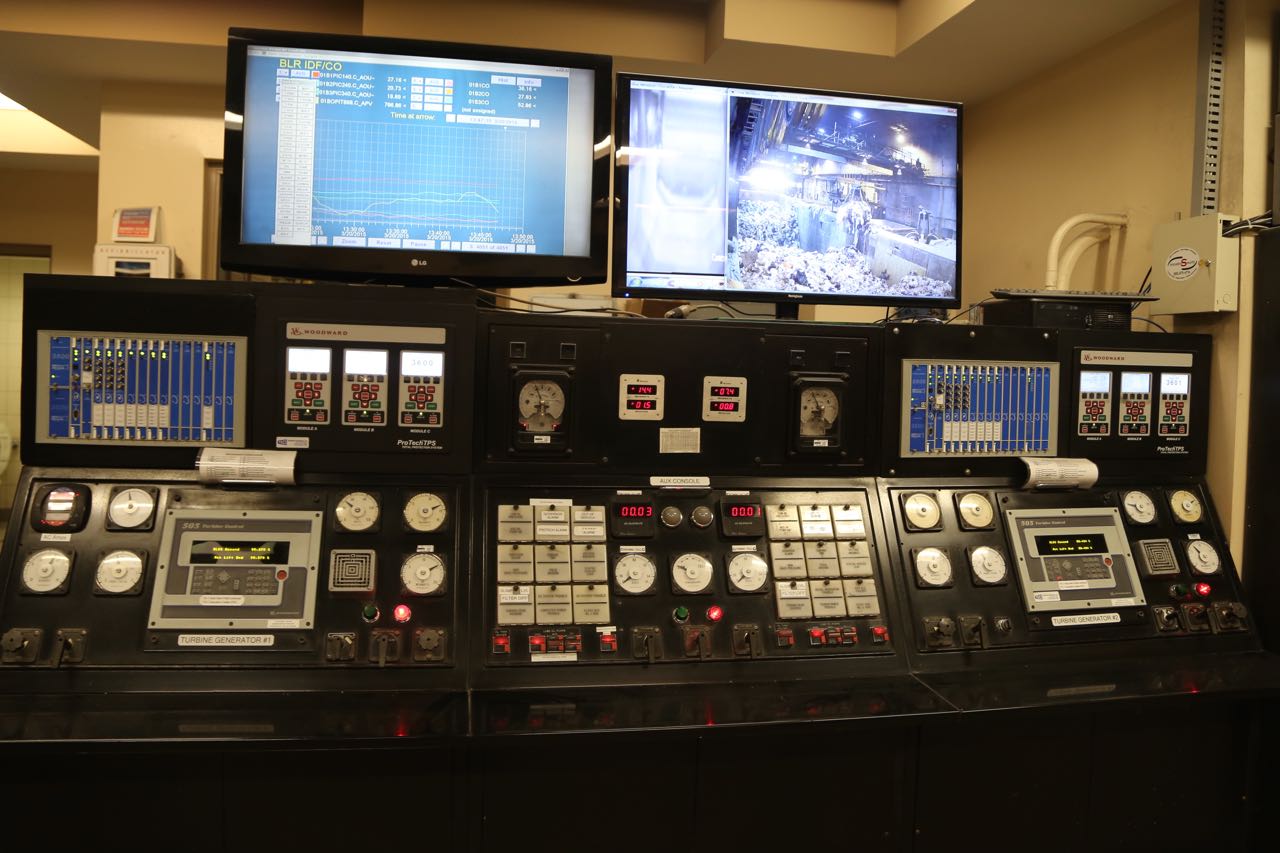
The whole process is monitored in a control room by one or two people. I was amazed at how simple the process was. I, the environmental engineer, was of course geeking out at the whole thing, but it was a really cool process and efficiently run.

Control panel monitors

Control panel monitors

Finally here is a very short video of a few scenes from the plant. This includes waste being loaded into the feed, the fire in the boiler, and bottom ash entering the metals separator.

WMATA L’Enfant Plaza Fire

Today there was a fire in a WMATA subway tunnel near L’Enfant. The National Transportation Safety Board (NTSB) is now investigating, and I have confidence that they will do a thorough investigation. I have some questions about actions taken right after the smoke was reported that no one, or at least no one in the media I have seen, has asked. The station filled with smoke, and they evacuated it. WMATA stopped running green and yellow trains through L’Enfant. However they kept running blue, orange, and silver trains through, but these trains did not stop at the station, as they normally would. For those not familiar with L’Enfant Plaza Metro Station, orange, blue, and silver lines share the same track on the lower level, and yellow and green share the same track on the upper level. My question is, were they sure it was safe to keep sending the orange, blue, and silver trains through? I am not asking from the standpoint of the fire, because presumably, they traced the location of the smoke enough to know it was not in the lower tunnel. By safe, I mean because of the potential inhalation of smoke in the lower level tunnels. If the station filled with enough smoke that it needed to be evacuated, then how were they sure that smoke would not enter the trains running through it?

A couple of quick points:

  • Just because air smells bad doesn’t necessarily mean it is toxic or hazardous, but conversely, just because air smells fine doesn’t mean it is safe.
  • Particulate matter in air and/or smoke is in general not something you really want to breath, but there are different levels of toxicity associated with it. That is, some particulate matter is not more than just an irritant. However, the effect particulate matter has on a person is also affected by that person’s health. People with respiratory issues are more susceptible to any effects.
  • Exposure to hazardous or toxic materials can cause effects on different time scales. People who were trapped on the WMATA train in the tunnel, would have acute (short-term) effects from breathing the smoke, such as coughing and having trouble breathing. However, they were probably also exposed to chemicals whose effect is not immediate, such as carcinogens.

The questions I have, that I have not heard anyone ask include:

  • What is the air exchange rate between the subway trains and the surrounding air? Can the ventilation be turned off manually, so that there was no air exchange between the train and the surrounding air while the trains were near L’Enfant?
  • Were there any measurements taken of the air in L’Enfant, particularly on the lower level where the orange, blue, and silver trains were still running through? If so, what were the measurements of? Just measuring particulate matter will not indicate almost nothing about organic compounds or other chemicals in the air.
  • How far did the smoke spread?
  • Assuming air measurements were taken, did anyone calculate the amount of contaminants that people in the trains would be exposed to while running through the station based on time and air exchange rate?

My educated guess is that no air measurements were taken. There are probably some sensors in place to measure smoke, but depending on how that measurement is taken, it will tell you information about the particulate matter and that is it. I seriously doubt there was initially any sensors that measured organic compounds or any other type of compounds in the air. I have my doubts that any portable system was put in place during the response. The priority would have been evacuating people (as it should have been). It is possible that WMATA had some qualitative data that there was not much smoke on the lower level. That is, someone may have looked at a video screen and decided the air didn’t look bad. However, unless they had actual quantitative data of what was in the air, then visual assessment of air is a really bad way to make assessments on the quality of the air.

The early statements by WMATA and all other sources, like the fire departments involved, was that they did not know the source of the fire, location or cause. Thus they could not have possibly known what was burning and what would be in the air. For example, if wood is burning, you can expect certain chemicals in the air. If rubber is burning, you can expect different chemicals in the air. WMATA probably decided that the air on the lower level didn’t look that bad, and the trains would go through the station quickly enough that very little exposure would occur. They very well may be right, but with no data and no statements about any calculations, they have no way to prove that. Also, did they inform their passengers of this? If I was on a train, and I knew that the train was going to go through, but not stop, at a station that was filling with smoke, I would get off the train. I don’t feel the need to expose myself unnecessarily to hazardous substances, even if in small amounts. I do not like standing near people who are smoking. The second hand smoke may only minimally increase my risk of disease, but I still don’t see the need for that tiny increase. Thus, was WMATA considering passengers’ exposures at all? Furthermore, did they communicate the possibility of exposure to their passengers on the orange/blue/silver lines to allow their passengers to make their own educated decision about staying on the train? My guess is the answer to both those questions is no, and that is another thing to which WMATA should be made to respond.

It’s Not Individualism or Bad Fashion, It’s Sexism

I once hypothesized that male heterosexual scientists and engineers single-handily keep the Hawaiian shirt industry in business. Don’t ask me why, but as a group, they love those shirts. I make jokes about their lack of fashion and just plain dressing ability. I tease because I love. I love their individualism, and I love how they don’t know or care about fashion. I may be a female heterosexual scientist and engineer, but I am one of them when it comes to dress. The last time I remember being fashionable was when I was in fifth grade. I don’t understand or like many fashions. I have my own style, and I like to look nice, but I consider my ability to wear jeans to work and not even own a suit, a serious perk of my career (and employer).

And then there is this.

This is Rosetta Project Scientist Matt Taylor of the European Space Agency (ESA) in a shirt covered in scantily clad women in in sexually suggestive poses. That is the shirt he chose to wear on a day when ESA did the amazing feat of landing a probe on a comet. This is the shirt he chose to wear on a day when he would be interviewed by the media and featured on live webcasts of the events. Not only did he not see a problem with this shirt, but evidently no one else at ESA did either. This. Is. Not. Acceptable. This is not appropriate. This is offensive. This shirt should not exist period, but it most certainly should not exist in the workplace. This is not about how ugly the shirt is. This is not about how unprofessional a shirt like that is. This is not about Dr. Taylor being an individual and expressing his style. This is about a shirt that objectifies women. This is about a shirt that is sexual harassment without Dr. Taylor even opening his mouth or making any type of gesture or doing absolutely anything other than wearing it. This is about a complete and utter lack of respect of women on the part of Dr. Taylor and evidently everybody at ESA who works with him and would have been in a position to say something. This about no one over there seeming to care about whether or not women feel comfortable working there when someone can wear a shirt like that. This about telling women it doesn’t matter your intelligence, skills, education, or ideas, you are but sex objects. The STEM fields continue to have a problem with sexism and gender inequality. My alma mater, a technical college, still only has about a 25% female student body. Wearing shirts like that to workplace will not help. It will not tell women that they are welcome. I quite frankly don’t care if Dr. Taylor is actually a really nice guy who is actually very supportive of women in STEM. His shirt says otherwise. He and ESA owe all of us an apology. That shirt overshadowed what should have been the main headline that ESA did the absolutely spectacular task of landing a probe on a comet. That shirt and the attitude it expressed ruined it for me in fact.

Finally, I would like to give mad props to Dr. Paul Coxon for his absolutely awesome idea, that if you want to wear a shirt with women on it, wear one with these women on it.


These would be some of the women of the Indian Space Research Organisation (ISRO) celebrating after ISRO’s Mars Orbiter Spacecraft successfully entered the Mars orbit. And they are awesome.

Gowanus Canal

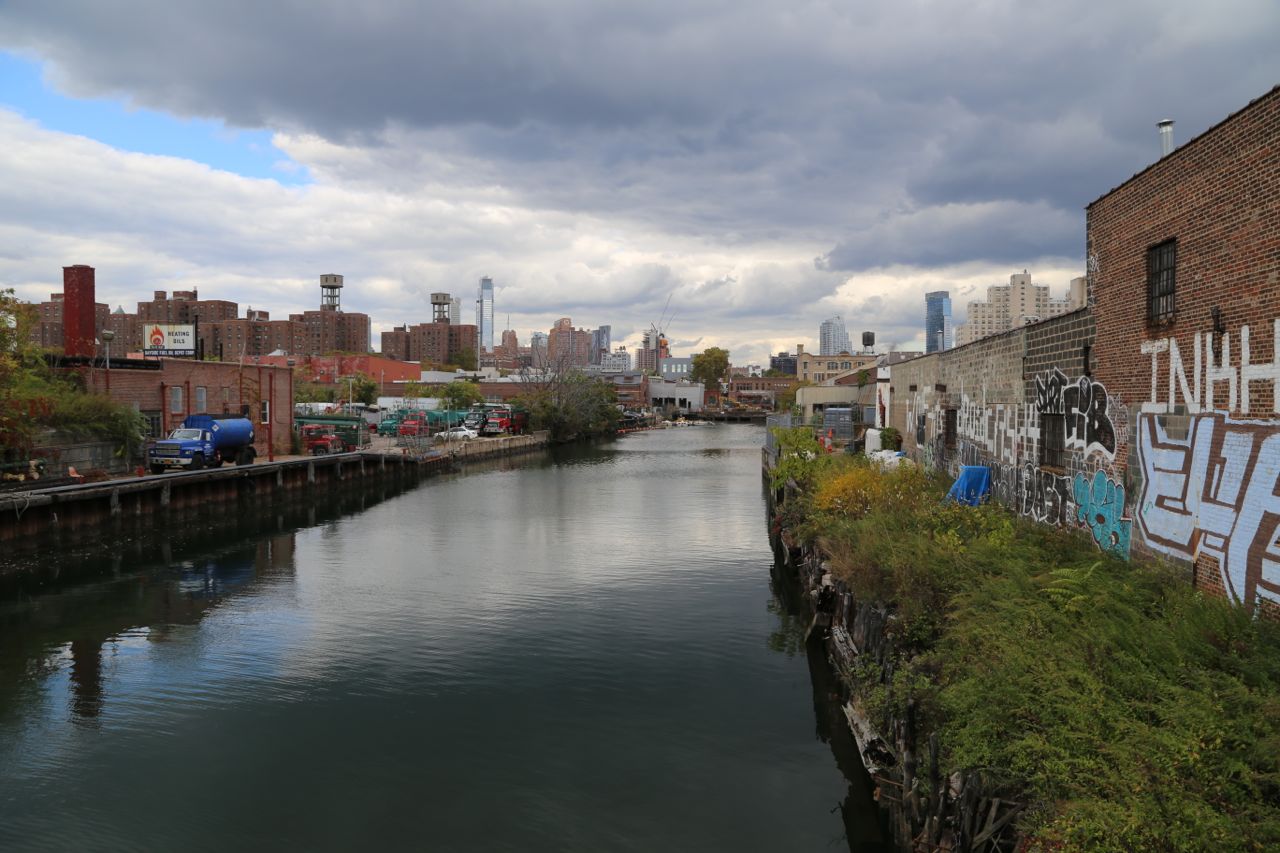
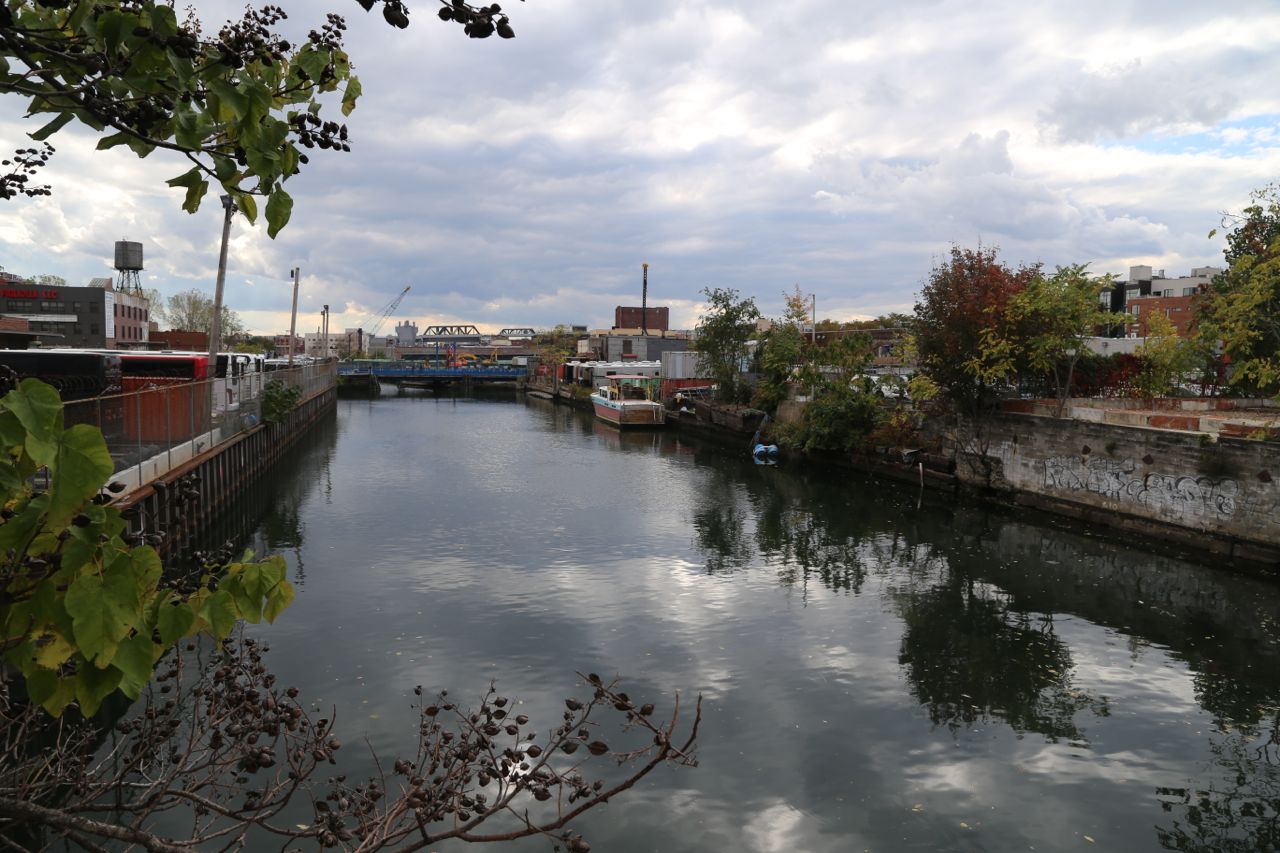
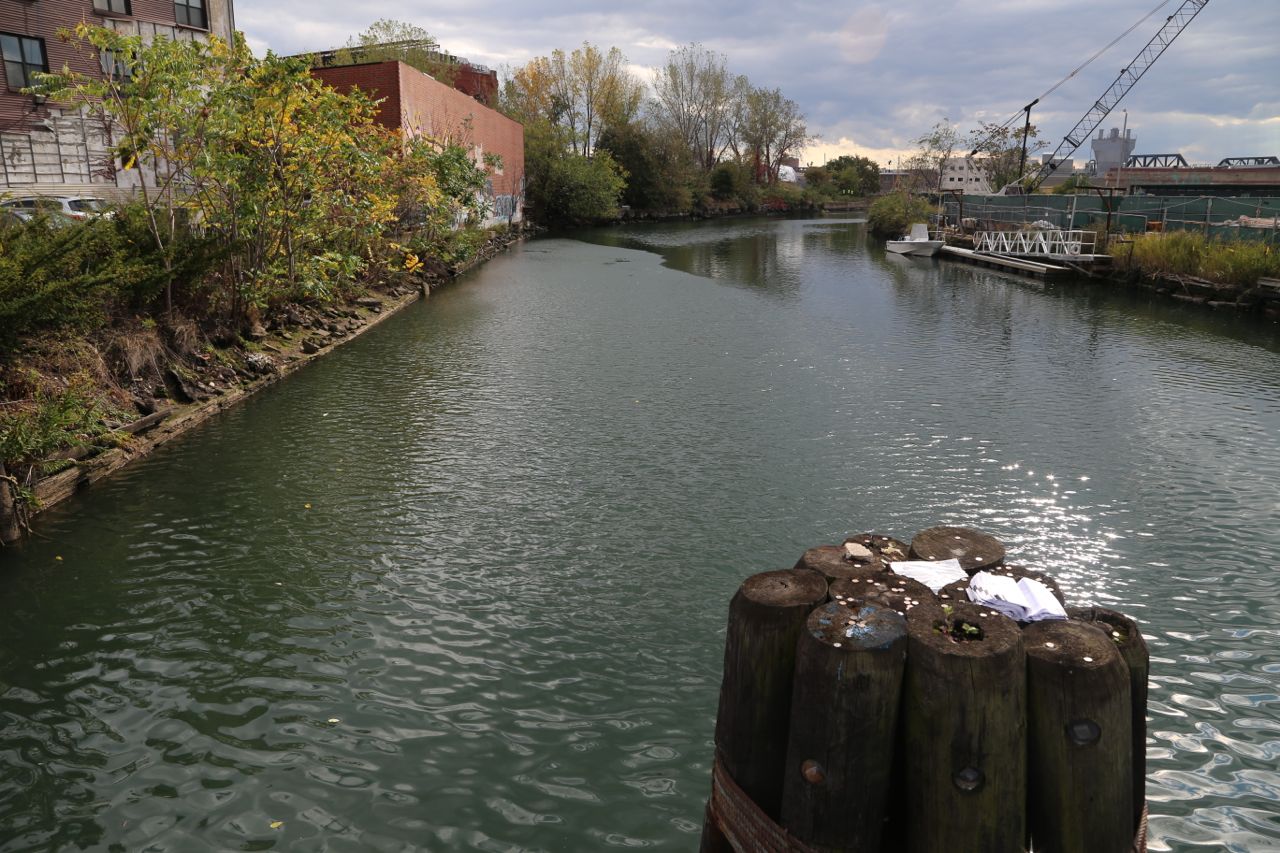
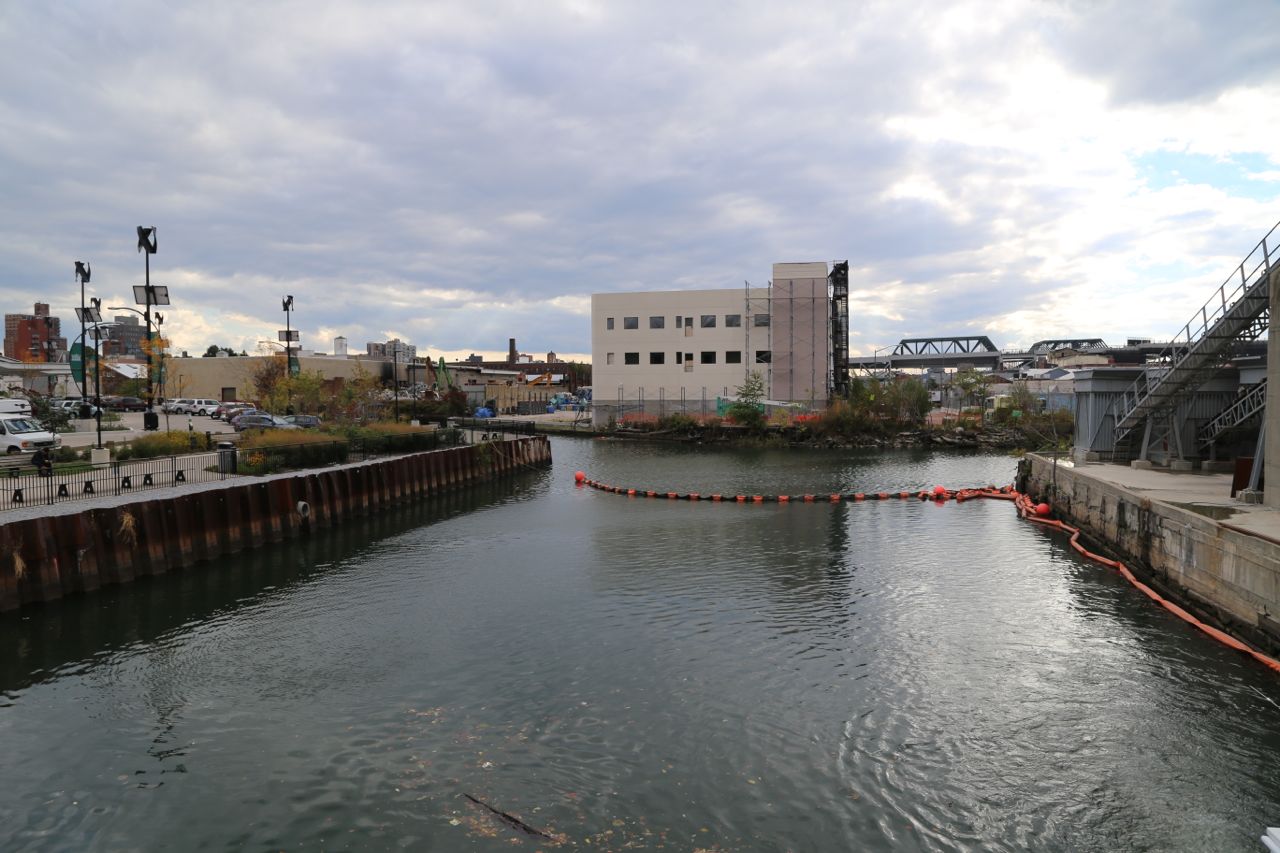
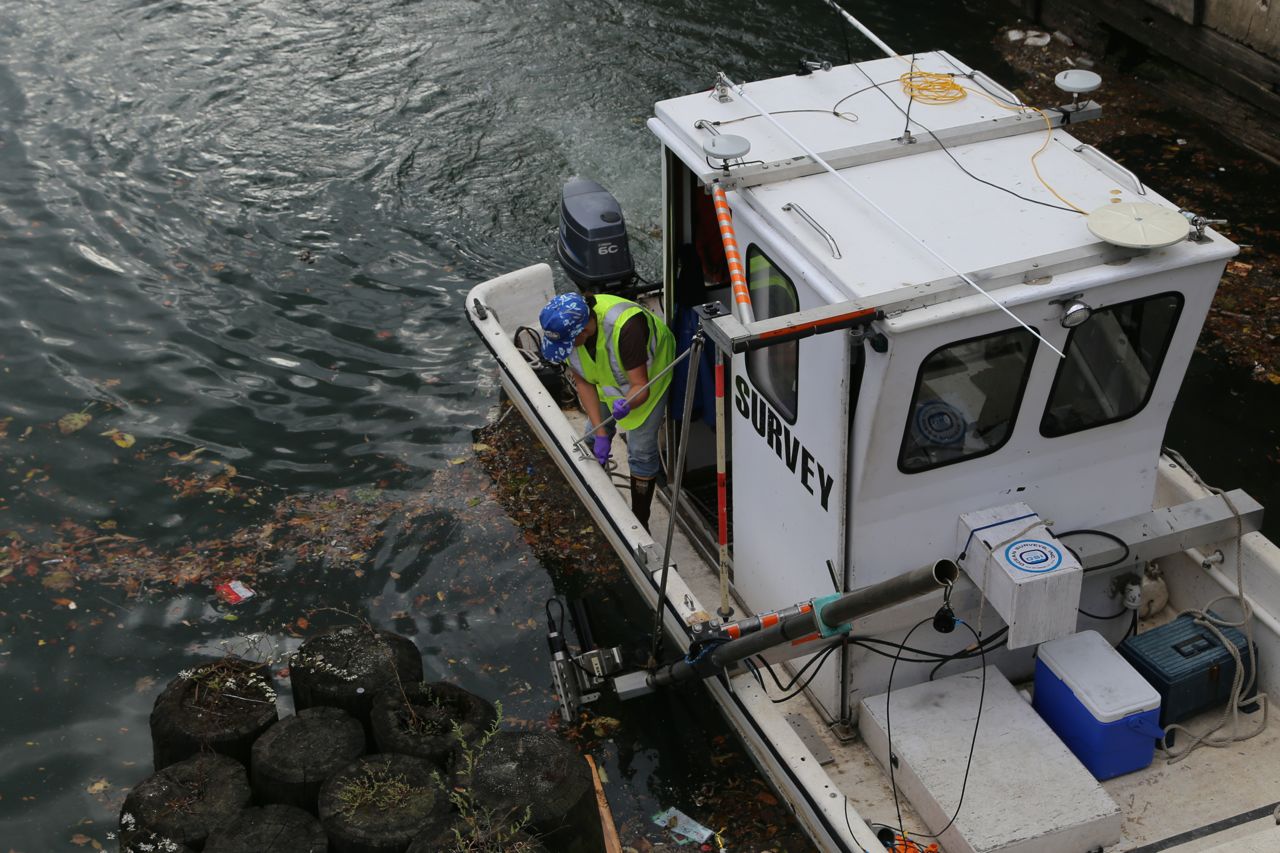
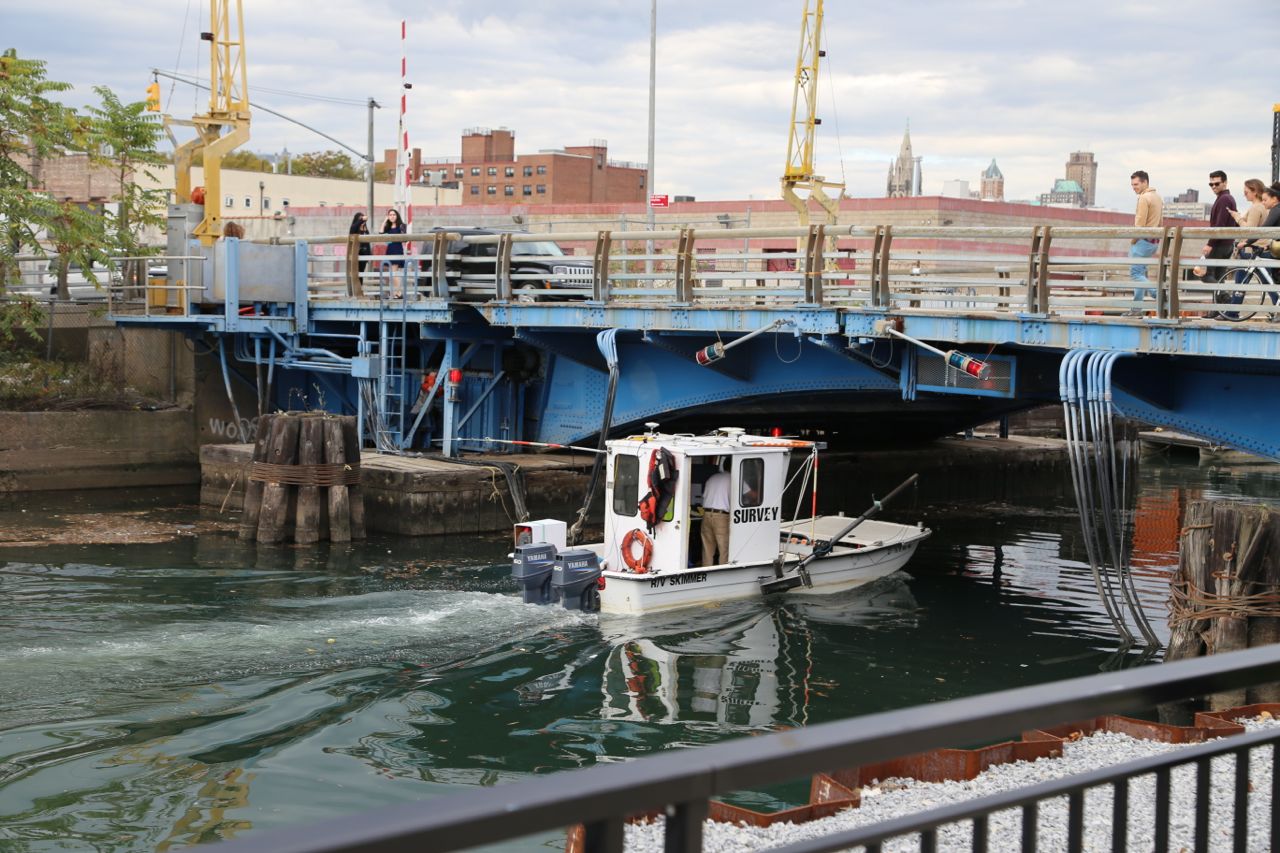
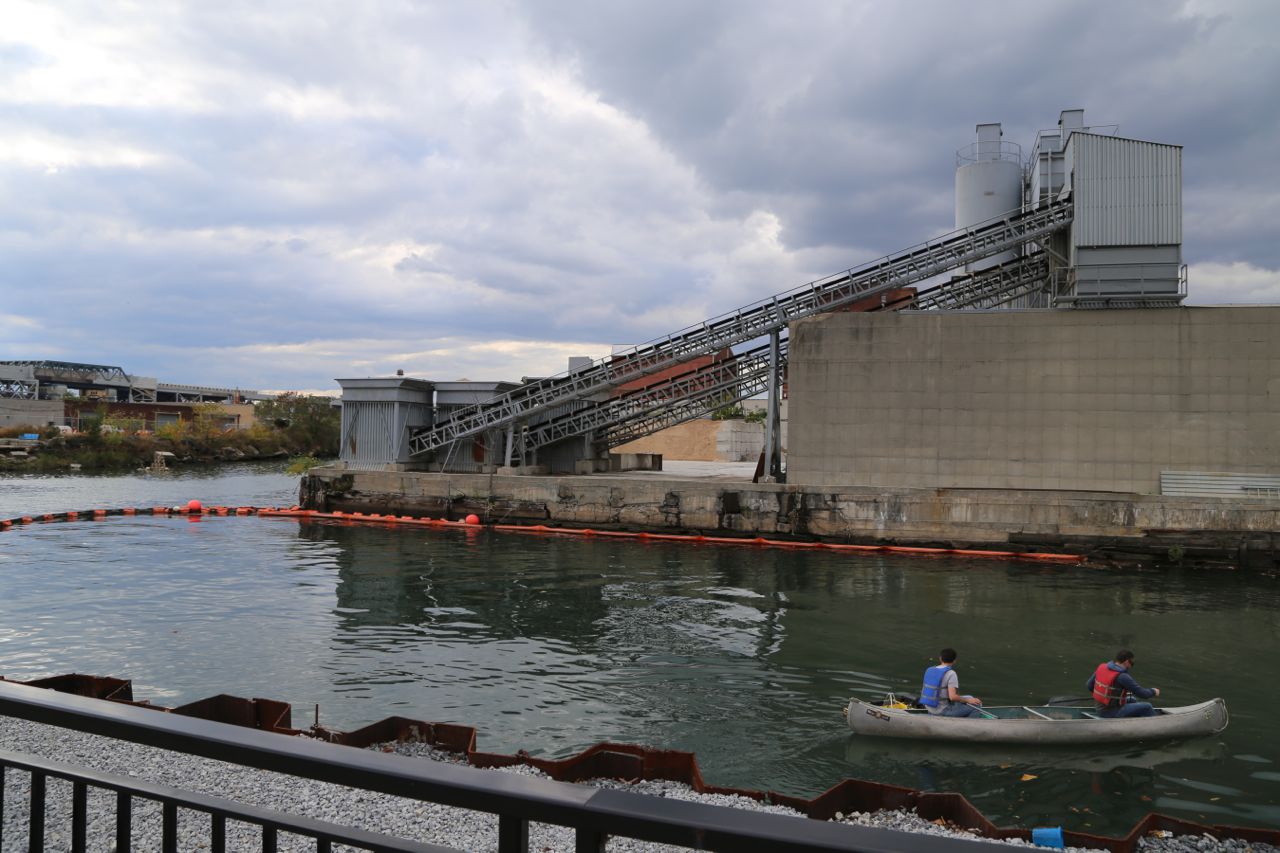
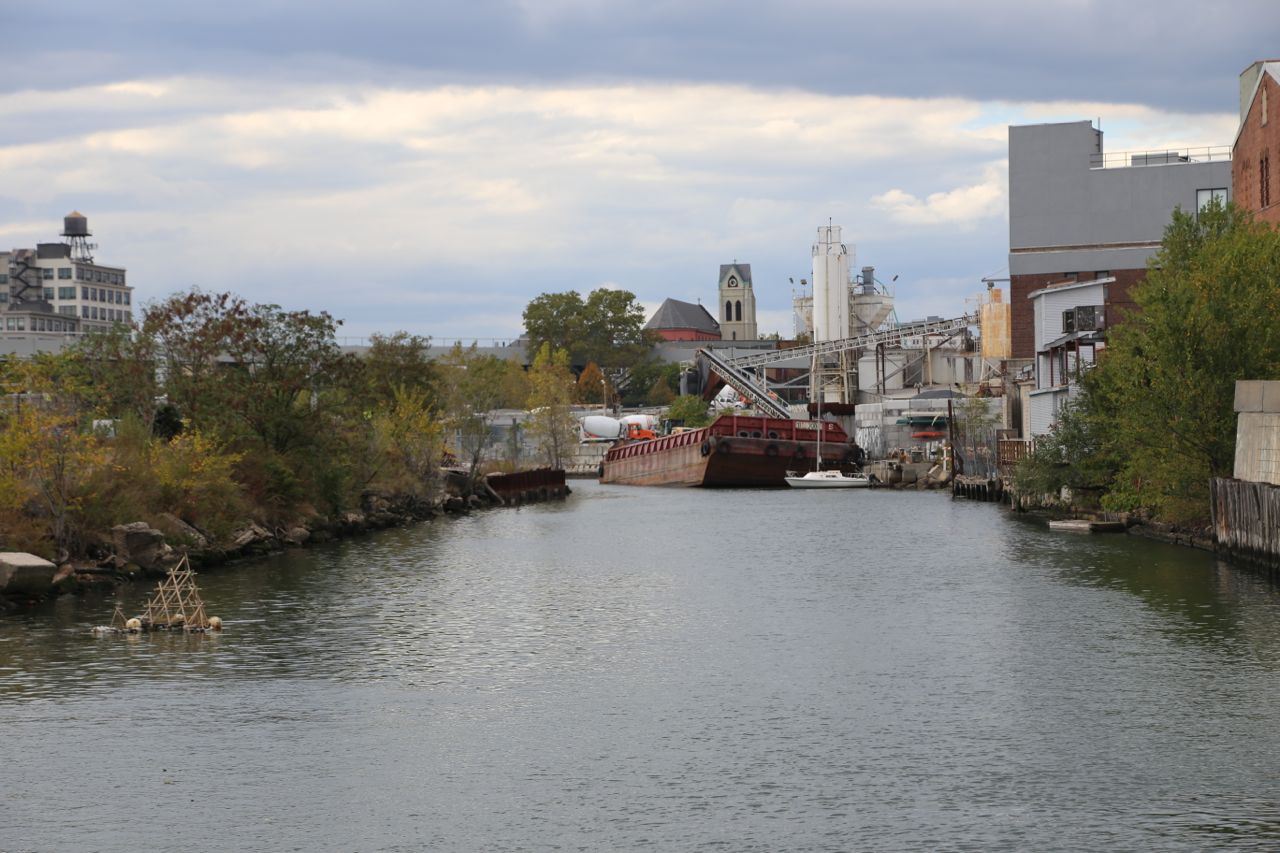
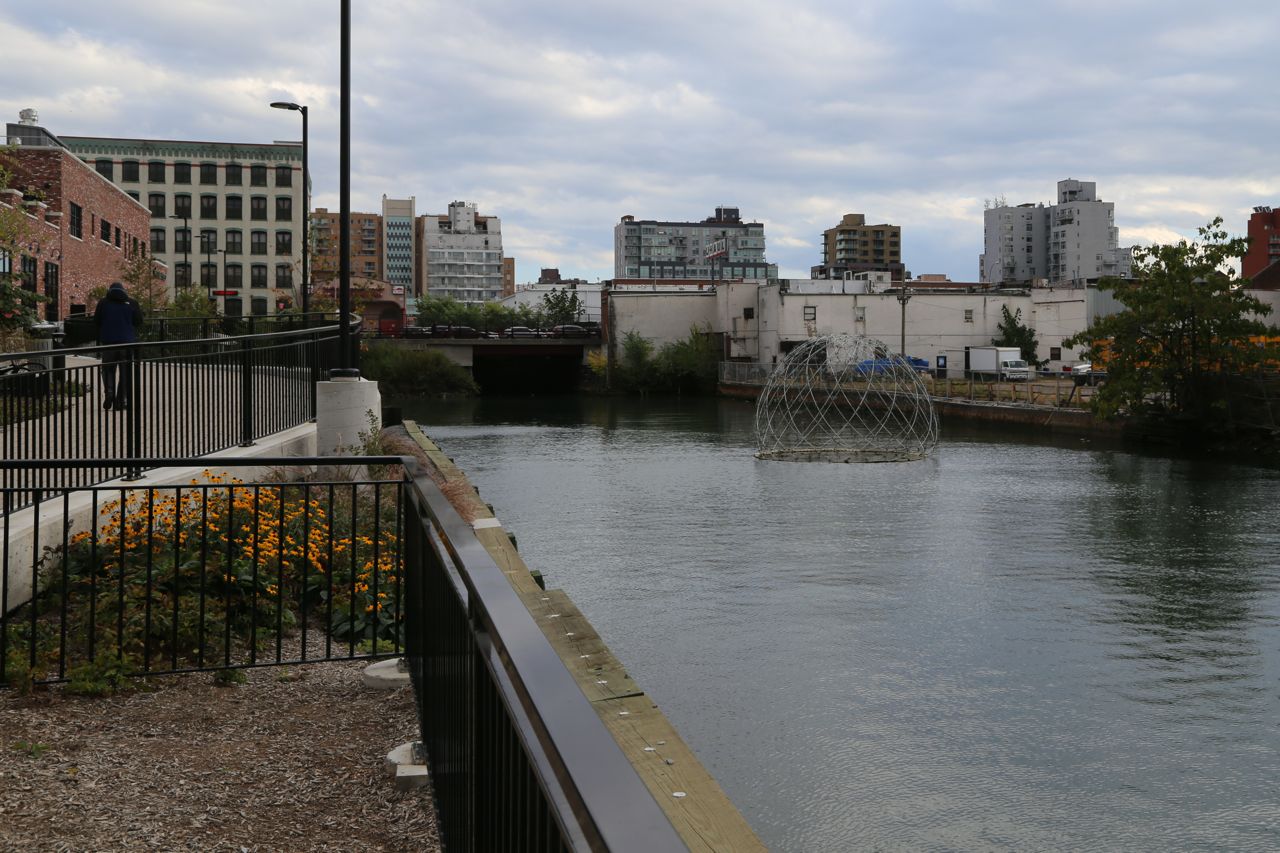
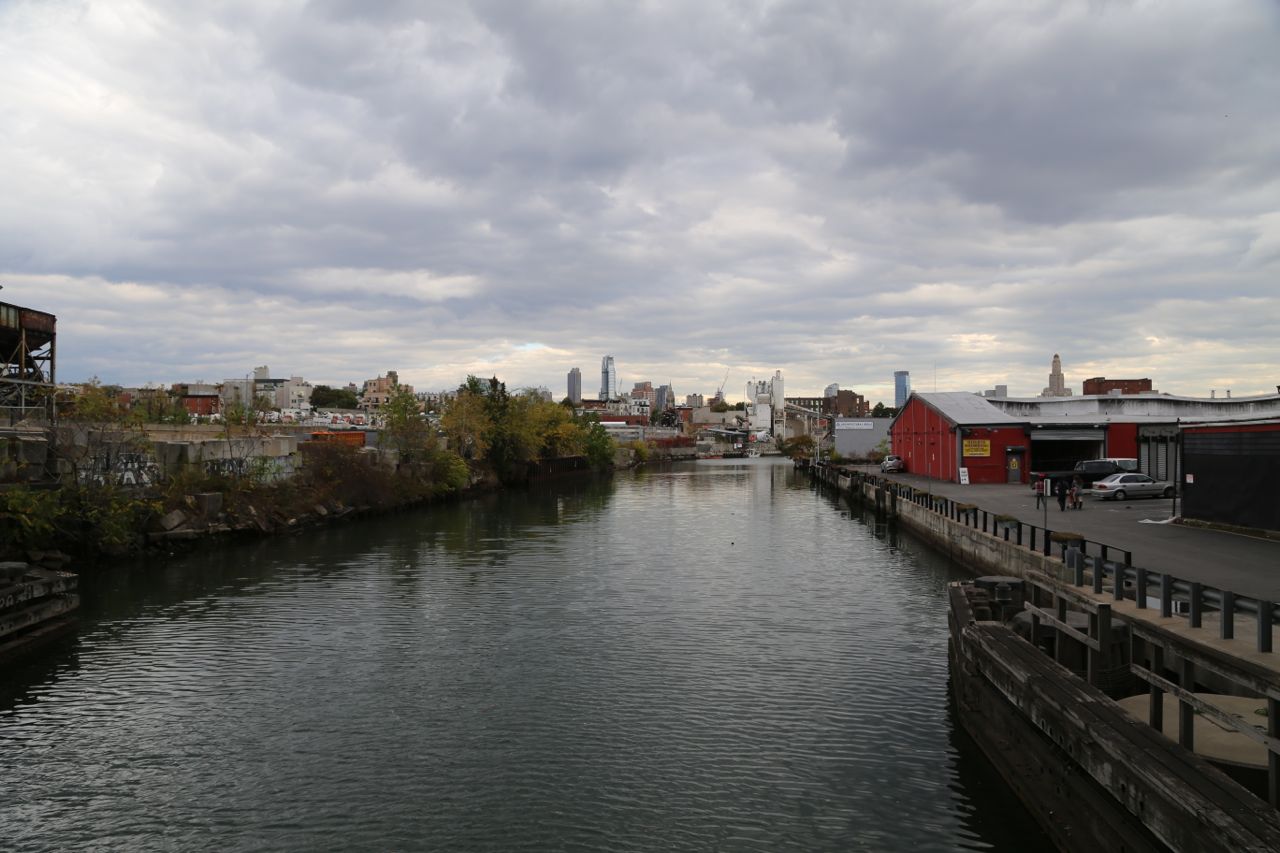
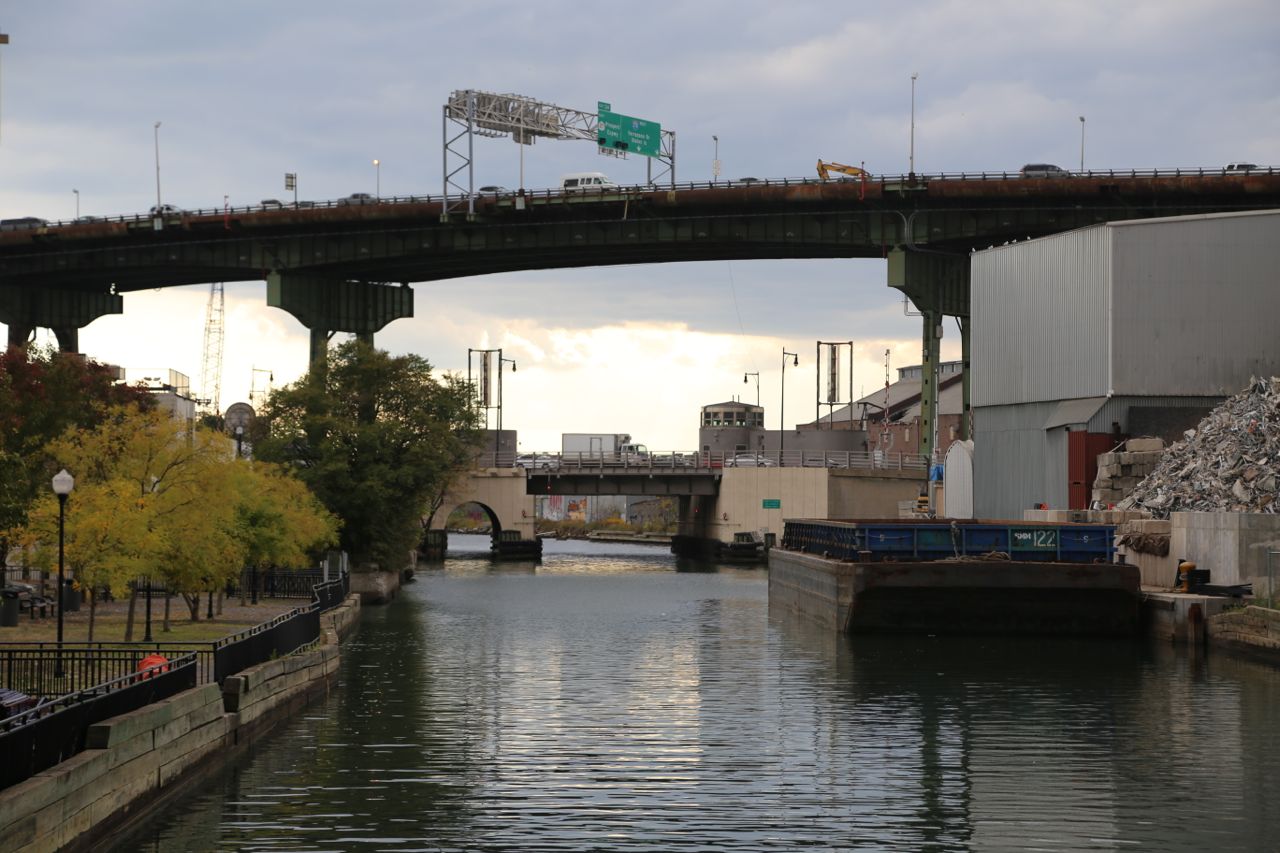
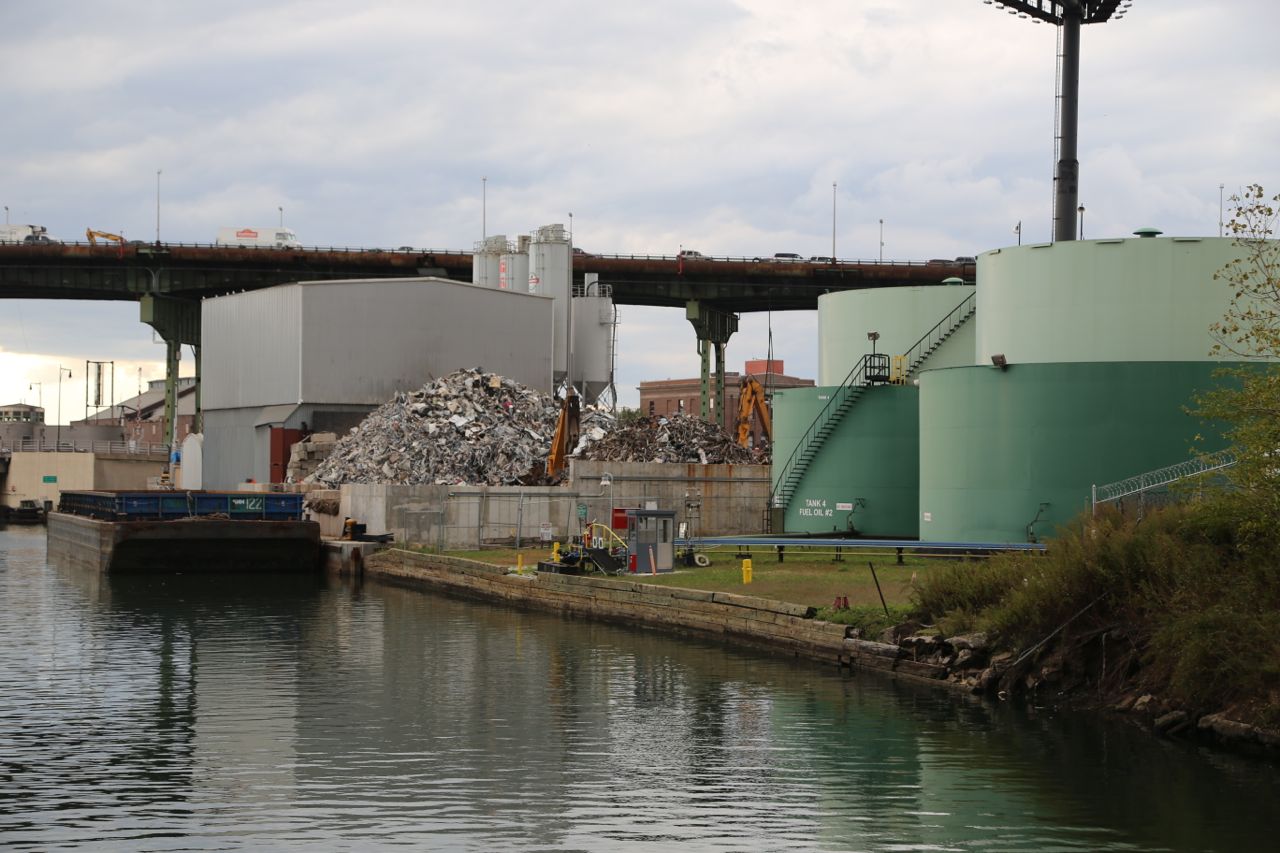
Last month while in New York, I spent some time walking around Gowanus Canal because I’m an environmental engineer, and I couldn’t resist an opportunity to visit a body of water, infamous for being incredibly polluted. The Gowanus Canal is a Superfund site due to contamination with polycyclic aromatic hydrocarbons (PAHs), volatile organic contaminants (VOCs), polychlorinated biphenyls (PCBs), pesticides, and metals. However, the Gowanus Canal is also polluted with more ordinary pollutants such as bacteria from untreated wastewater from combined sewer overflow outfalls and other urban pollutants from surface runoff (and possibly illegal outfalls). The area residents are understandably pushing to get the canal cleaned up quickly, and the cleanup is a joint effort between the city, state, and federal government. The area around the canal is an interesting mixture of industrial, art galleries, and up and coming residential. It is actually a nice area. There is a Whole Foods Market next to the canal that has a nice little canal walk on the property, which features signs that say “This is the greenest supermarket in New York State. No smoking, please.” I will take them at their word about being the greenest supermarket, as I did notice solar panels and wind turbines in the parking lot. However I still had to laugh at the irony of the sign. On the bright side, the Gowanus Canal is not so polluted that should someone smoke near it, it is not in danger of catching on fire, like the Cuyahoga River did in 1969. While I was walking along the canal, I spotted a small boat with two people who seemed to be monitoring the water and also two people in a canoe. I guess the canal is safe to canoe on, if you just make sure you don’t touch the water to your skin and most definitely don’t let any get into your mouth, nose, eyes, or any other orifices. The canal does not look that polluted. There are areas with floating trash, but there are very few places where I saw a sheen. When I was there it did not smell either, but evidently especially in summer, it can smell. However, it is a good example of how appearance is not a good way to tell if something is polluted. If you want to read more about the Gowanus Canal, this article in Popular Science is pretty interesting.

Northern end of the Gowanus Canal

Northern end of the Gowanus Canal

Bridge on northern end

Bridge on northern end

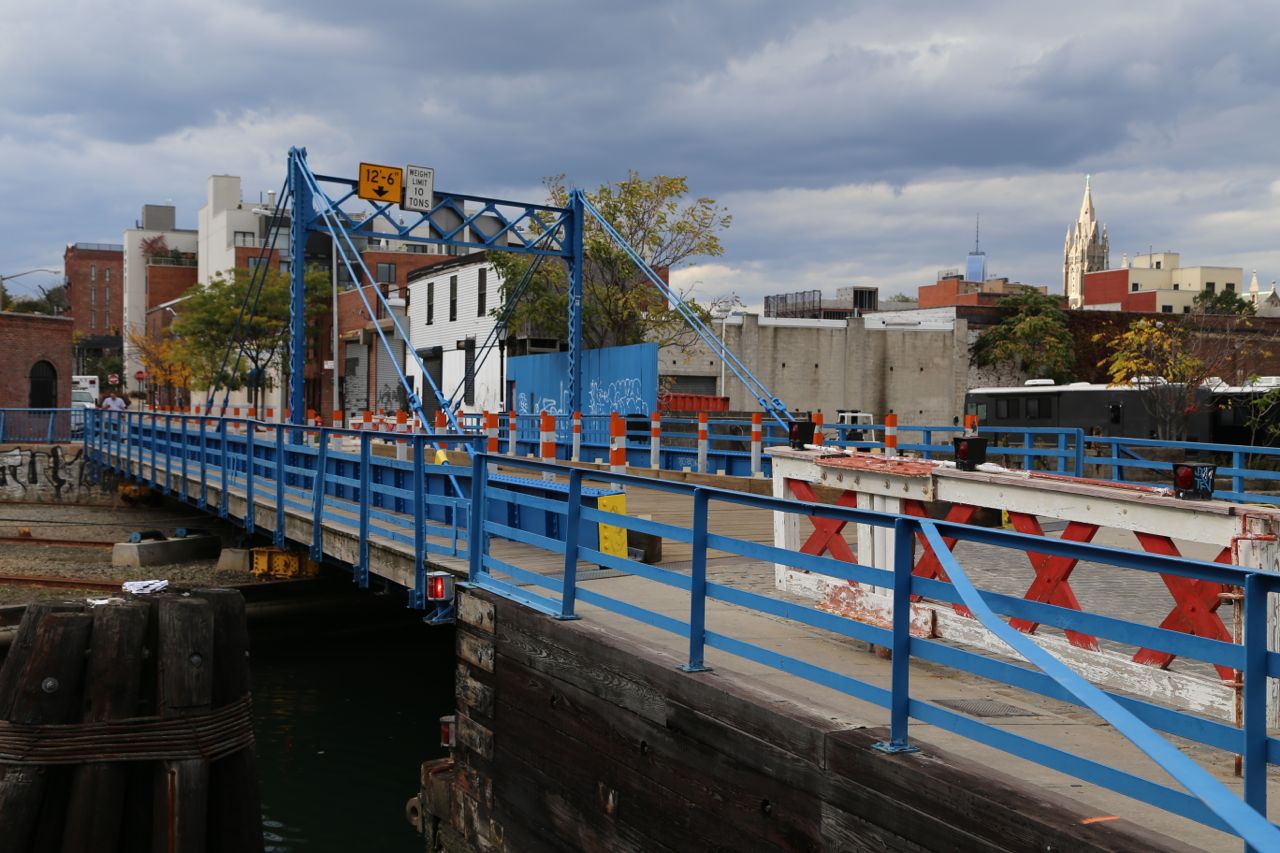
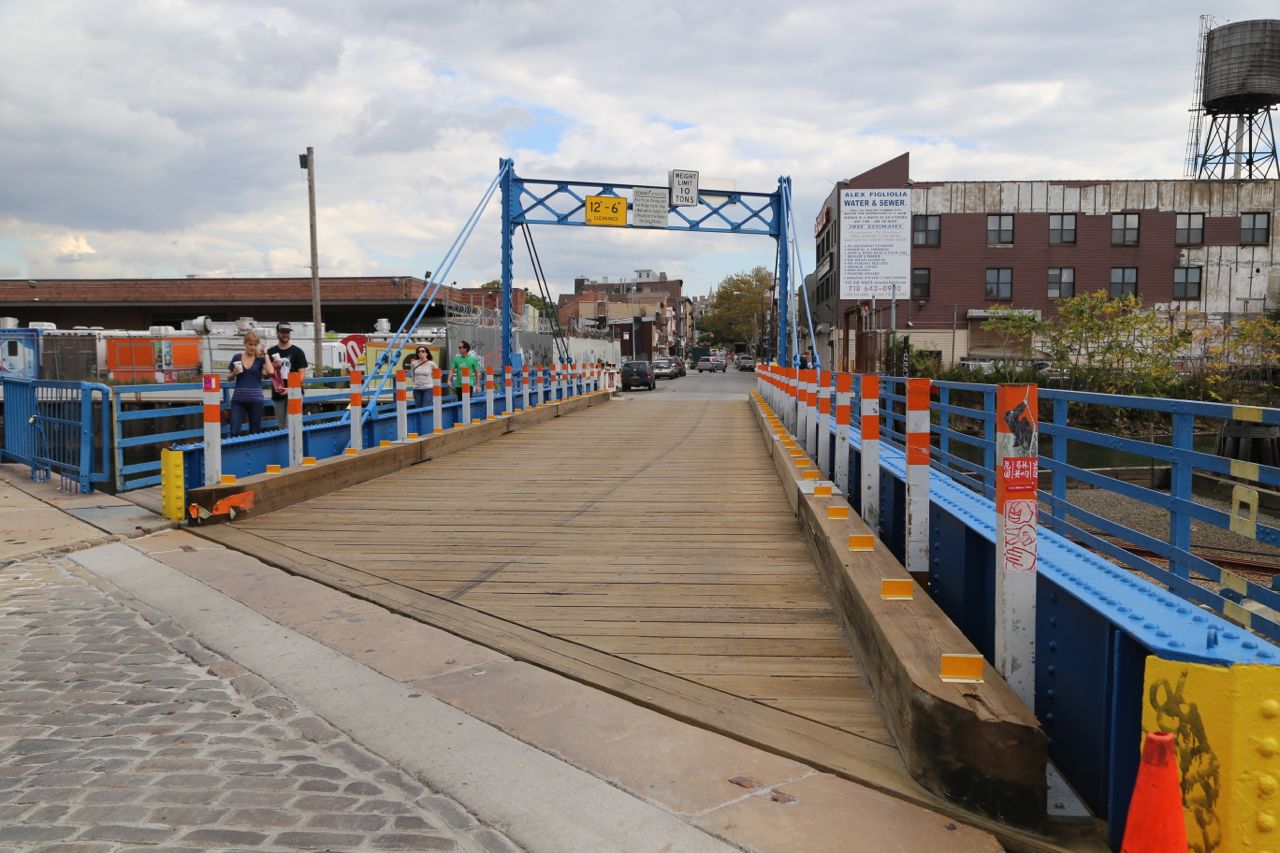
Carroll Street Bridge

Carroll Street Bridge

Carroll Street Bridge

Carroll Street Bridge

Stormwater discharge warning sign

Stormwater discharge warning sign

A wooden dolphin that had a book attached to the top as some sort of art or memorial

A wooden dolphin that had a book attached to the top as some sort of art or memorial

View from the Third Street Bridge

View from the Third Street Bridge

Survey boat

Survey boat

Third Street bridge

Third Street bridge

People actually canoe on the Gowanus Canal

People actually canoe on the Gowanus Canal

Barge sitting on the canal

Barge sitting on the canal

Fourth Street Basin, next to the Whole Foods Market

Fourth Street Basin, next to the Whole Foods Market, with some sort of art in the sculpture in the water

Gowanus Canal southern end

Gowanus Canal southern end

Gowanus Expressway

Gowanus Expressway

Liquid storage tanks

Liquid storage tanks

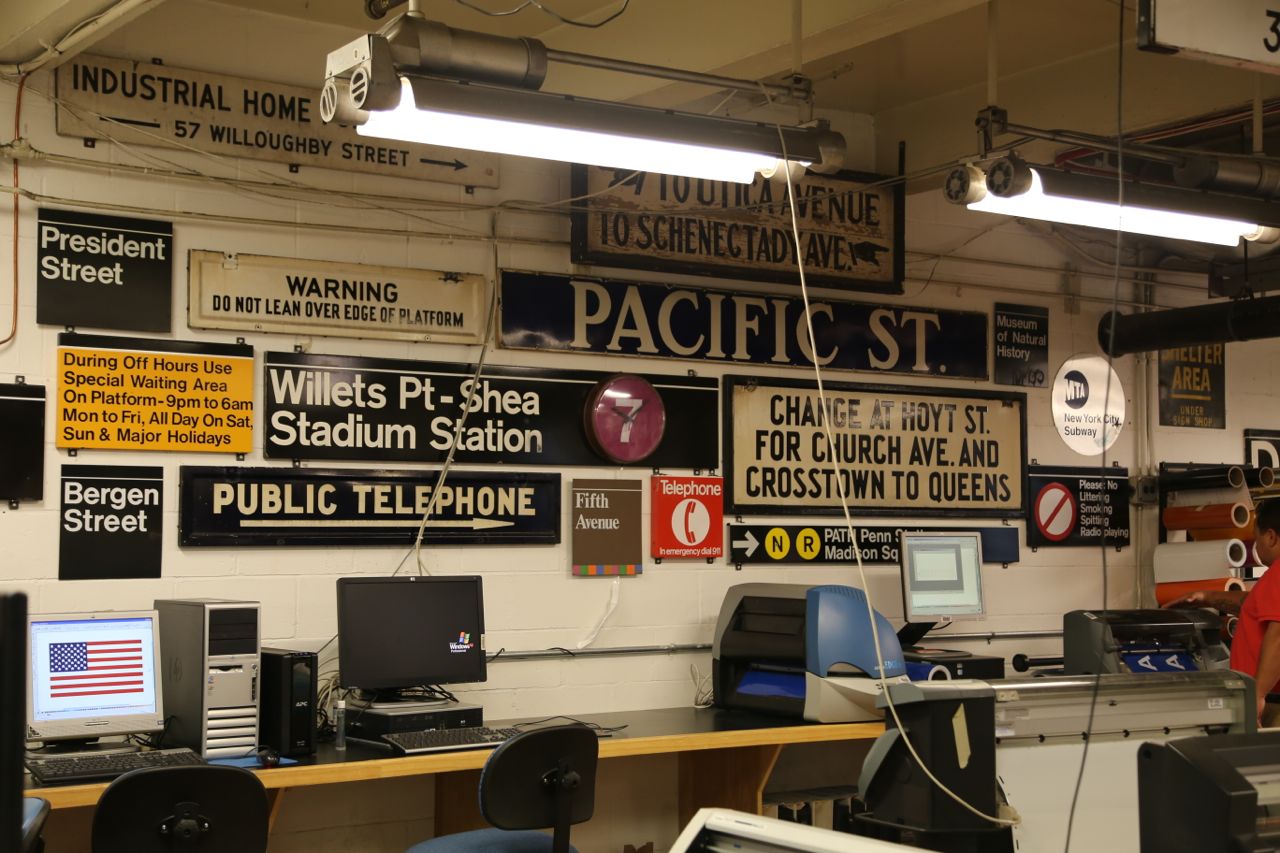
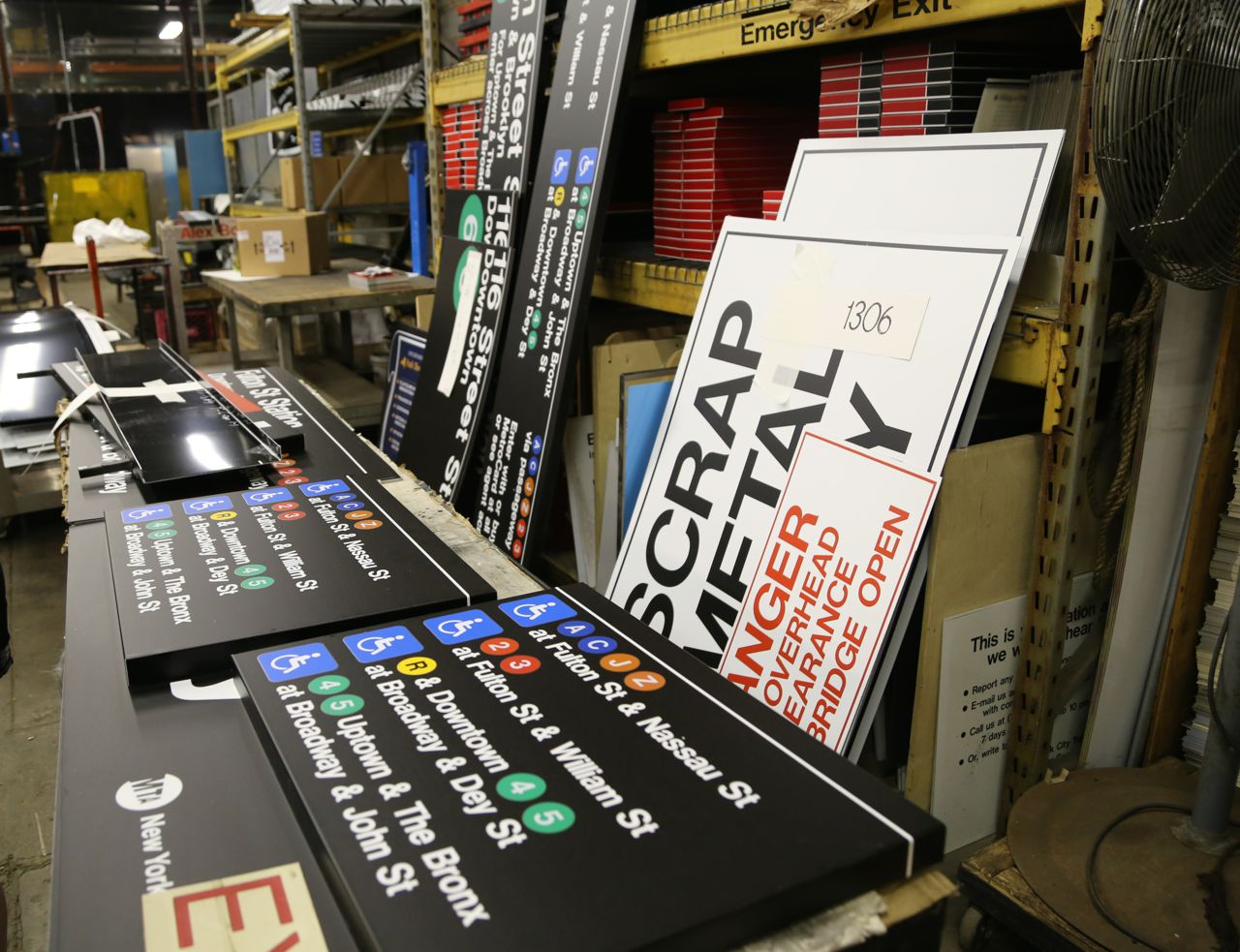
Bergen Sign Shop

Collection of old signs on the shop's wall

Collection of old signs on the shop’s wall

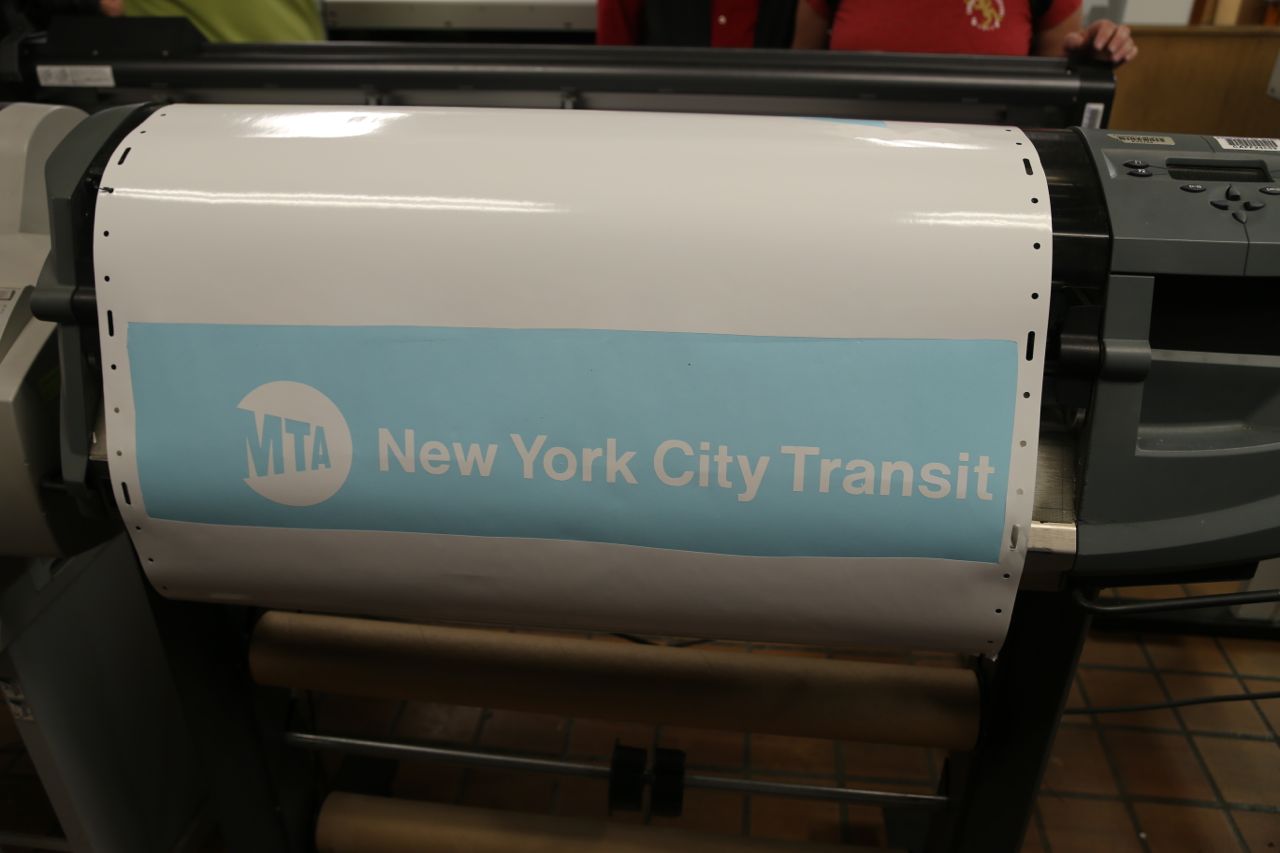
I recently had a chance to tour New York City’s MTA’s Bergen Sign Shop. The Bergen Sign Shop is where all the signs for MTA’s subways are made and possibly a few other signs. The wonderful employees came in on a Saturday so that they could take two tour groups, from the New York Transit Museum, through the shop and show us how they make the signs. It was really neat to see and also interesting to hear how things have changed from the way things used to be made. Computers are now used for much of the process where as like many things, they used to have to be done by hand. Some of the signs they make are made like many of us make signs with regular ink jet printers, although they have massive printers with the biggest ink cartridges I have ever seen.

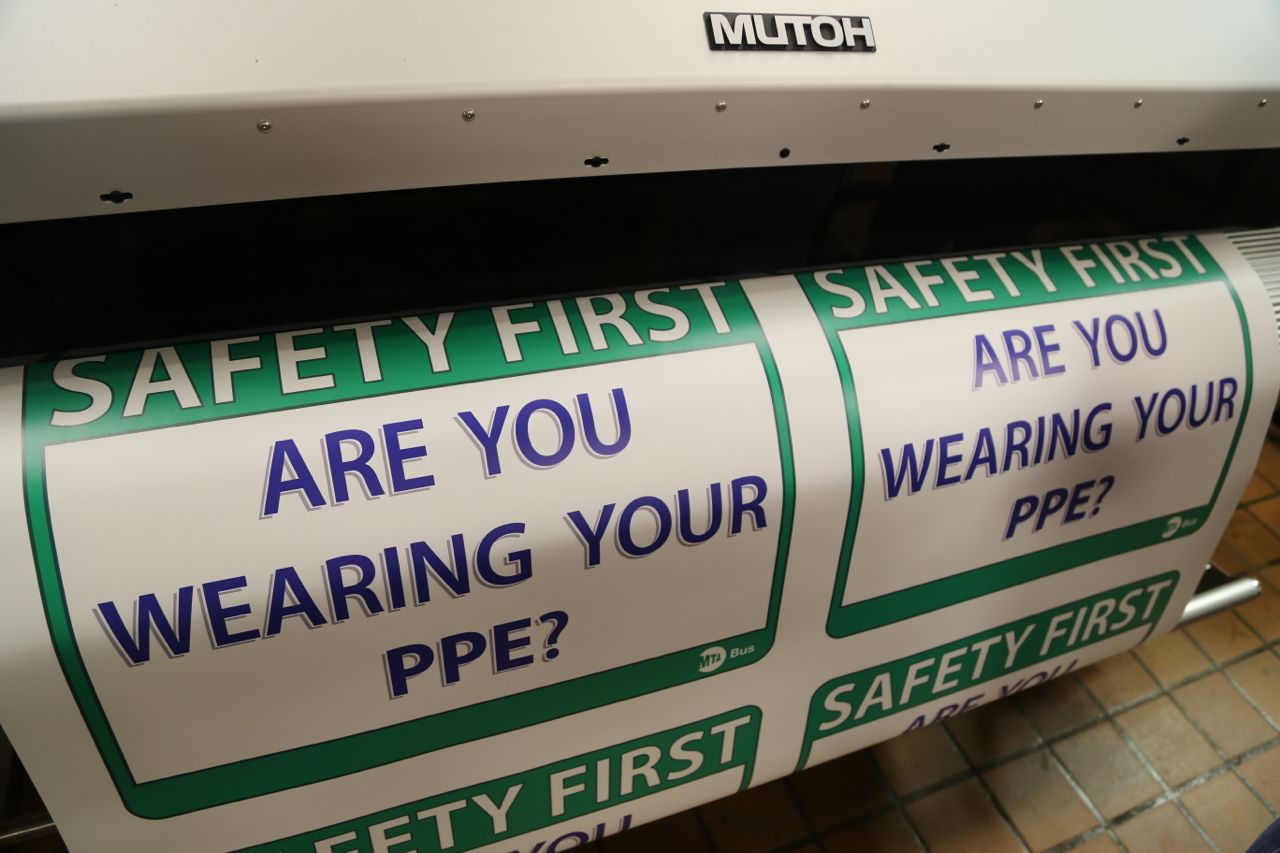
Safety first signs being printed in bulk. As an engineer, I particularly enjoyed seeing this.

Safety first signs being printed in bulk. As an engineer, I particularly enjoyed seeing this.

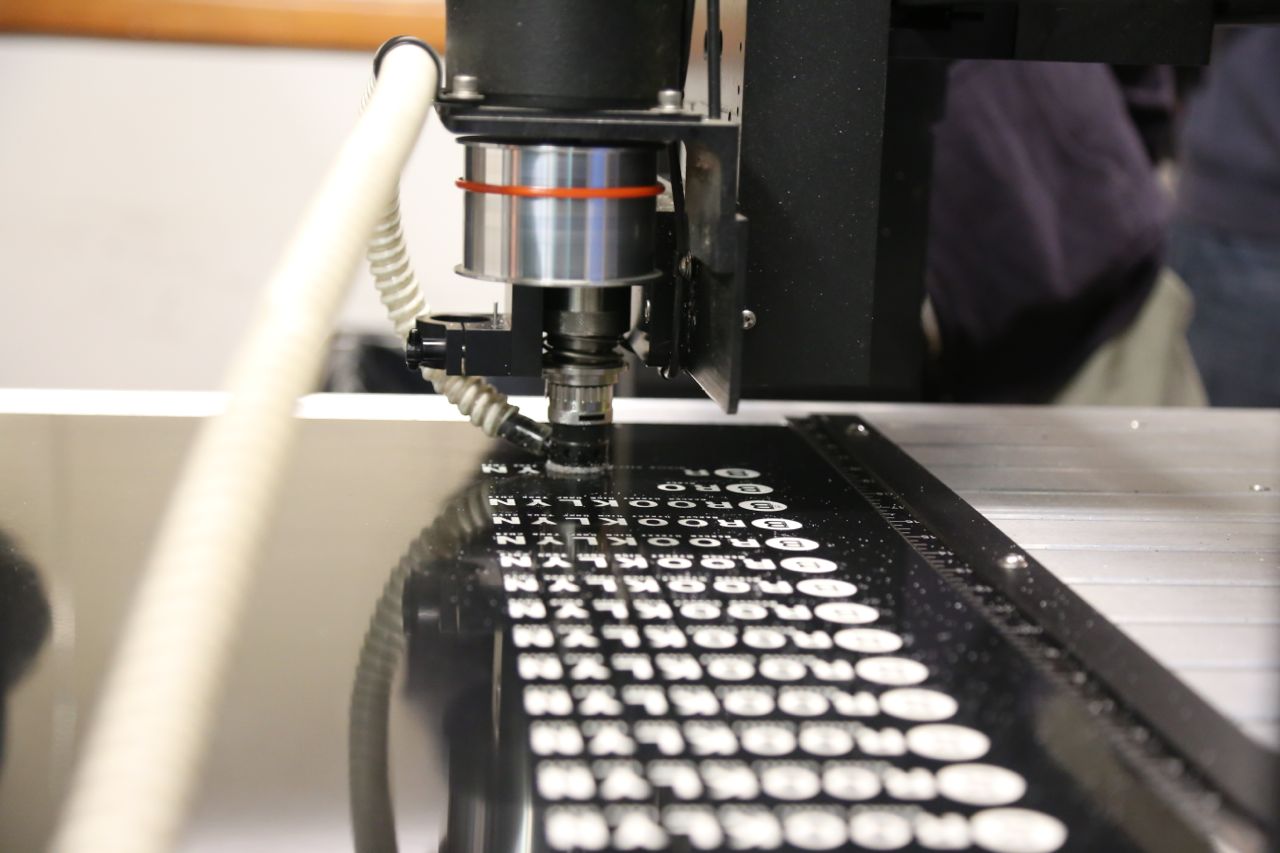
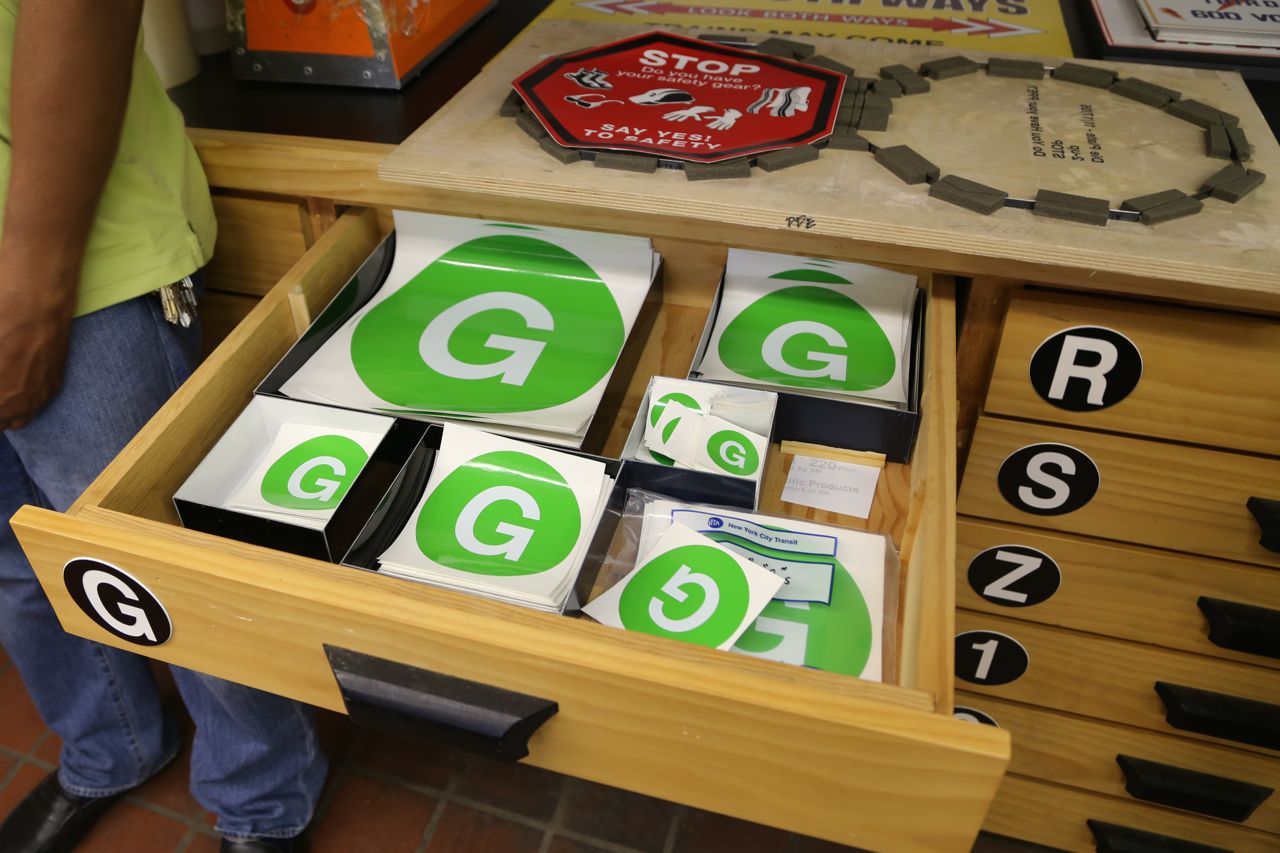
All the “buttons”, the colored circles with the subway line letter or number, are printed on rolls of colored vinyl with adhesive backing. The line’s letter or number is then printed in black or white. A machine also cuts the circle into the vinyl, so employees just have to remove the excess from around the circles.

Rolls of vinyl in various colors ready for the printer. C line buttons being printed.

Rolls of vinyl in various colors ready for the printer. C line buttons being printed.

Drawer full of ready to go buttons. The buttons are made in 7 standard sizes.

Drawer full of ready to go buttons. The buttons are made in 7 standard sizes.

They have another machine that just does detailed cutting of vinyl rolls. Once the vinyl has been cut, the excess is removed, and letters, numbers, and symbols are left in place. The letters are already spaced properly like they would be from a printer and are then transferred as a unit by an employee to a sign.

Roll of vinyl leaving the cutter.

Roll of vinyl leaving the cutter.

The below, very short video is a series of photographs of an employee showing how he transfers the cut letters to a sign. The method he uses keeps all the letters spaced properly as they were spaced by the computer. The letters are transferred from the vinyl roll to transfer paper then to the sign.

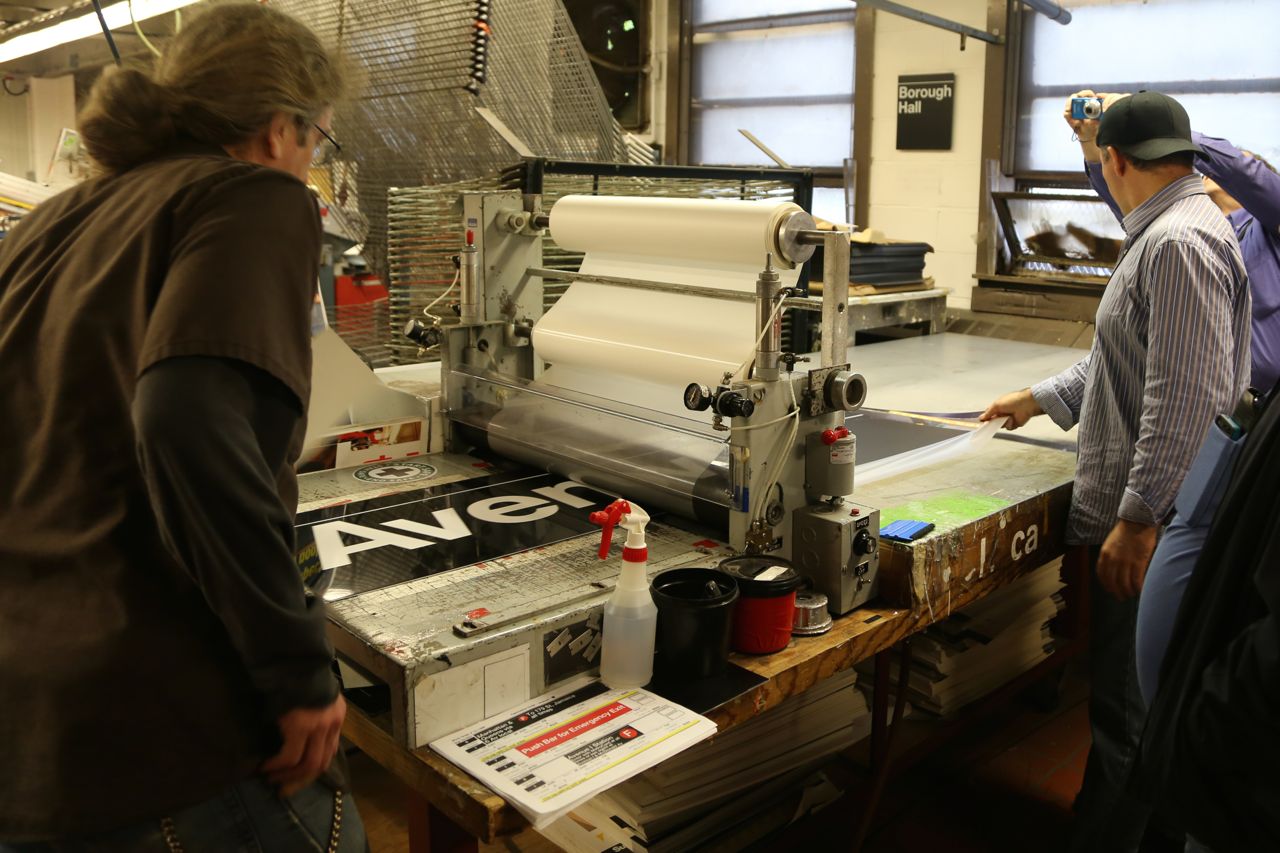
Once the letters, buttons, etc. are on the sign, the sign is then laminated. It is later sent to the tin shop to be applied to a metal frame.

Sign being laminated

Sign being laminated

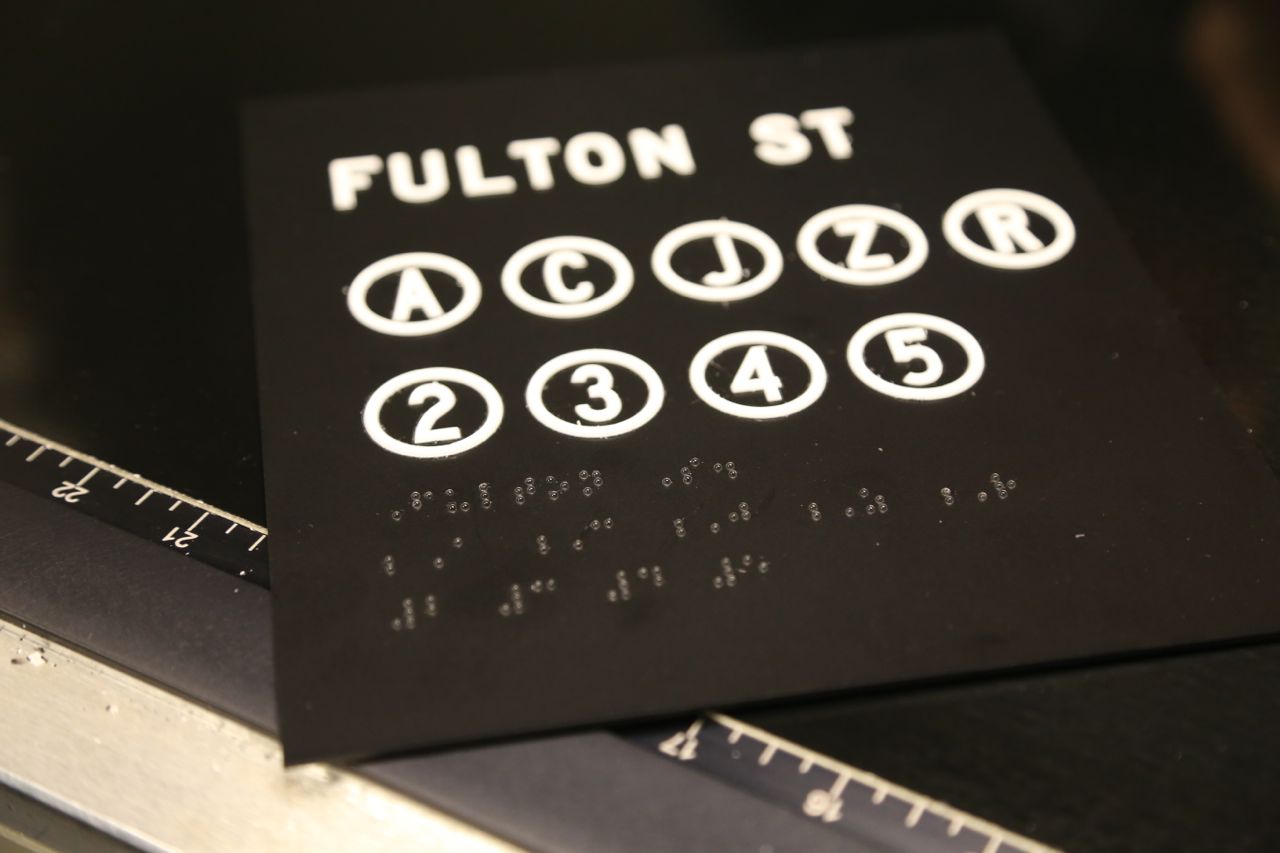
There is another machine that engraves signs and also applies to plastic beads to make braille signs.

Engraving machine

Engraving machine

Temporary location sign with Braille.

Temporary location sign with Braille.

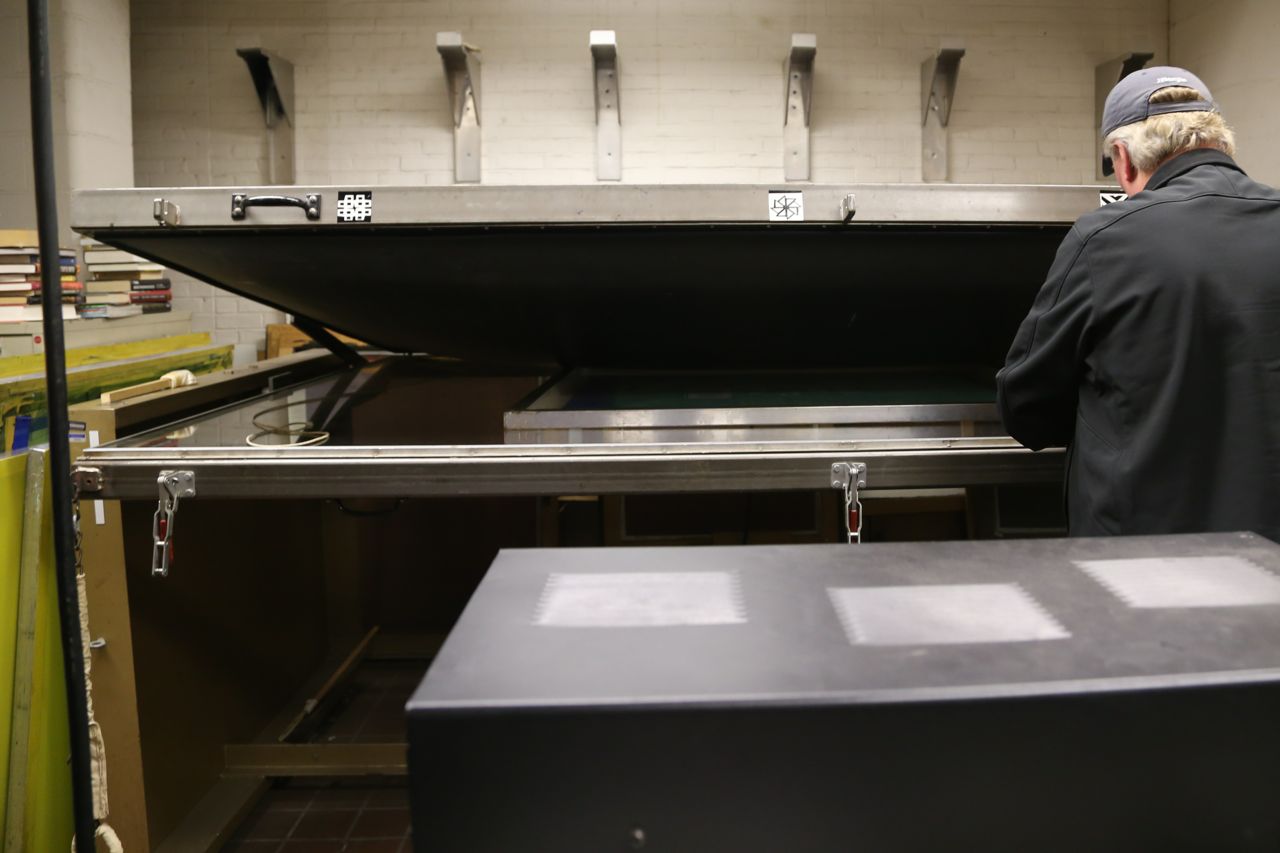
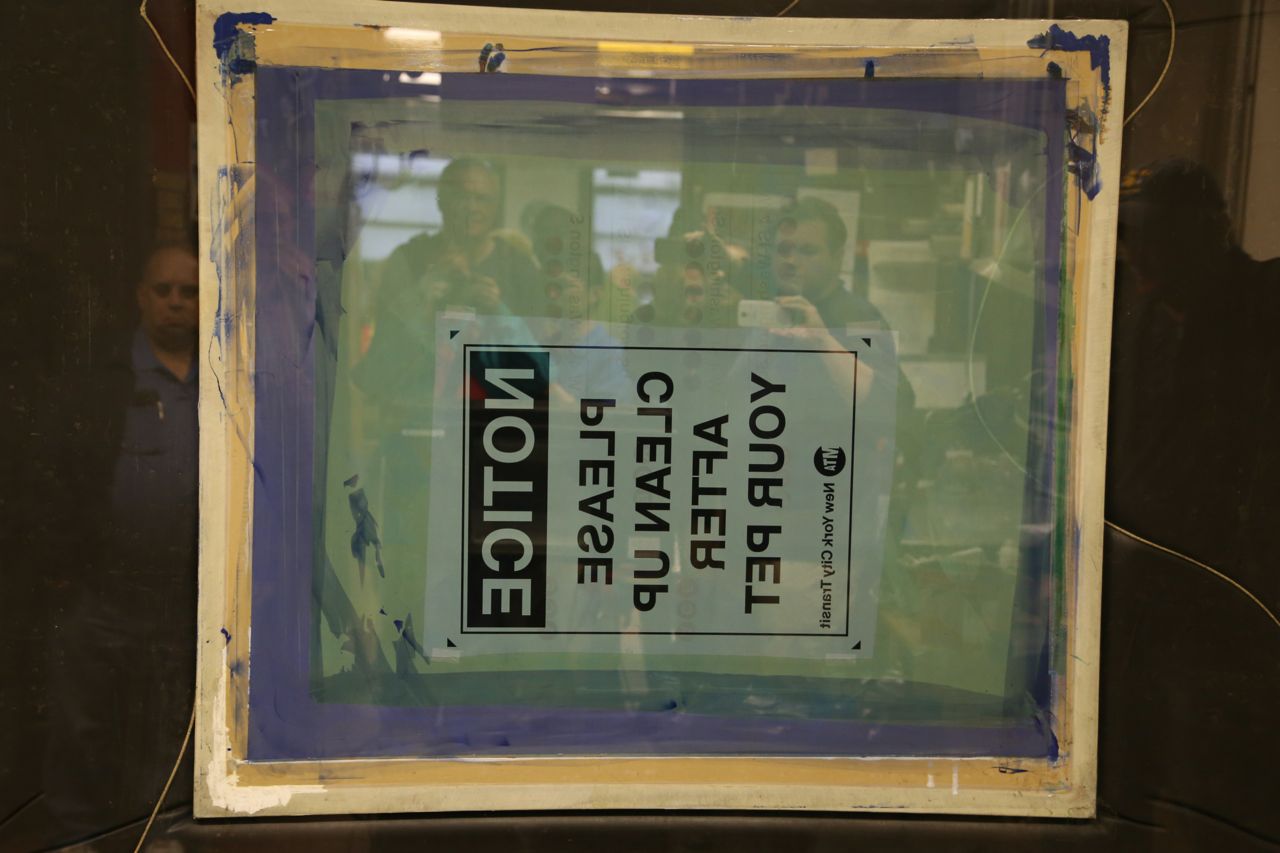
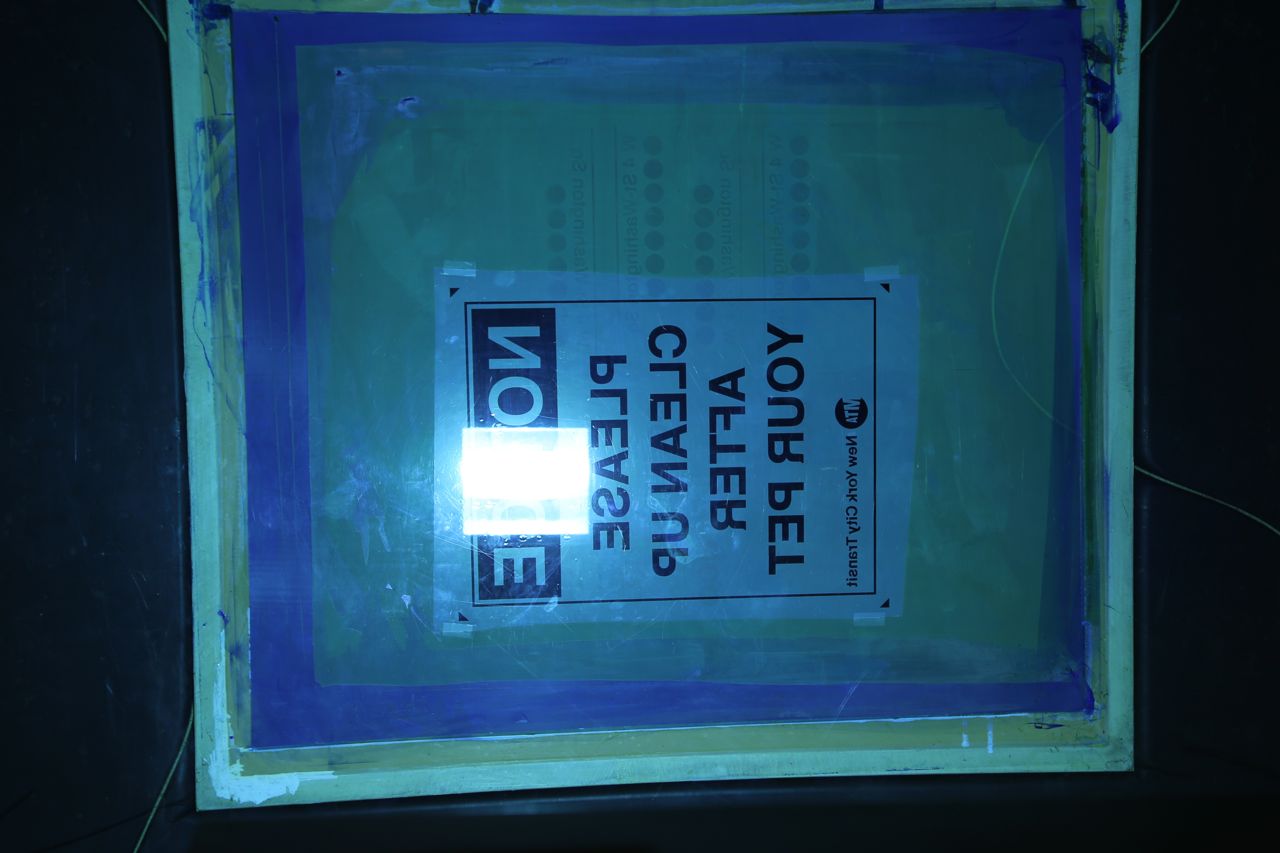
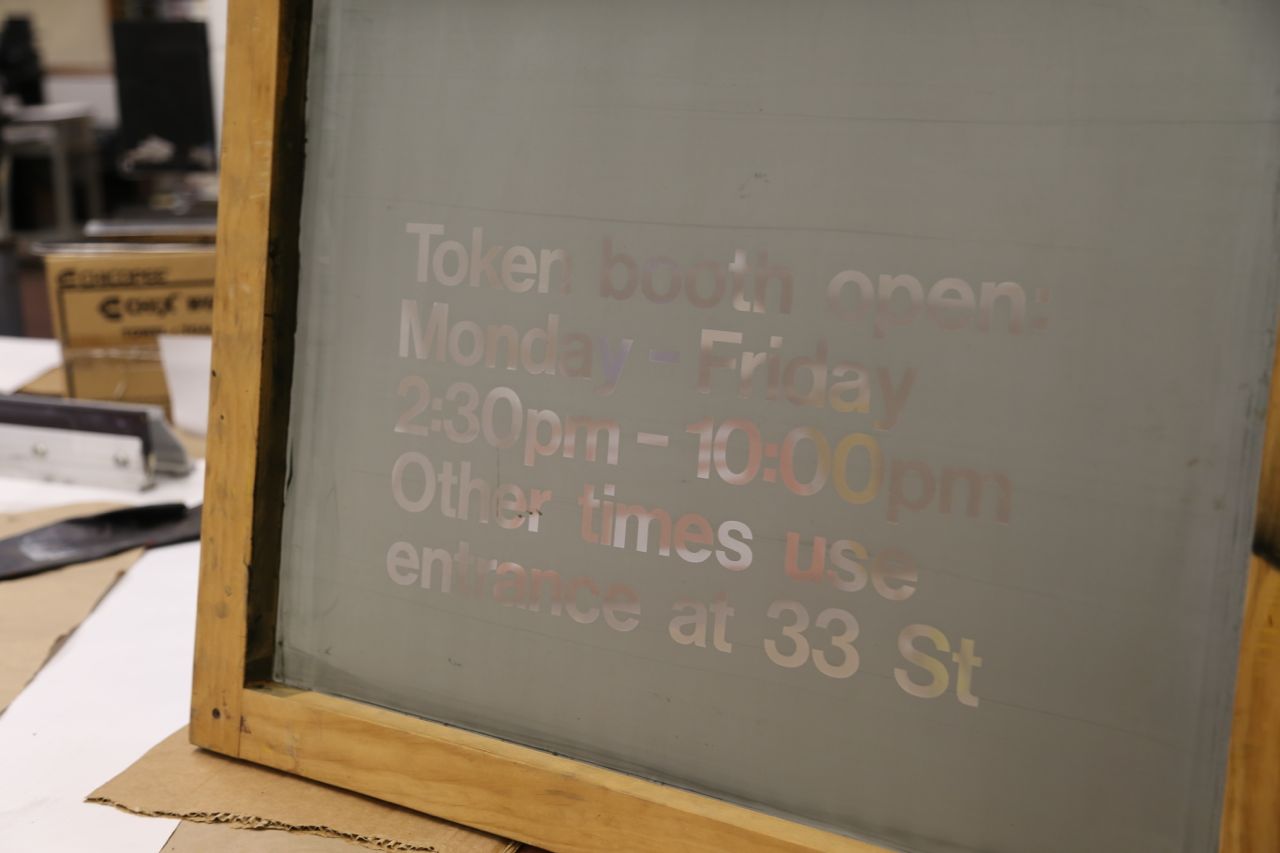
In a separate room, they make frosted glass signs by applying a template and coating the glass with uv-activated substance. Ultraviolet light is then applied, and anything not covered by the template will be frosted.

Glass placed into machine where a vacuum will be applied and then it will be treated under ultraviolet light

Glass placed into machine where a vacuum will be applied and then it will be treated under ultraviolet light

Sign about to be treated under ultraviolet light

Sign about to be treated under ultraviolet light

Sign being treated under ultraviolet light

Sign being treated under ultraviolet light

Glass after being treated with uv light

Glass after being treated with uv light

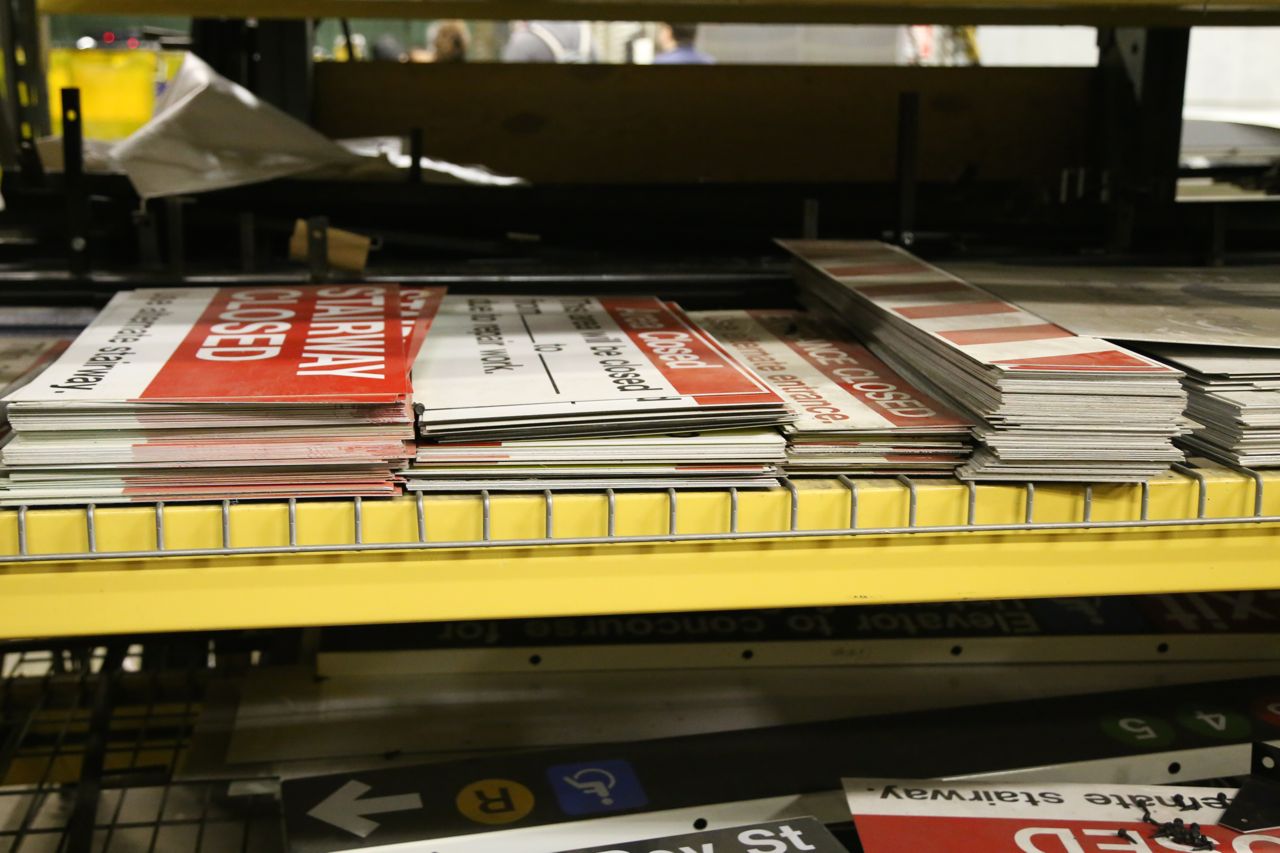
In the back, they had the finished signs stacked up ready to be installed. They also had a supply of generic signs used in various places.

Spare generic signs stacked in storage

Spare generic signs stacked in storage

Finished signs ready to be installed

Finished signs ready to be installed

It was a really fun tour, and it was really neat to learn how the signs are made. Thanks to the New Your Transmit Museum and MTA employees for allowing us to take this tour and showing us how they do everything!

When an engineer gets to comment on building maintenance

One nice thing about where I work is that we get to fill out surveys about how we like the building we work in and comment on it. I have my doubts about how much they act on the survey results, or how much they pay attention to the comments if an employee bothers to give comments, but hey, it’s a great place to vent. I actually for the most part like my building. It is relatively new and doesn’t have the problems that many older buildings that my employer has has. It is kept clean and and looks nice. One big problem I have with it is the same that I have with almost every other office building: the temperature is set at a temperature that is comfortable for men not women. By about 11 am, once the HVAC has fully gotten the ambient air to the set point (as opposed to earlier in the day when it is ramping up after having been off during the night), the vast majority of women are walking around in sweaters, jackets, or blankets that all of us keep at our desk. [Spoiler: When I rule the world, I will dictate two things. Office buildings will be set at temperatures that are comfortable to women, not men. Also, public restrooms will be designed better. In particular, the stalls will be longer so that women don’t have to climb on the toilet to close the stall door. Truthfully there are many things that need to be improved in public restrooms, most of which I and many other people have covered is this somewhat comical, somewhat serious past blog post.] However, the building I work in has some of the worst plumbing issues I have ever seen, especially for a building that is less than ten years old. Ironically it has LEED certification, but whoever certifies it appears to ignore the obvious water wasting issues it has, as I detail below. I’ve decided to share below the comments I gave in the building survey, not because it will really accomplish anything, just as a way to vent and possibly to serve as a warning why if you let an engineer comment on a building with design and maintenance issues, you may get more than you wanted. Thus, my full comments are as follows.

With all the dual flush toilets, only one flush button actually works. With some toilets it is the half flush button, with some the full flush button. However whether or not the working button is actually whichever button it appears to be is unclear, or if they have possibly all been disabled and all converted to full flush. They constantly run. Almost every time I enter a restroom, I have to push the flush button on at least one toilet to get it to stop running. The restroom auto soap and water sinks are like sink roulette. Which sink will give me soap? Which sink will not continuously squirt soap at me? Which sink will give me water? It takes forever to get repairs done on issues in the pantry/kitchens. It took them two weeks or so to put a new aerator in the sink faucet. A part that can be bought at any time at Home Depot. It is not special. Maintenance blames pantry sink issues on reasons that are not the problem. On numerous occasions, water has come bubbling up from the drain pipes into the sink. Sometimes so much water has bubbled up that the sink has overflowed with disgusting brown wastewater. Then maintenance posts signs saying not to put coffee grounds down the drain as that caused issue. While coffee grounds will cause a sink with a bad garbage disposal to not allow the sink to drain (and putting coffee grounds down the drain is a bad idea), it will not cause water to flow up from pipes below. (I’m a chemical engineer I can prove this with fluid dynamics equations!) There is obviously some issue with the drain pipes below our floor, which any competent plumber or chemical engineer could tell you.

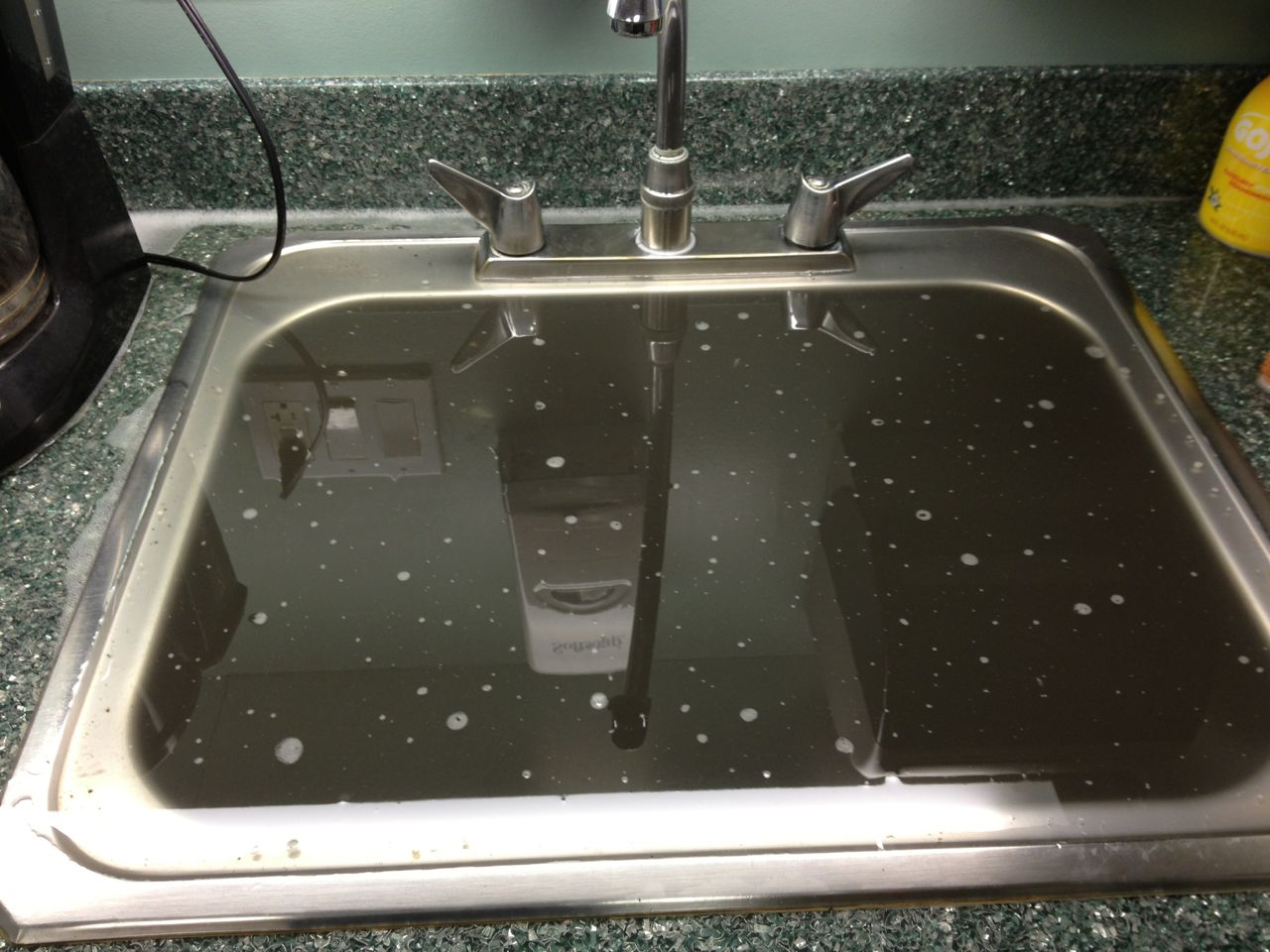
While there was no place to attach photos or videos, below is a photo of the backed up kitchen sink and video of it overflowing.

My office's pantry/kitchen sink when it was backed up and overflowing with wastewater. Photo was taken 1/8/2013.

My office’s pantry/kitchen sink when it was backed up and overflowing with wastewater. Photo and below video was taken 1/8/2013.

HAZWOPER Training

Last week I attended 40 hour HAZWOPER training. HAZWOPER, an acronym for Hazardous Waste Operations and Emergency Response Standard, is OSHA mandated training for employees who may potentially be exposed to hazardous substances and who are engaged in cleanup operations or other certain other activities involving hazardous waste. Normally I work in an office, and the closest I come to hazardous materials or waste is sitting at a computer and analyzing data from hazardous waste sites. However, there is a possibility that I may sometimes be asked to go to a site where HAZWOPER training would be necessary, and I had an opportunity to take the training, so I did.

HAZWOPER training includes topics such as basic chemistry, toxicology, biology, radiation, environmental science, analytical sampling, and law and regulations. Truthfully, I could have taught a good portion of the training. It also includes hands on training with some of the sampling methods and instruments that are used in the field. Personally, I think playing with instruments and sampling materials is fun. As part of the training, you are required to get dressed in various personal protective equipment (PPE) that would be required under various circumstances at sites. In general, you look rather ridiculous in the PPE, but of course PPE is not supposed to be fashionable or make you look good, it is supposed to protect you from hazardous materials that could kill you or cause injury or illness. What PPE does not do, is keep you cool. It was in the 90’s °F when we were dressing in the PPE. While the suits protect you from most hazards, ironically they can cause potential health hazards if you over heat. There are different levels of PPE that are used depending on what the potential hazards are. The most protective is Level A, which is a fully encapsulating chemical-protective suit with positive pressure, full face-piece self-contained breathing apparatus (SCBA), inner and out gloves, and boots.

Me in Level A PPE

Me in Level A PPE

The next level, Level B PPE, is slightly less protective and includes chemical-resistant coveralls instead of the fully encapsulating suit, as well as SCBA, inner and outer gloves, and boots.

Me in Level B PPE

Me in Level B PPE

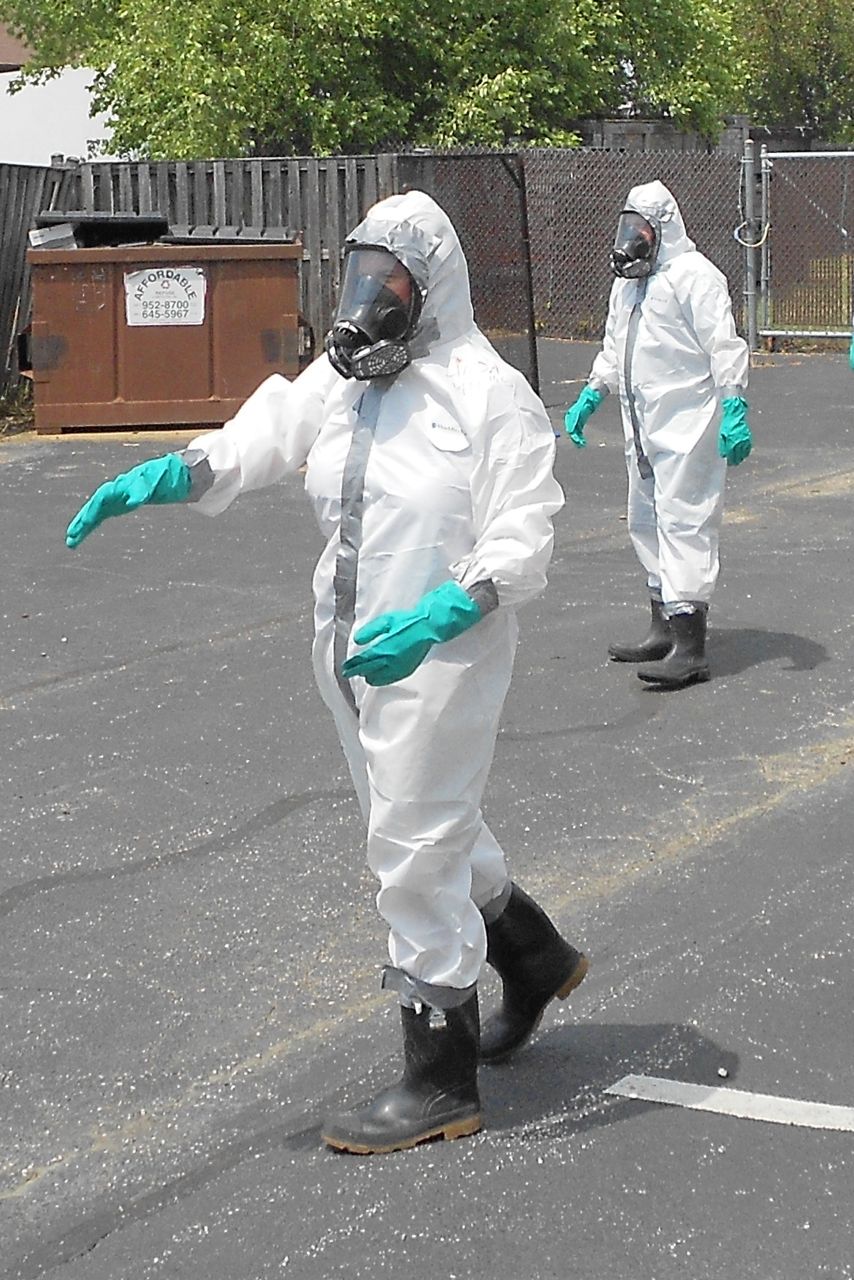
The next level, Level C PPE, is less protective still. It includes an air purifying respirator instead of SCBA, but other than that is fairly similar to Level B.

Me in Level C PPE

Me in Level C PPE

There is one final level, which is Level D PPE, which is minimal protection from physical hazards but does not include respiratory protection. This may sound strange, but if it is hot, Level A is actually easier to wear than B or C. The fully encapsulating suit is roomier, and the compressed air is continually blowing through your mask and then through the suit itself before it exits an exhaust vent. This air flow helps to cool you. In the chemical resistant suit for Level B and C, I just felt like a turkey that had been baked in a cooking bag. Side note, the SCBA tanks we used were made of a composite material and weighed  about a third of the weight of the metal SCUBA tanks I have worn before. Also, for as cumbersome as it was to get dressed out in all the PPE, I think it was easier to dress in and walk around in the PPE compared to the SCUBA drysuit I was wearing a month beforehand while SCUBA diving Silfra. Obviously once underwater, the tank weight is negligible, and the drysuit becomes less cumbersome, but above water, they are really difficult to get into and move.

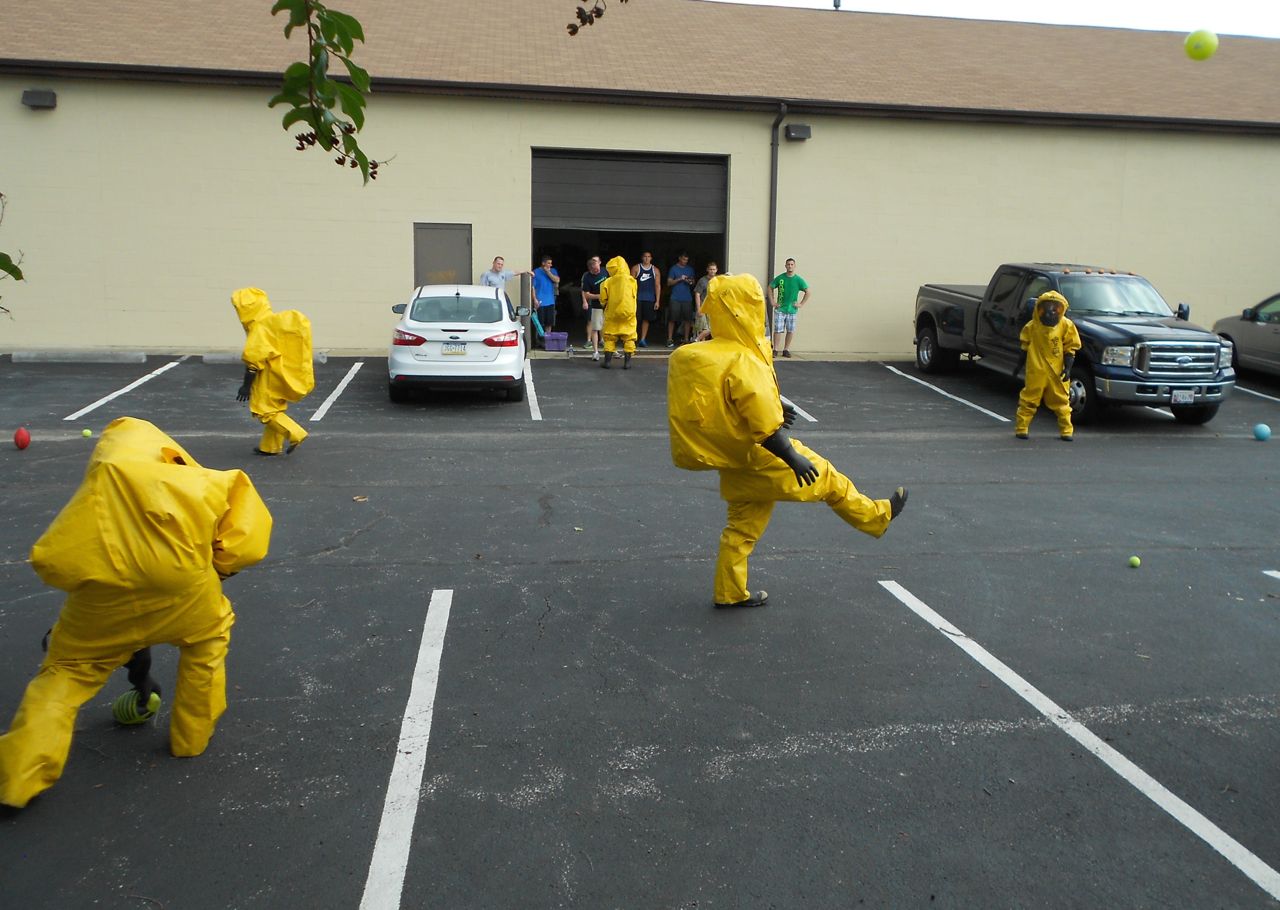
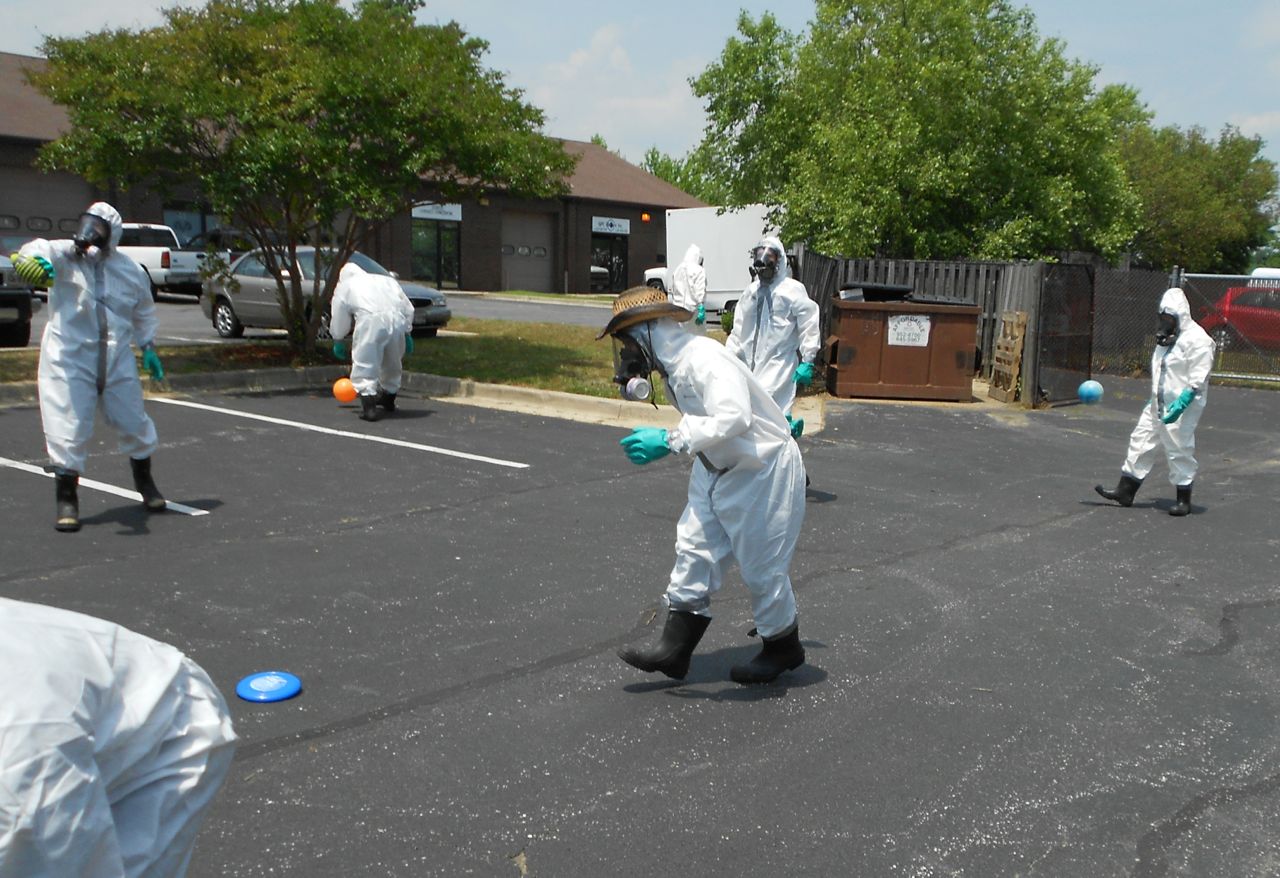
For HAZWOPER training, you don’t just have to get dressed in the different levels, you need to get used to actually moving and doing various tasks in them. Hence, when we first wore them, our tasks were to play with balls, as one would normally do at a hazardous waste site.

Playing ball in Level A PPE

Playing ball in Level A PPE

Playing ball in Level C PPE

Playing ball in Level C PPE

Note in the above photo, the person in the center is wearing proper head protection in the form of a straw cowboy hat. No, he actually just being fashionable. Wearing hazardous material PPE is no reason to not be fashionable.

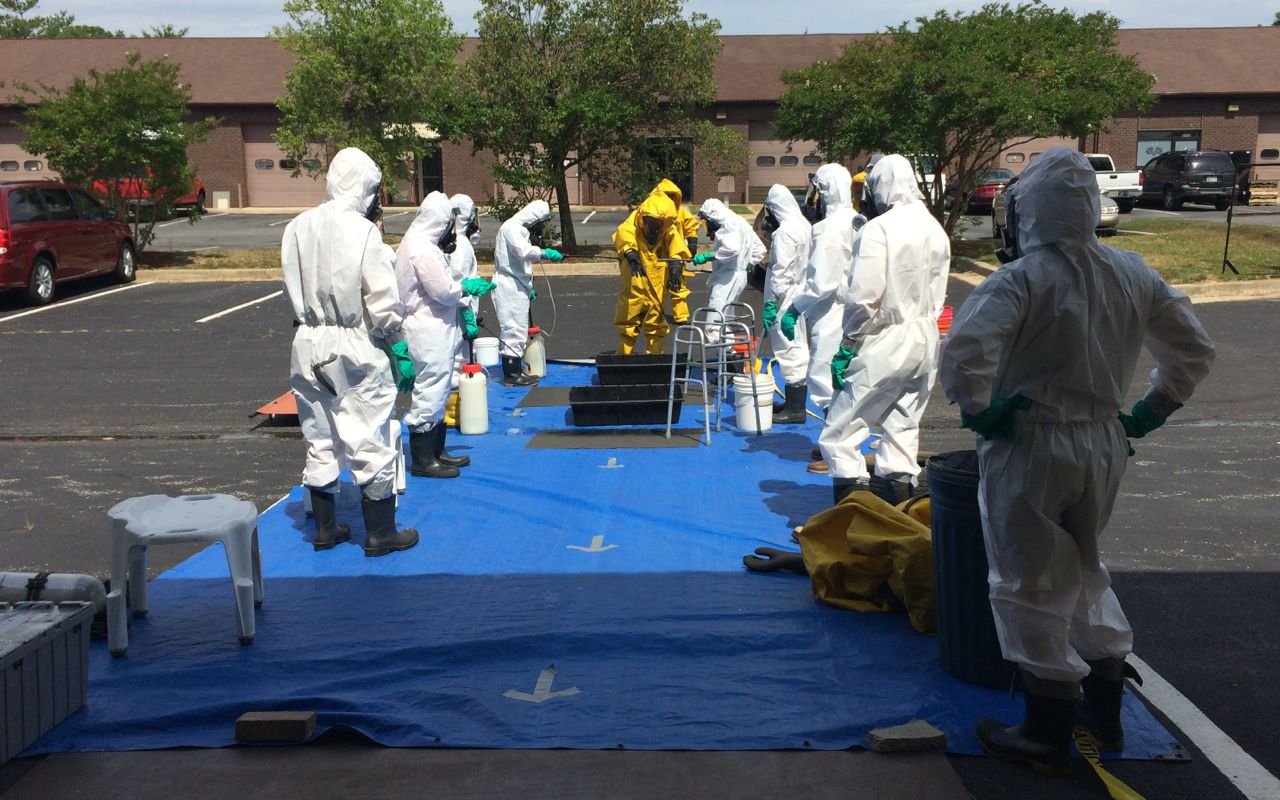
We also did a few exercises to practice tasks at a hazardous materials site, including decontamination. There are set steps and tasks to make sure decontamination is done properly. The first pair of people wash the worker, the second pair wash the worker again, the third set inspect the cleaning, and the fourth set help the worker out of the PPE. Notice the use of walkers for the worker to hold onto while the decontamination team washes the boots. There is no dignity in any of this.

Decontamination practice

Decontamination practice

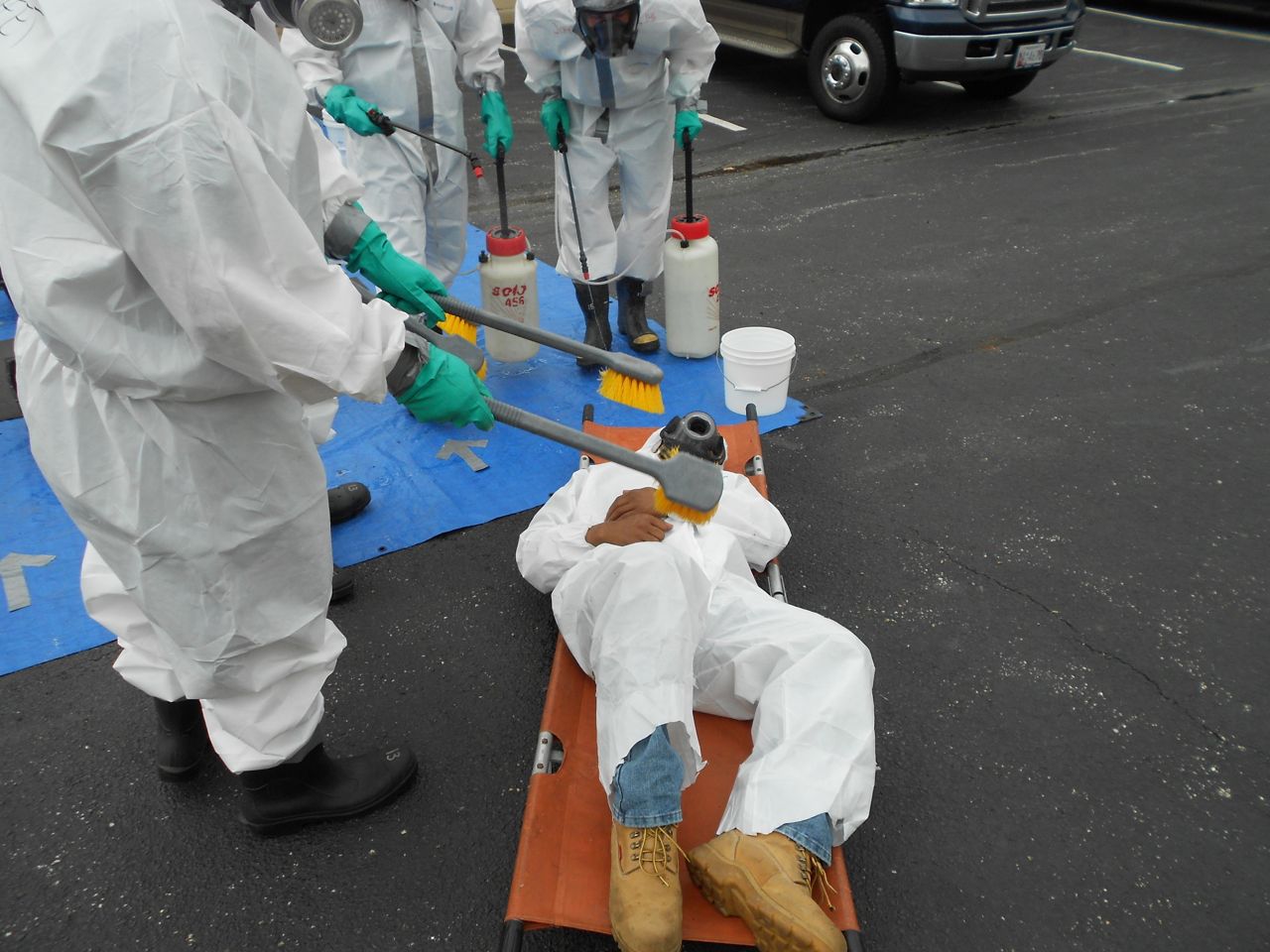
We also practiced emergency decontamination of an incapacitated worker. We actually did not finish this task. This was due to the fact that after they started decontaminating him, someone loudly said, maybe we will have to do mouth to mouth. At that point, the incapacitated worker suddenly regained conscienness and took off running.

Emergency decontamination of an incapacitated worker

Emergency decontamination of an incapacitated worker

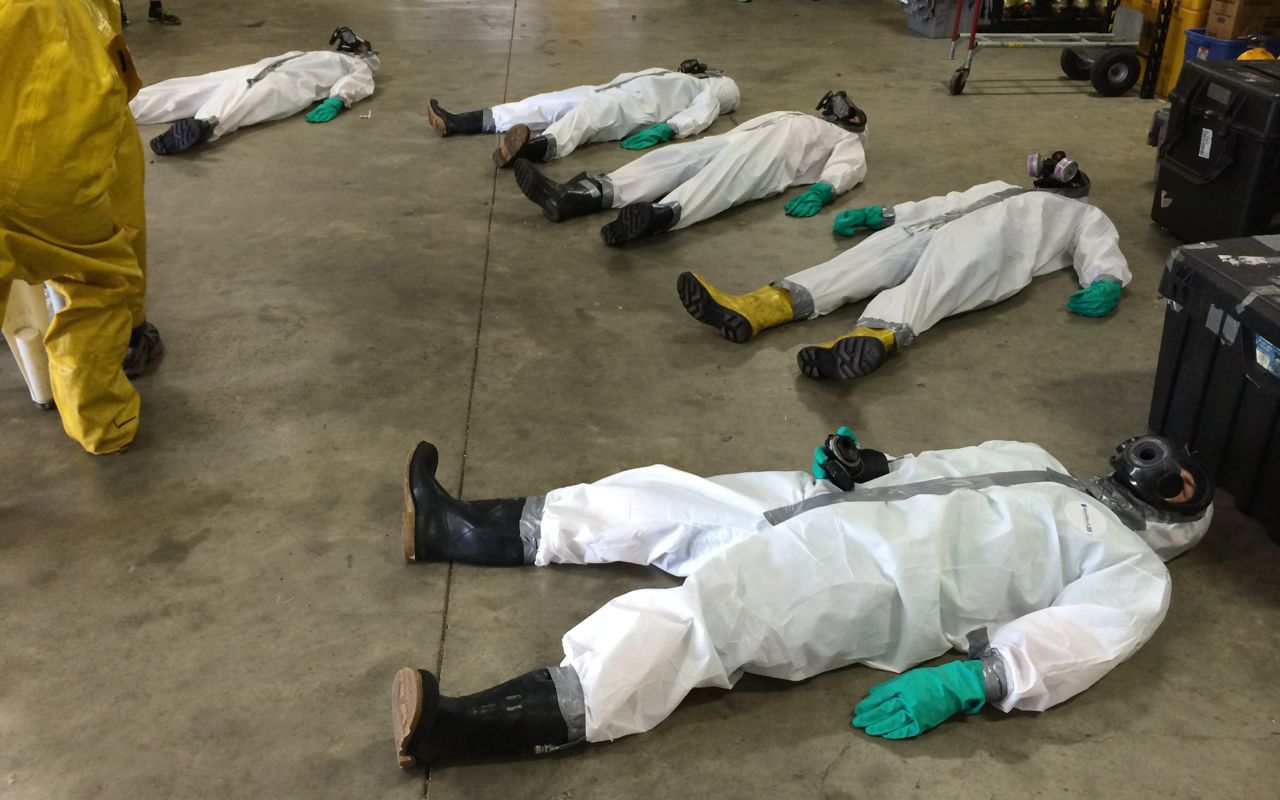
Since this was practice and not a real situation, we did a few things you can’t do on a real site. For example, the decontamination team stayed inside when not needed outside and did various things to stay cool. One thing that we did was lay on the concrete floor because the concrete was cooler than the air, and it absorbed some of your body heat. Sure, we looked like casualties at a hazardous waste site, but it worked and helped keep us cooler.

Cooling off by laying on the concrete floor

Cooling off by laying on the concrete floor

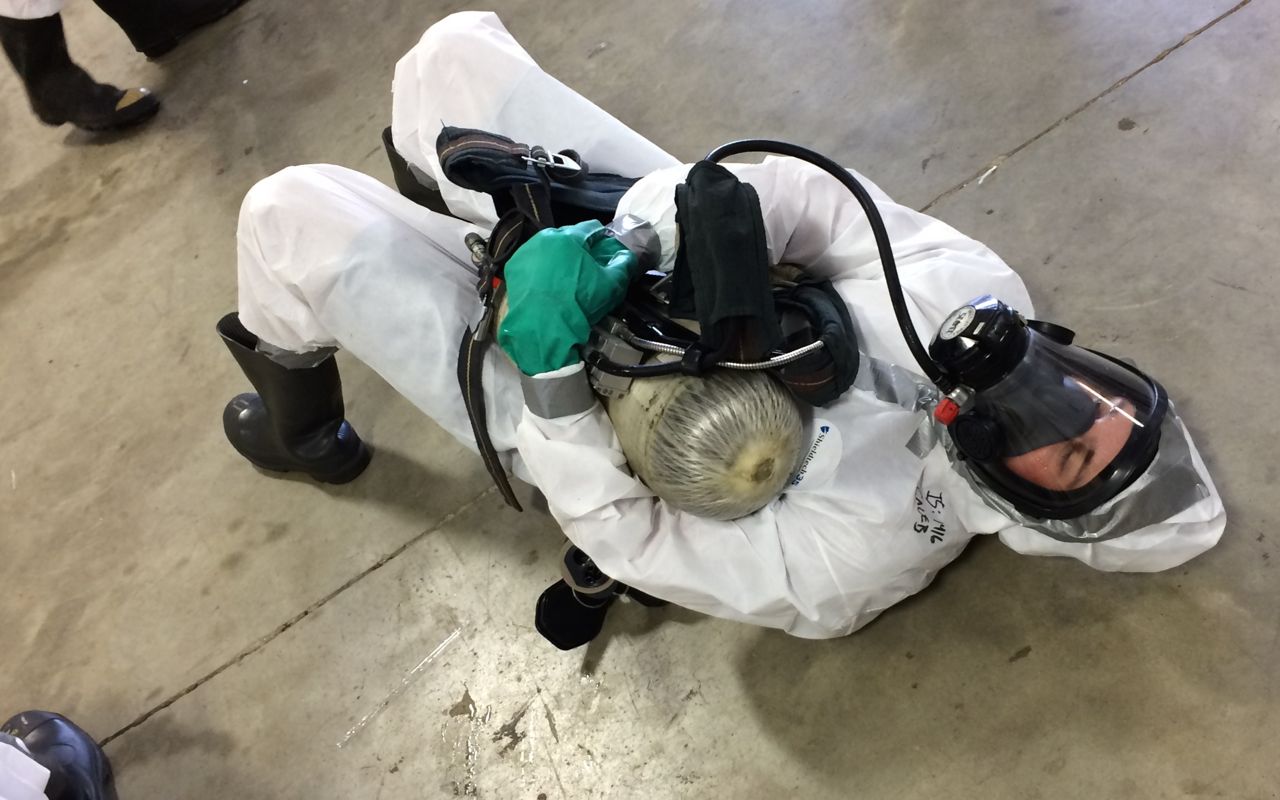
We also took “hits” of the compressed air from the SCBA. The full face masks we wore were interchangeable for either air purifying filters or for the hose from SCBA. In between tasks, we didn’t wear either. However, we would attach the SCBA for short periods of time because the compressed air blowing into your mask helps to cool you.

Cooling off by attaching the SCBA to the mask

Cooling off by attaching the SCBA to the mask

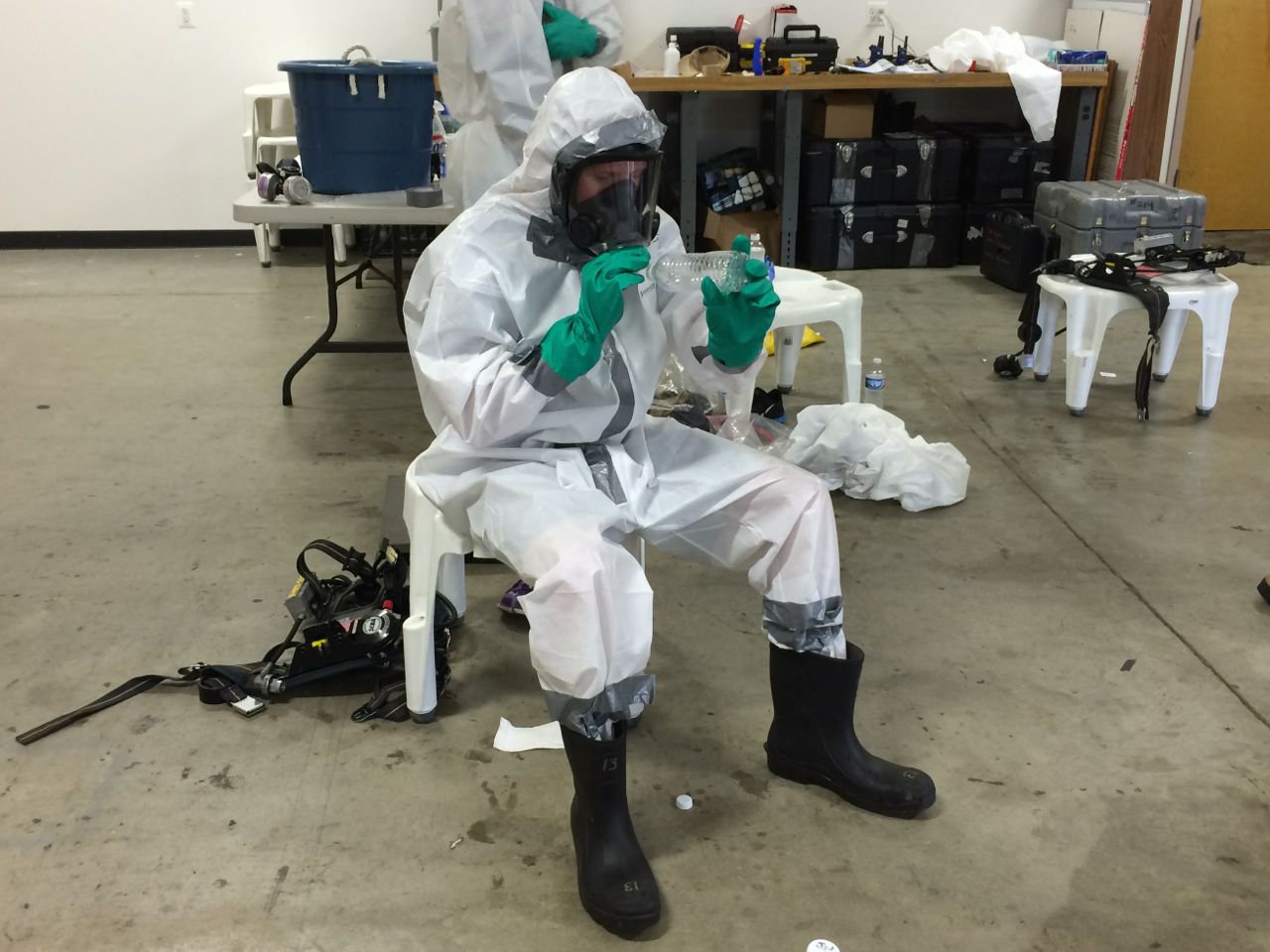
Another thing that should never be done at a real site was drinking water through the mask via a straw. Actually it might be acceptable to do this, assuming someone with clean hands put the straw in the bottle and then into your mask. It is not acceptable if you are doing this with your gloves.

Drinking water through the mask

Drinking water through the mask

For as hot as I was while in some of the PPE, I still had fun. I was out of the office, and that in itself was fun. Also, I learned a bit, and that is always fun.

Concrete Crushing

Excavators with concrete crushers attachments are badass. They just chomp concrete like most of us chomp on walnuts. The claw closes around the concrete, then chomp, and then there is rebar and small bits of concrete.

There is an old railroad bridge being destroyed over Four Mile Run between Arlington and Alexandria, Virginia. Here is video I shot of an excavator destroying what is left of a pier from the bridge.