

Solar Eclipse
Snorkeling in Alaska
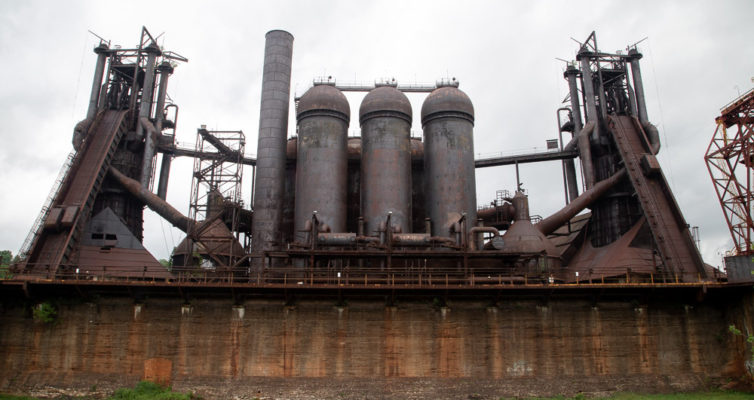
Carrie Blast Furnaces
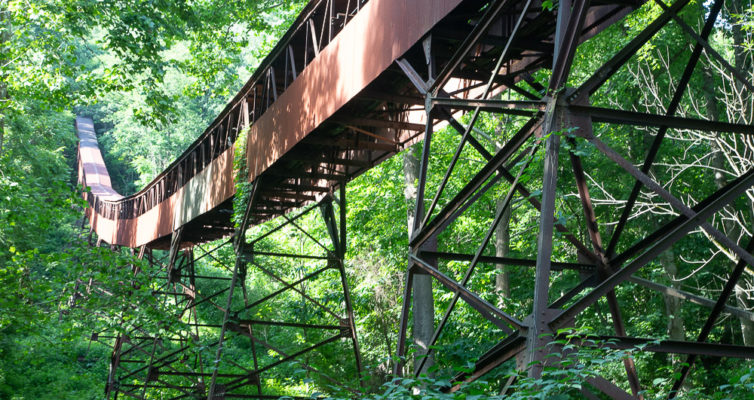
Nuttallburg
Bridge Walk

Harrisburg

I came to Harrisburg to see the Pennsylvania State Capitol, but while I am here, I spent some time exploring. Harrisburg is one of those old cities where downtown is a mix of historic and modern buildings. Some of the historic buildings have been preserved; some need some preservation. It is a mostly walkable city though. There is a nice riverwalk, at least part of it is close to the water level next to the levee, and another parallel part of it is on top the levee.

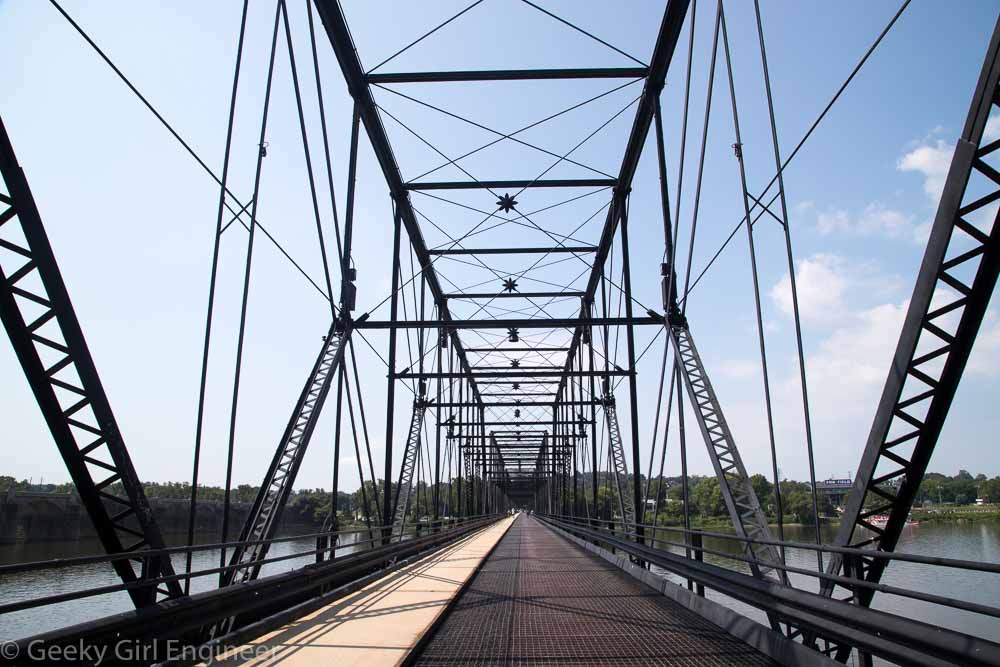
One place that I really enjoyed walking to is City Island, which can be accessed on foot by the Walnut Street Bridge, a pedestrian and bicycle only bridge, that connects downtown to the island in the Susquehanna River. From City Island, I took a ride on the Pride of the Susquehanna riverboat that takes a short cruise up the river. By the time the river gets to Harrisburg, it is about a mile wide, but it averages only about 3.5 feet deep. On the cruise, I saw some people standing in the middle of the river, which only went to their waist, next to their pontoon boat.
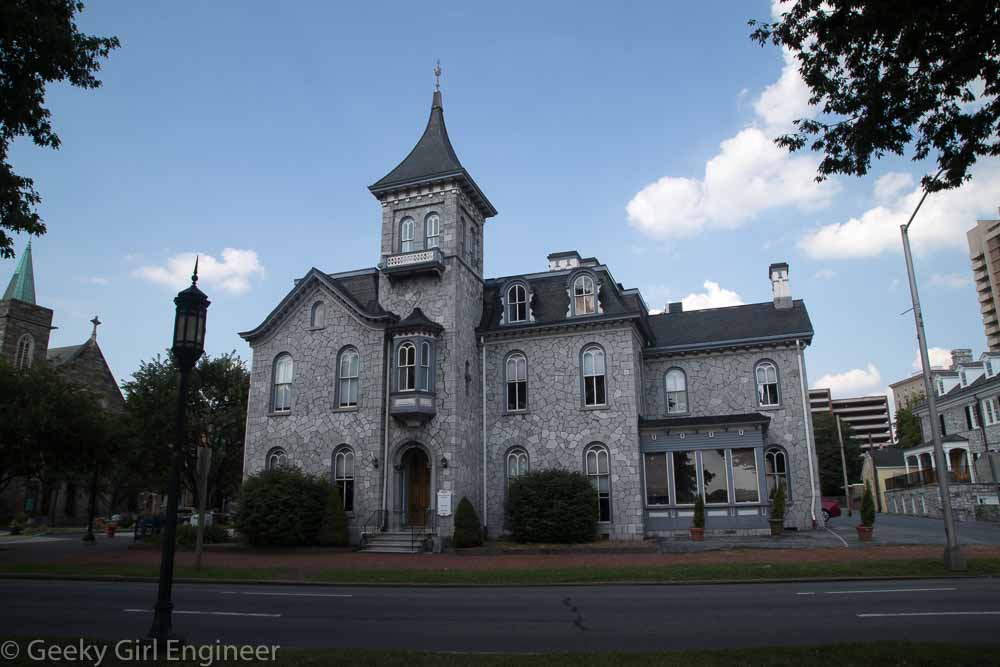
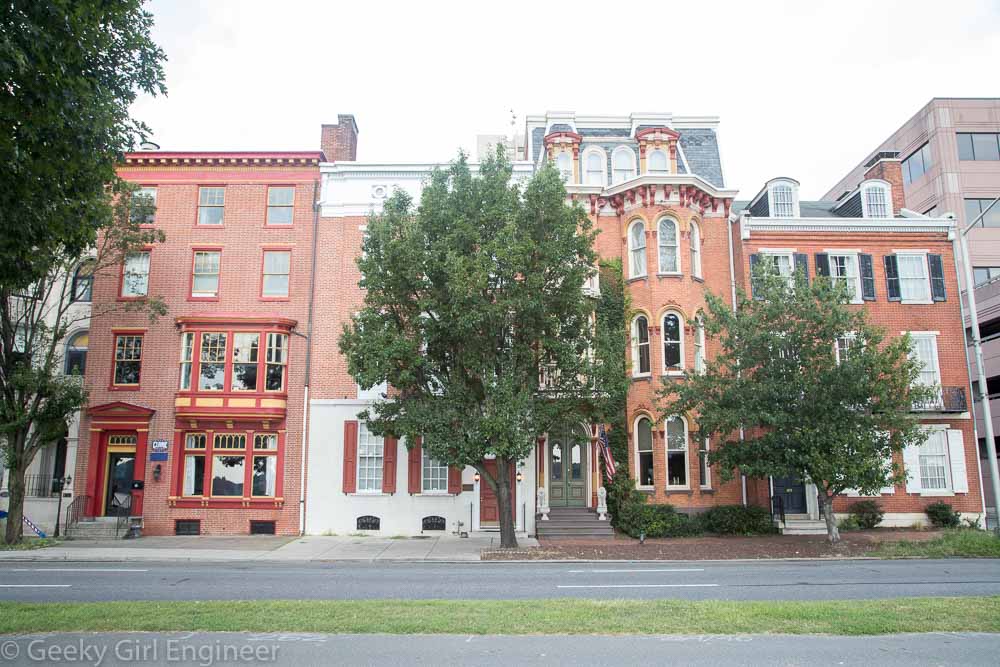
Mansion across from the river
Walnut Street bridge
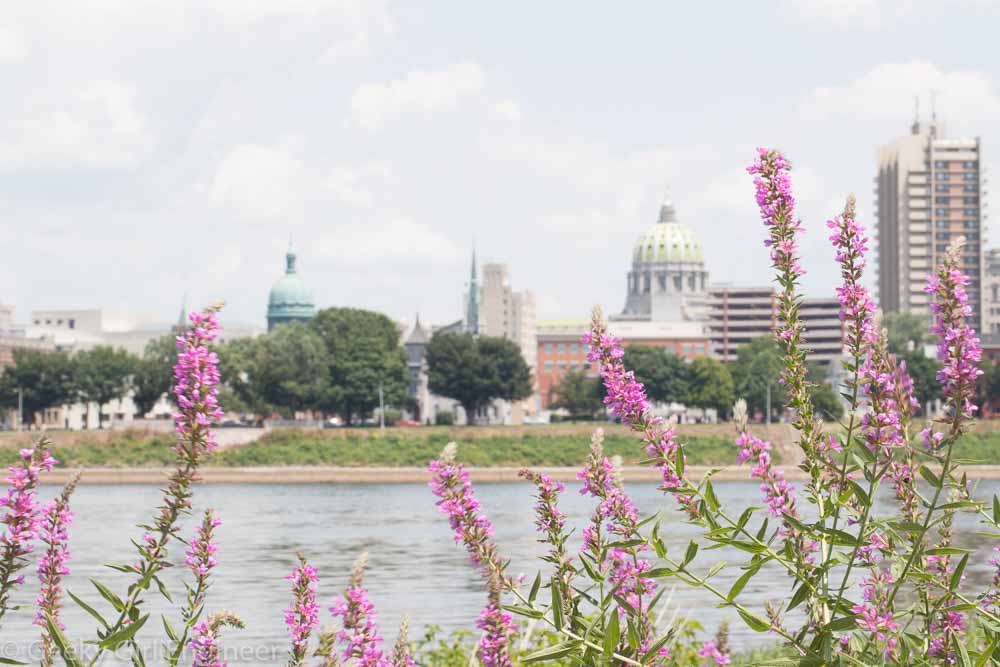
View of the state capitol and downtown from City Island
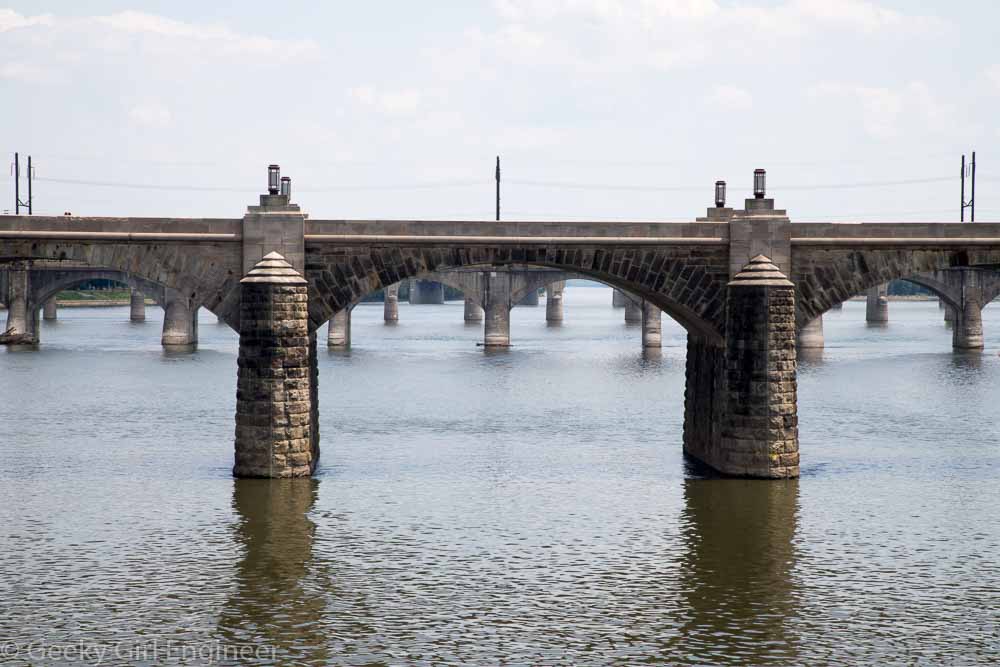
Market Street Bridge with more southern bridges in the background
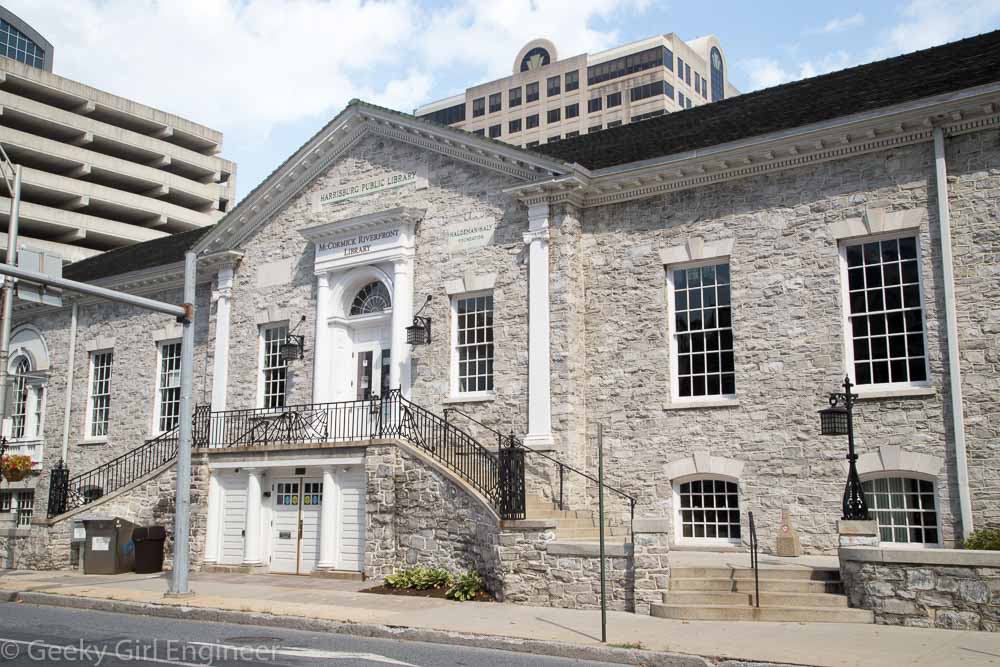
McCormick Riverfront Library, Founded in 1889 as The Harrisburg Public Library, now part of the Dauphin County Library System
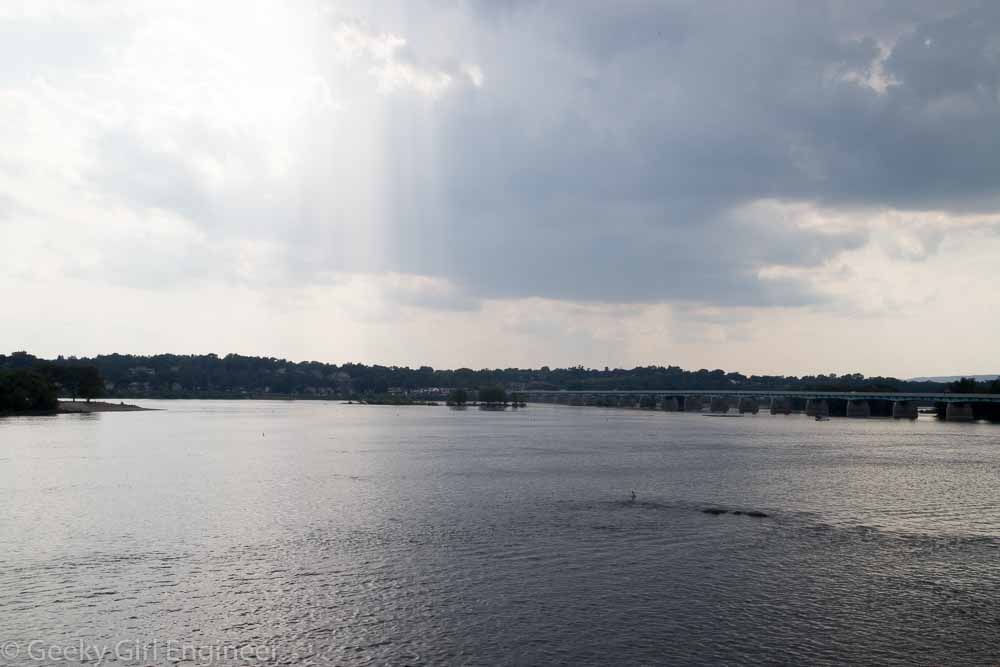
Storm approaching the Susquehanna River from the west
Riverfront buildings/houses
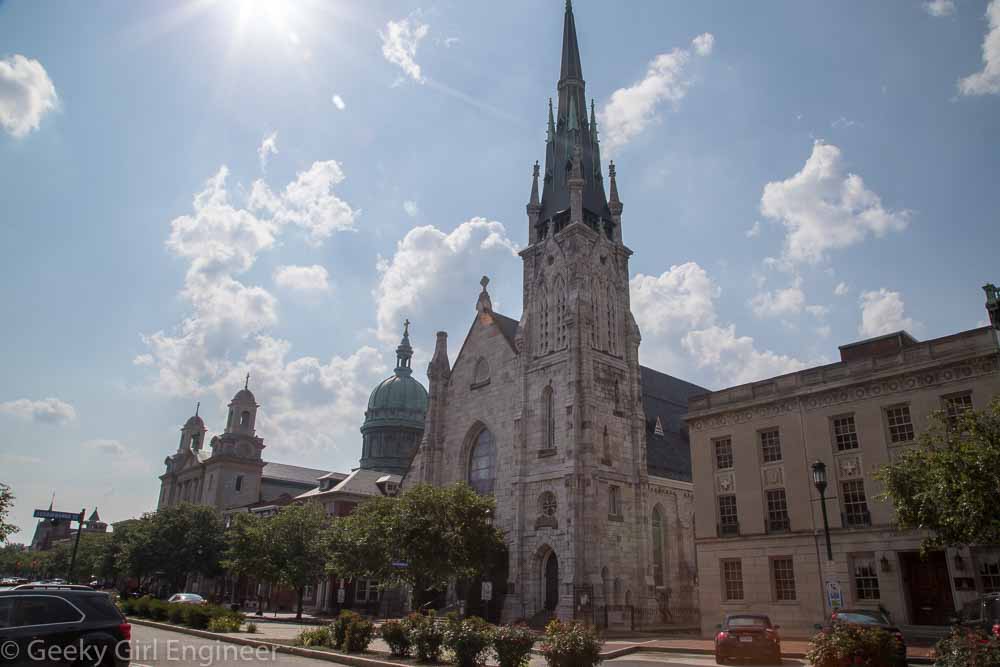
Churches line State Street, a block from the Capitol
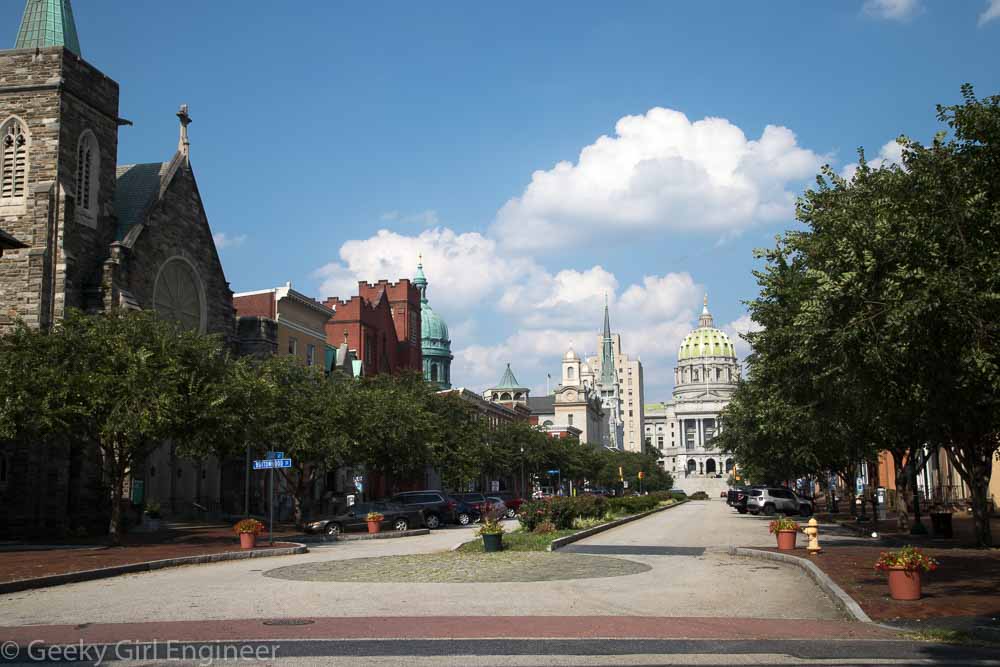
View from Front Street up State Street
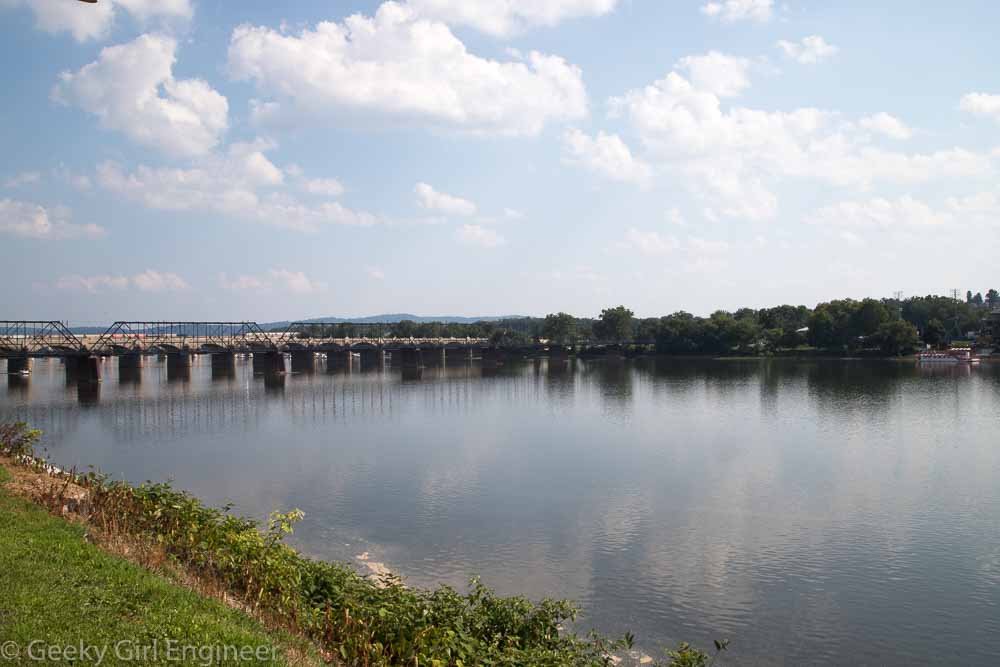
Susquehanna River with numerous bridges to the left, the first one is the Walnut Street Bridge

Pennsylvania State Capitol

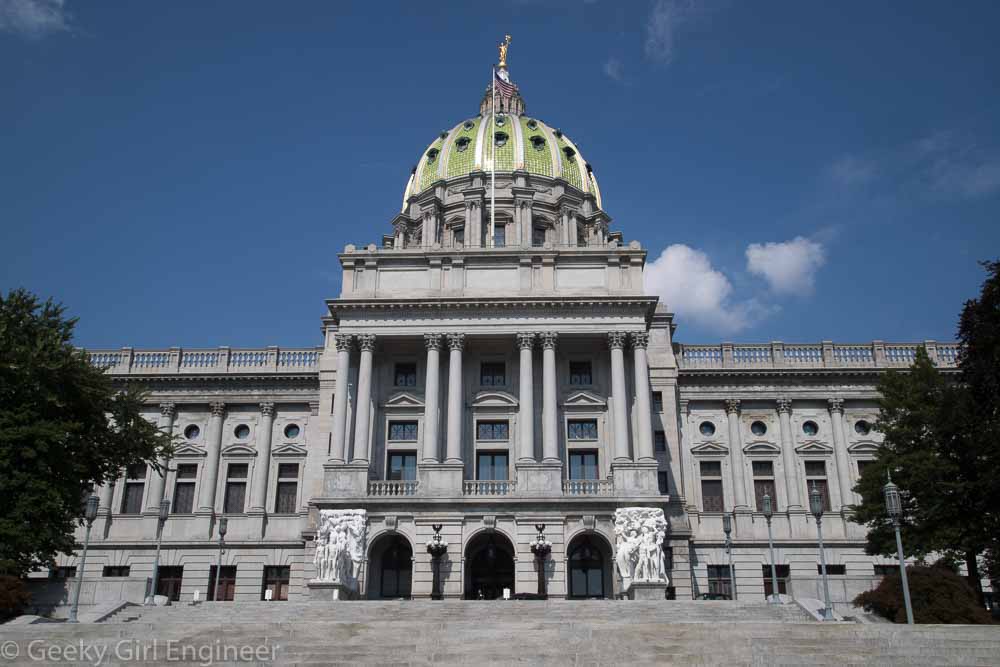
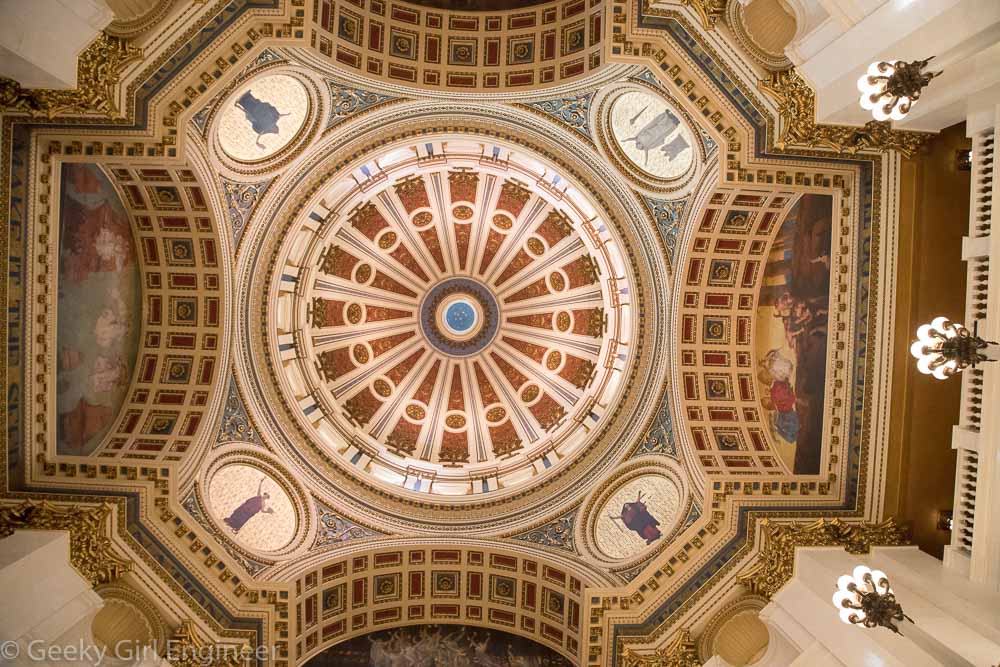
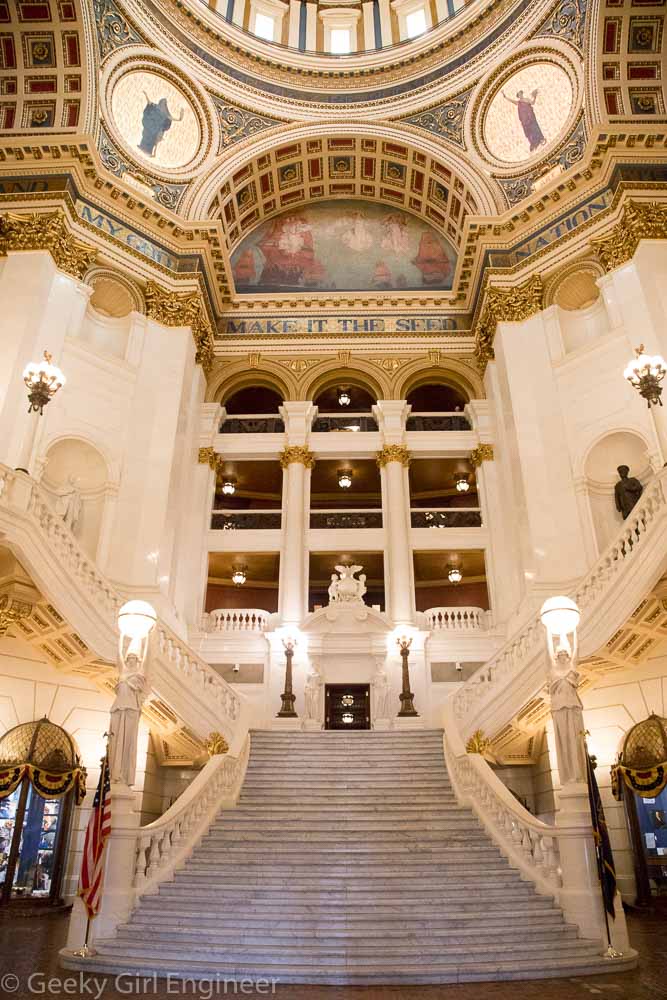
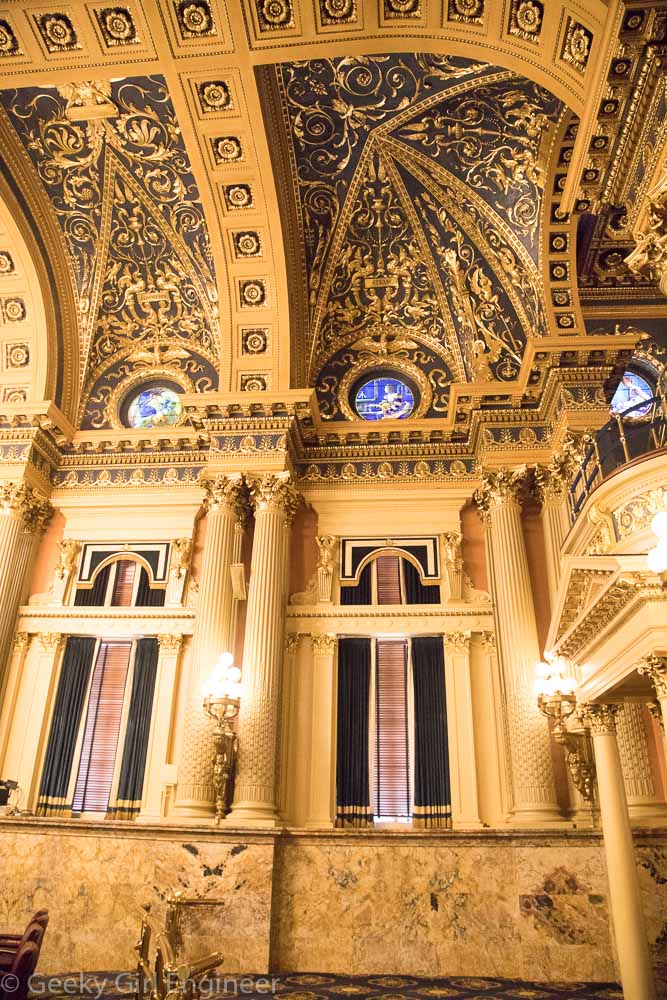
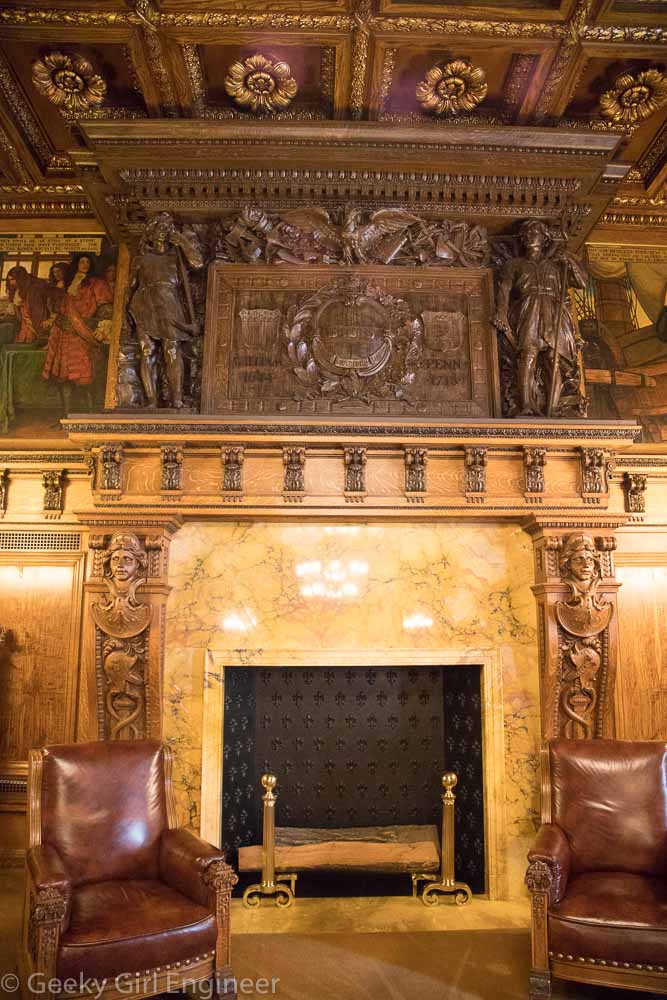
I am continuing on my quest to see all the state capitols, and today was the Pennsylvania State Capitol in Harrisburg. It is gorgeous. Harrisburg is the third city to serve as the capital, and the current capitol is the third building in Harrisburg to serve that purpose. So I guess they had several chances to get it right. When the current building was dedicated, President Theodore Roosevelt said it was”the handsomest building” he ever saw. This capitol has everything: stained glass, paintings every where, tile, columns, and gold leaf galore. The rotunda was inspired by St. Peter’s Basilica in Vatican City, and the steps and balconies with the rotunda were inspired by the Paris Opera House, so that says a lot about the design.

Front or west entrance to the capitol
View of the capitol from the east or rear entrance. The east wing is relatively new.
Ceiling of the rotunda
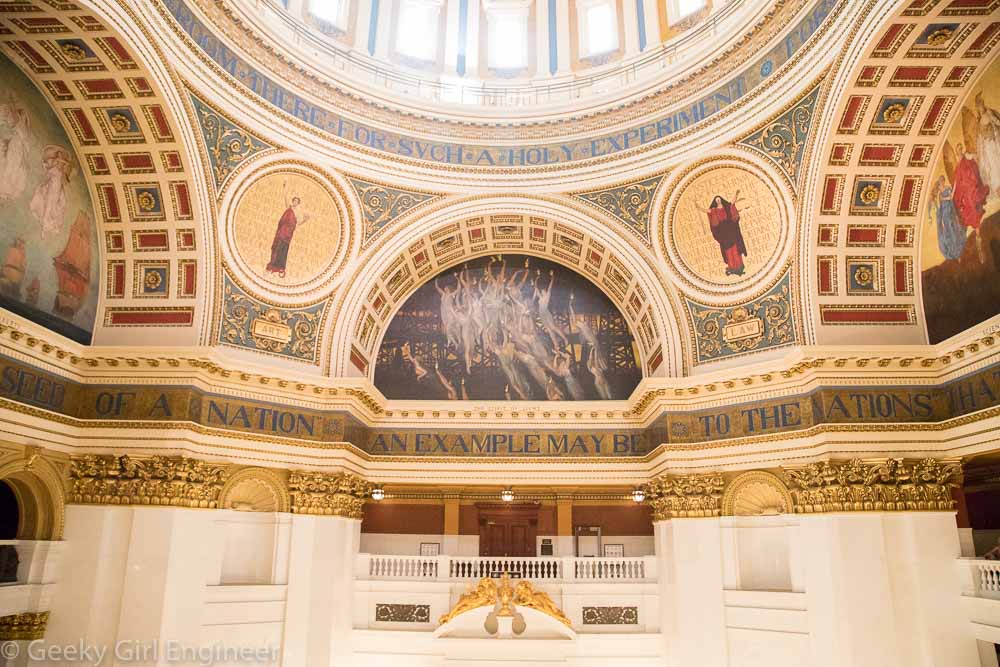
The sides of the rotunda are filled with paintings. The quote below the paintings is a mosaic.
Steps and balconies in the rotunda
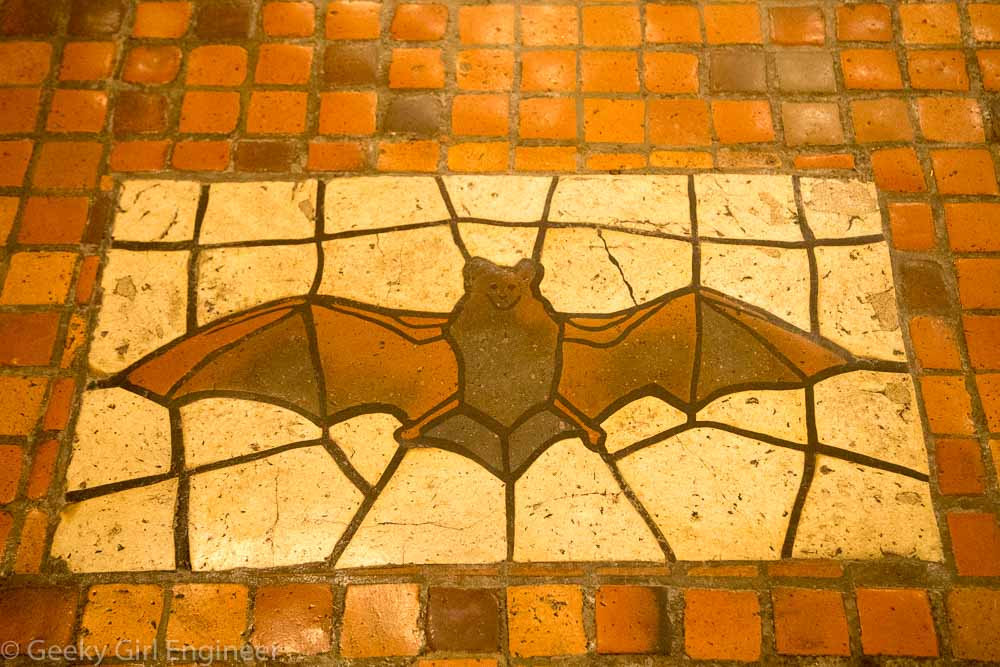
The floor of the rotunda and halls off of it are tile with many mosaics. My favorite is this happy bat.
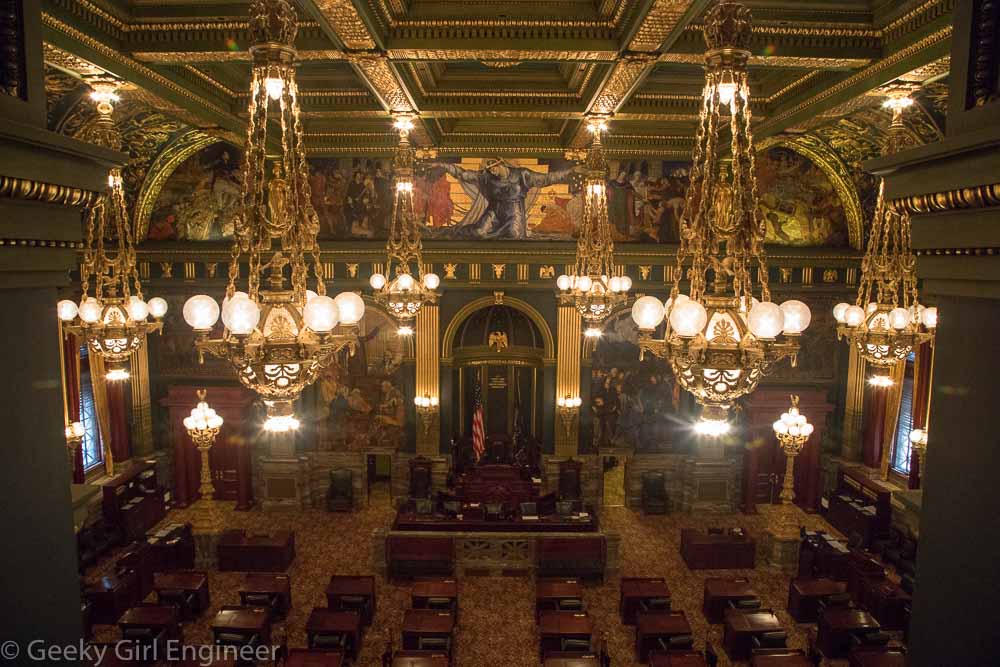
Senate chamber
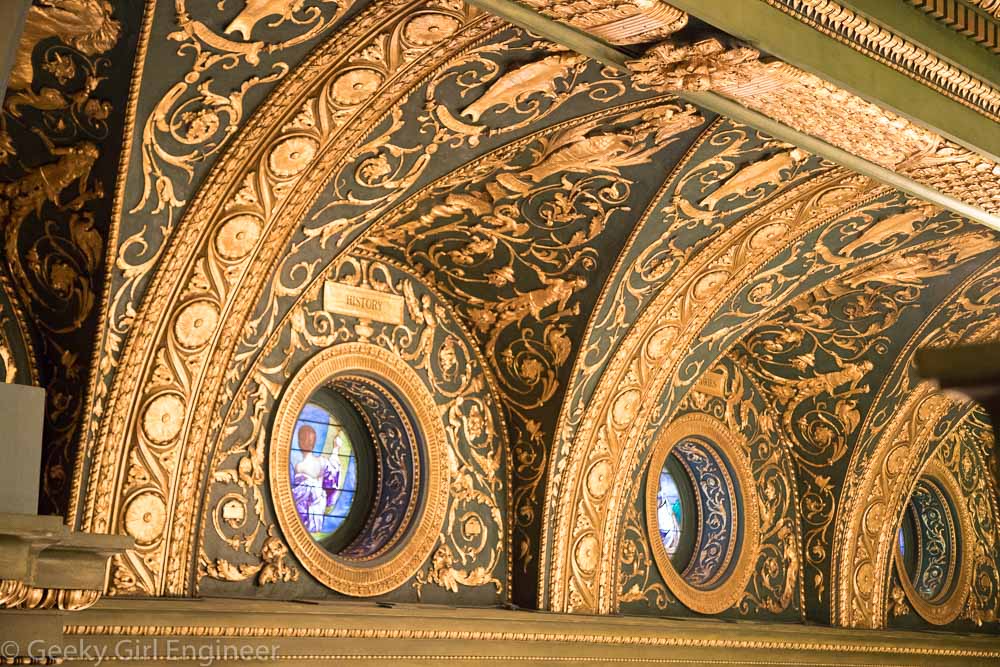
Top of walls with stained glass in the Senate chamber.
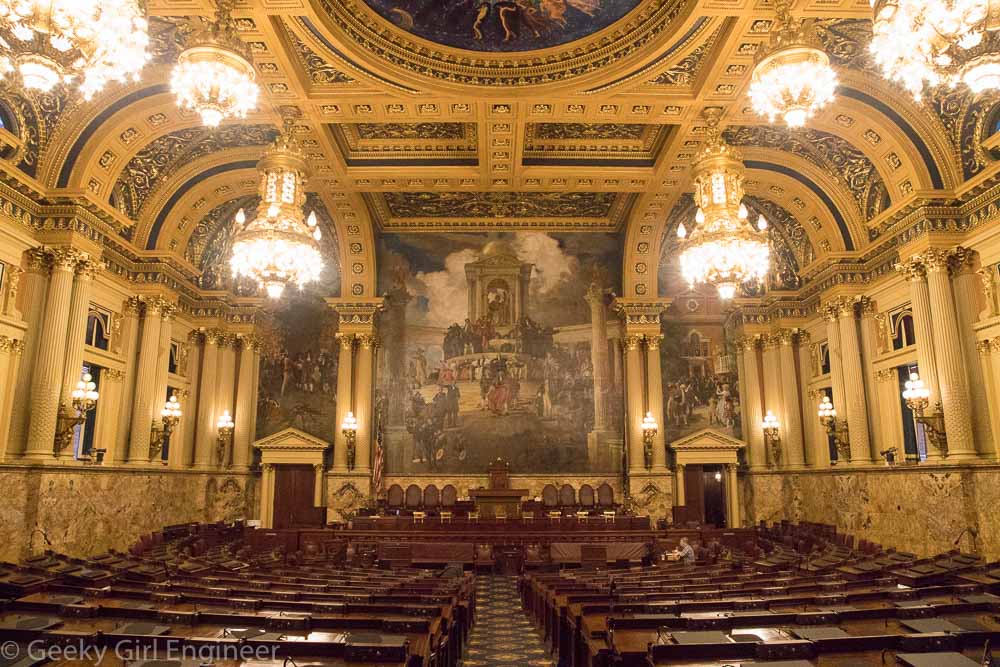
House of Representatives chamber
Wall of House of Representatives
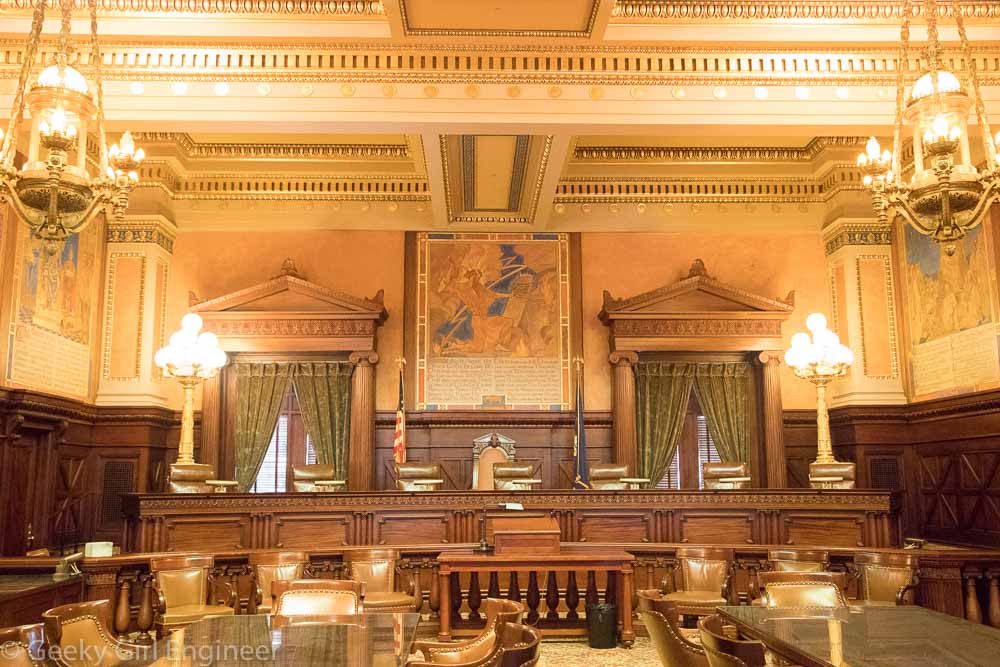
Supreme Court chamber
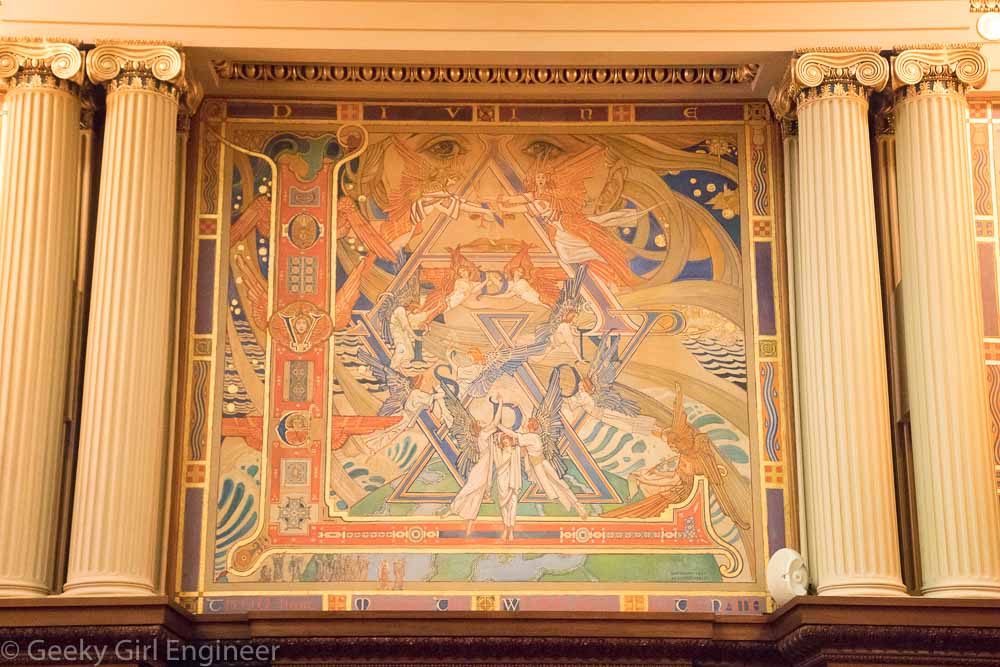
Painting in the Supreme Court chamber. It says “Love, Law, and Wisdom”.
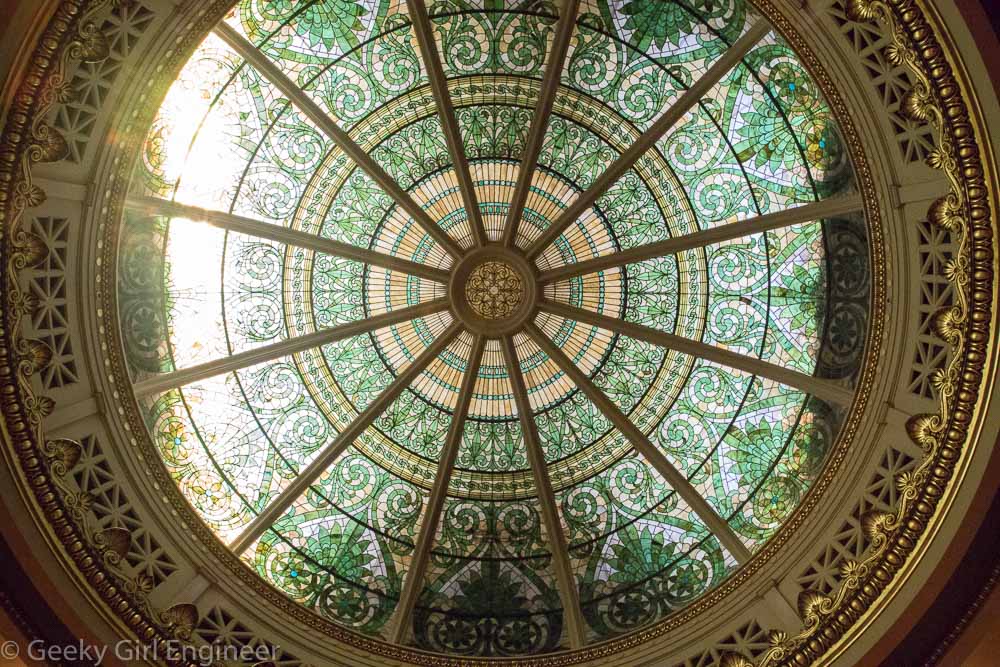
Stained glass ceiling of the Supreme Court chamber
Governor’s reception room
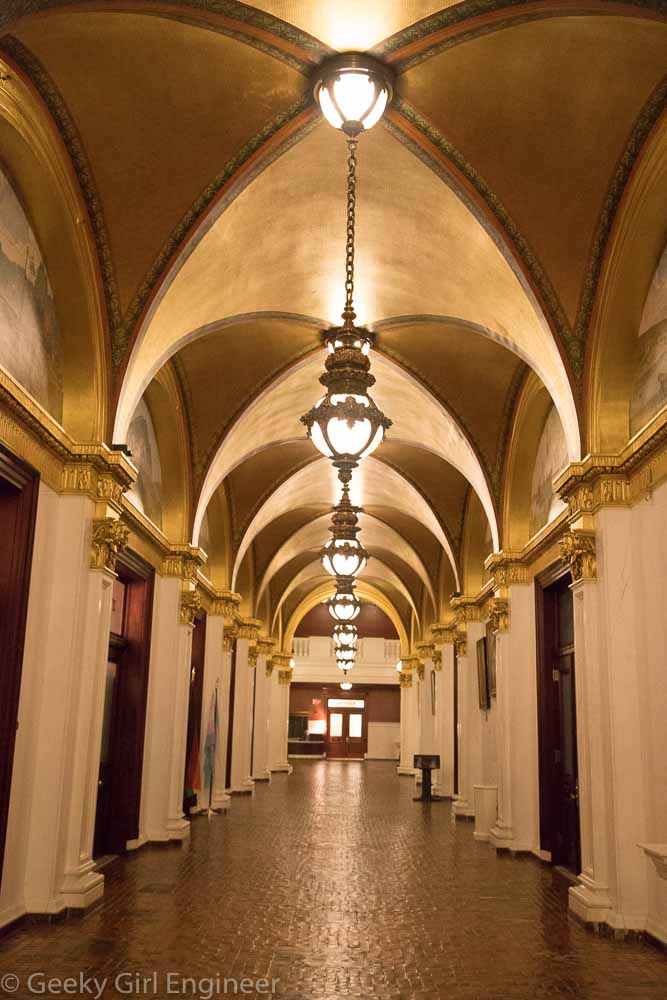
Hallway from the rotunda to the Senate chamber
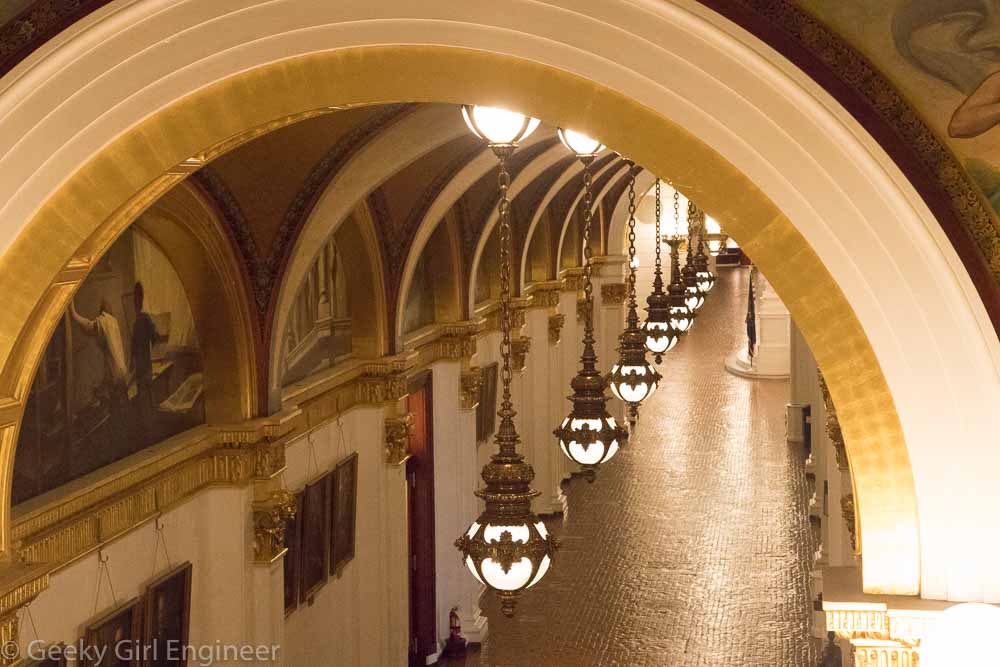
Hallway from the House of Representatives to the rotunda

Ferdinand: In Memoriam

A week ago I put my buddy, my bubba, my very good boy Ferdinand the basset hound to sleep. He had developed a large mast cell tumor several months ago. A surgeon removed it, and he thought he got clean margins. Two months later, I was rubbing Ferdinand’s belly, and I found several more tumors. They were really large considering it had only been two months. Ferdinand was about 14 years old, and I was not going to put him through chemotherapy. [He was a rescue, and I can’t be sure of his age, but I had him for about 11 years.] I decided that putting him through more surgery was just going to prolong his problems, and I made the decision to put him to sleep. I know it was the right decision, but it was still very difficult. He was my buddy, and I didn’t want to lose him, but I had to let him go. So a few photos to remember my buddy and the wonderful times we had together.
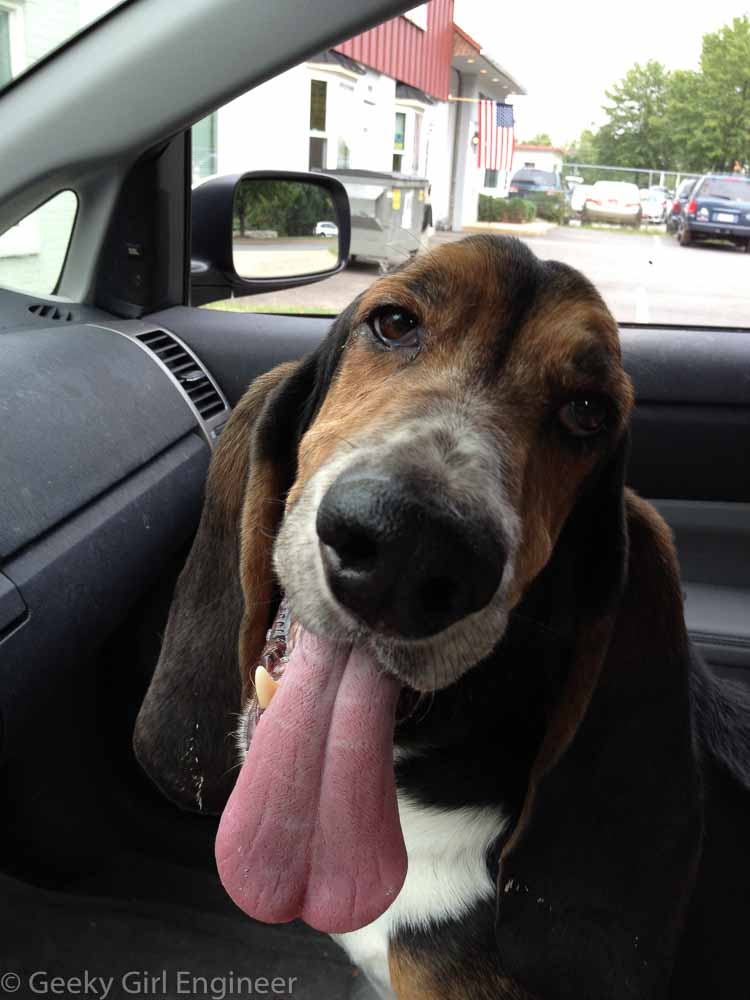
This is probably one of my favorite photos of him.
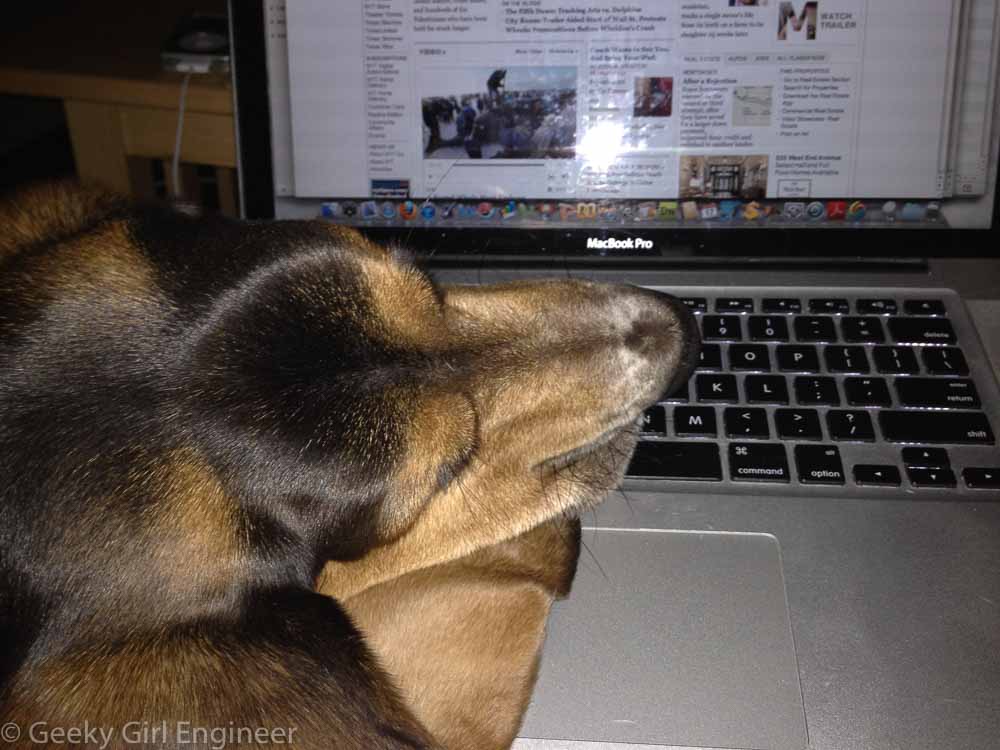
He didn’t like my laptop because he liked to have his head on my lap.
Putting up with me giving him a hat.
Look at those ears fly!
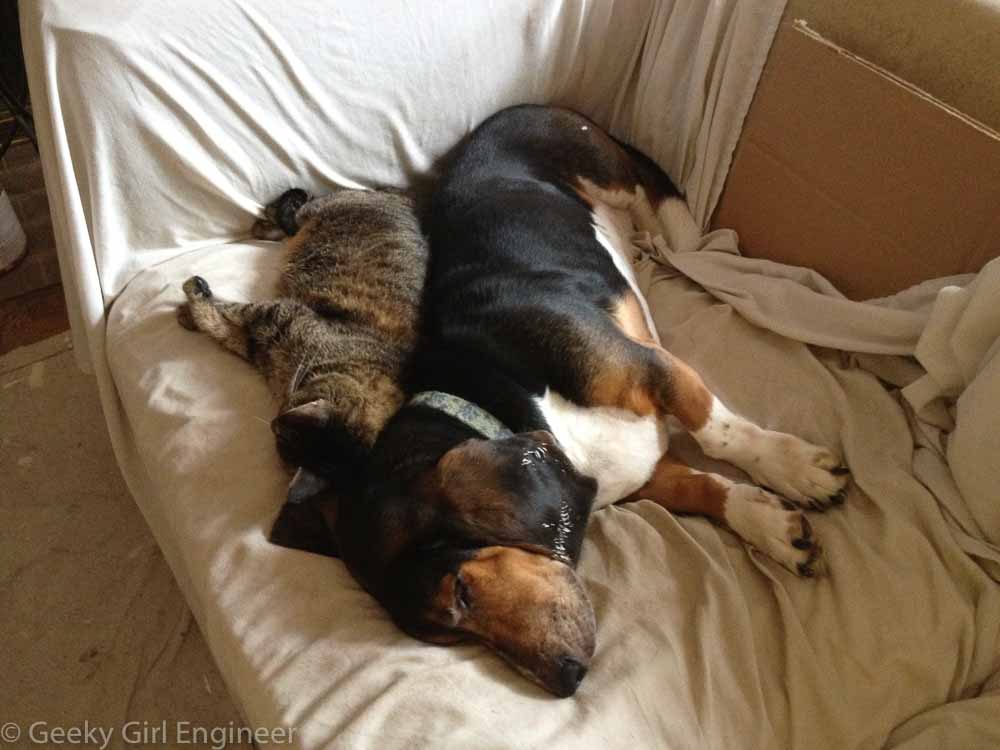
With his sleeping buddy Puck the cat.
My copilot.
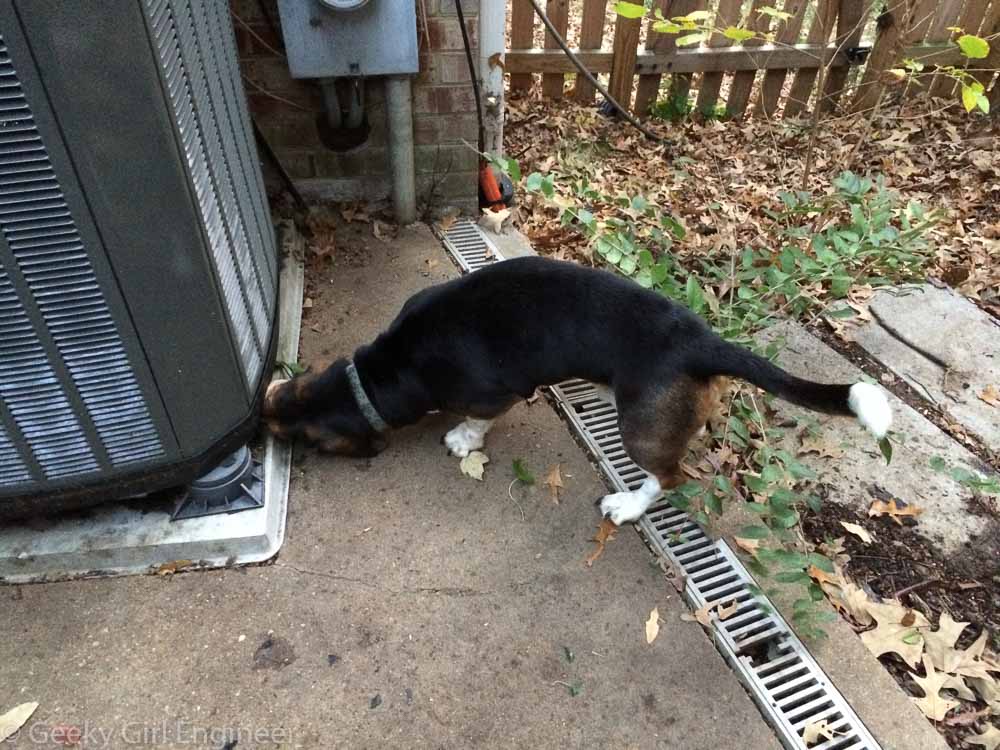
Desperately trying to reach the rodent under the HVAC.
Leaping through the snow.
Sleeping with Puck’s foot on his snout.

Ferdinand was the subject of many of my blog posts because well, he was a great subject.

Sleeping while I photograph his face with a new camera lens

In the snow

More snow

And his more natural state of being: sleeping outside

Historic Don Jail

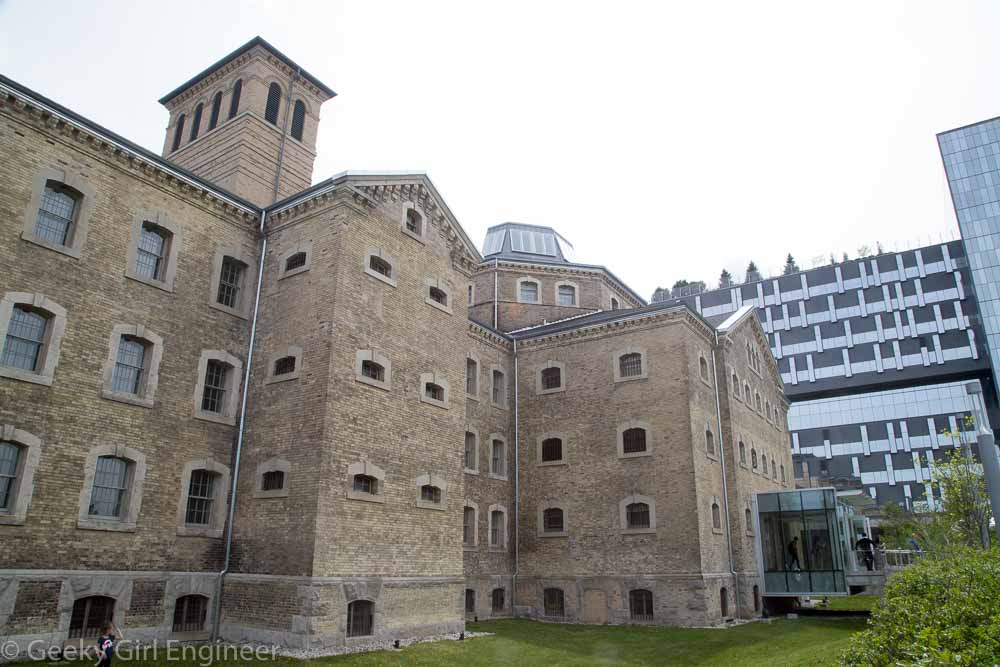
One of the buildings open for Doors Open Toronto was the historic Don Jail, which now houses Bridgepoint Active Healthcare Administration Building. The jail was built between 1800-1866 and closed in 1977. I have not toured that many old jails, but this building has ornamentation that I honestly did not think would ever be in a jail. It was built as a reform jail, and evidently sunlight was part of that idea. The cells, or at least the doorways I could see, were still pretty darn tiny though. Architecturally, it is something to behold.

After it closed, the jail evidently sat unused for a while because really, what do you do with an old jail? Bridgepoint purchased it to turn it into an administrative building next to their hospital. They preserved its historic elements. It does seem like some of the offices must be nice, but I can’t imagine working in an old jail no matter how many fresh coats of paint are put on it. There is even a closed off area, which was open for photos, where the gallows were. The are offices across the hall for the gallows room. I really don’t think I could work on that hallway.

Historic Don Jail exterior
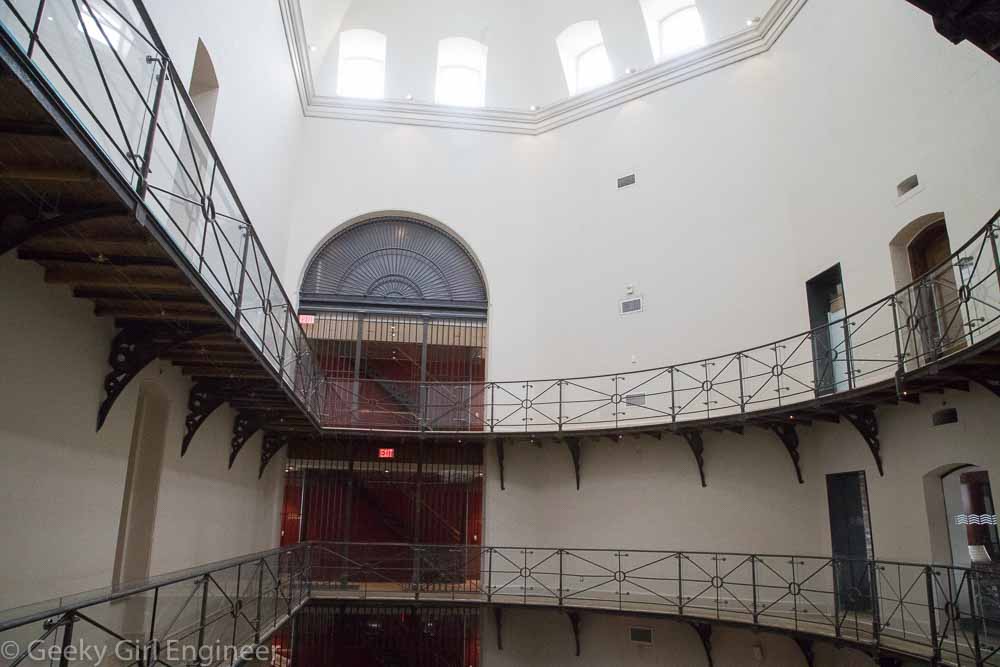
Atrium which is shaped as half an octagon.
Atrium view from second floor
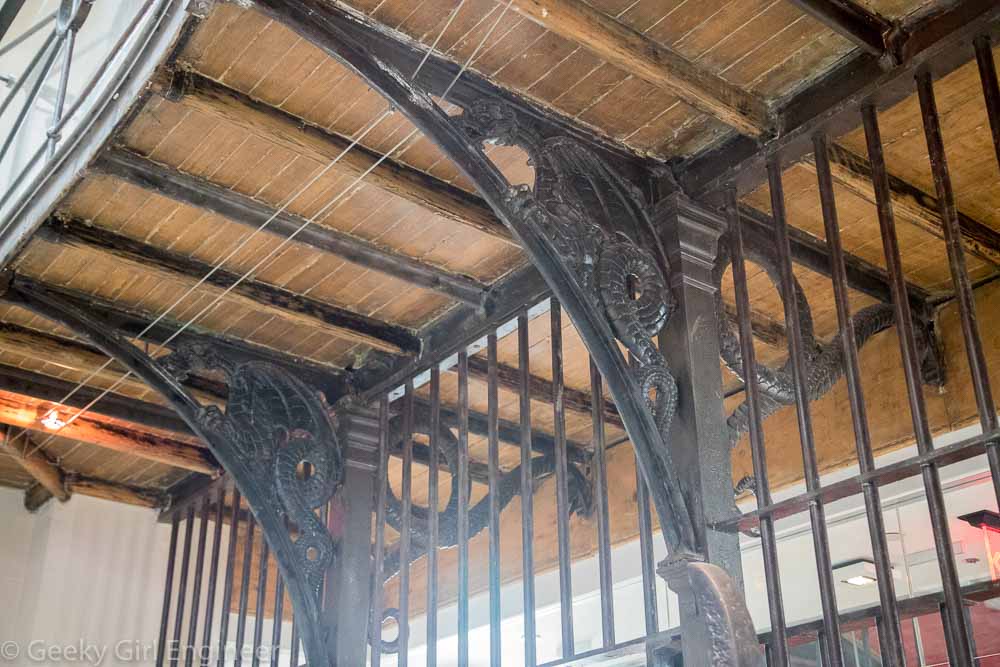
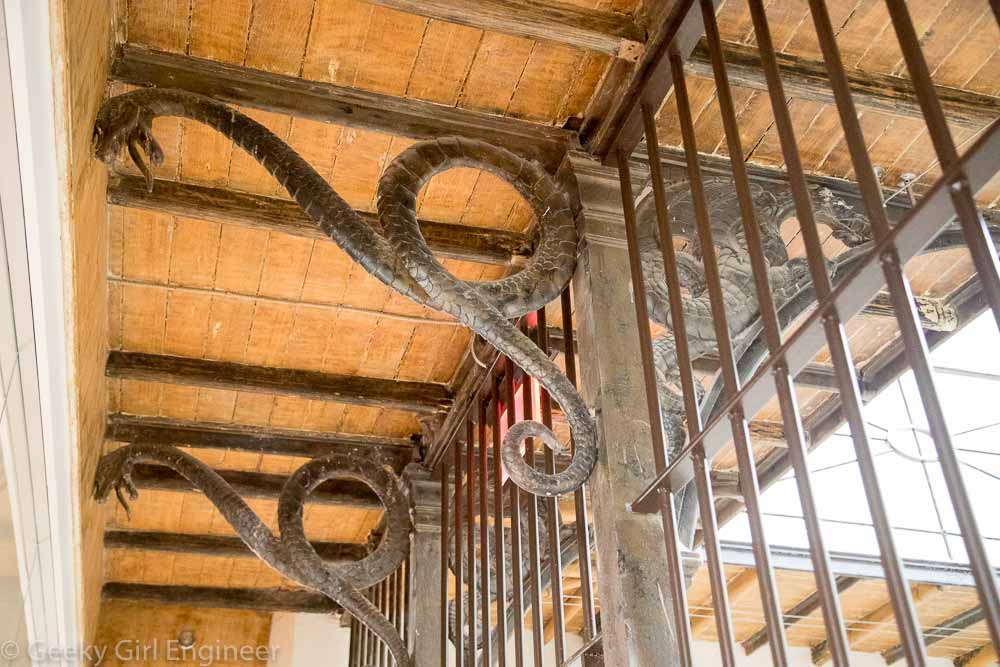
The atrium balconies are help up by really ornate brackets shaped like dangerous animals like servants and dragons
A better view of the dragon brackets supporting the balconies
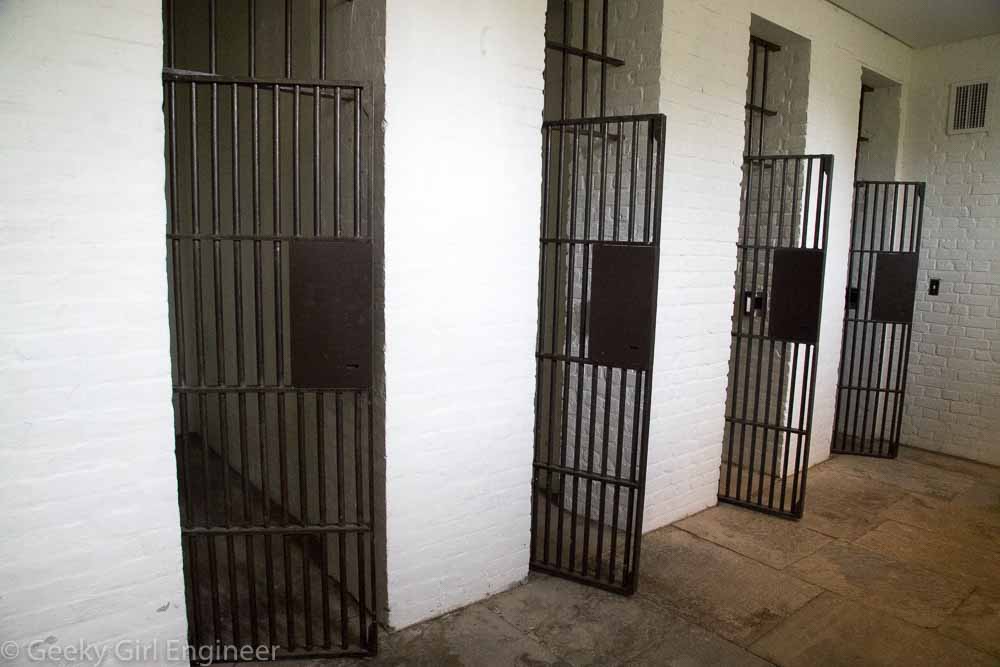
Isolation cells for punishment were about a cot’s width
Cells that have been turned into offices
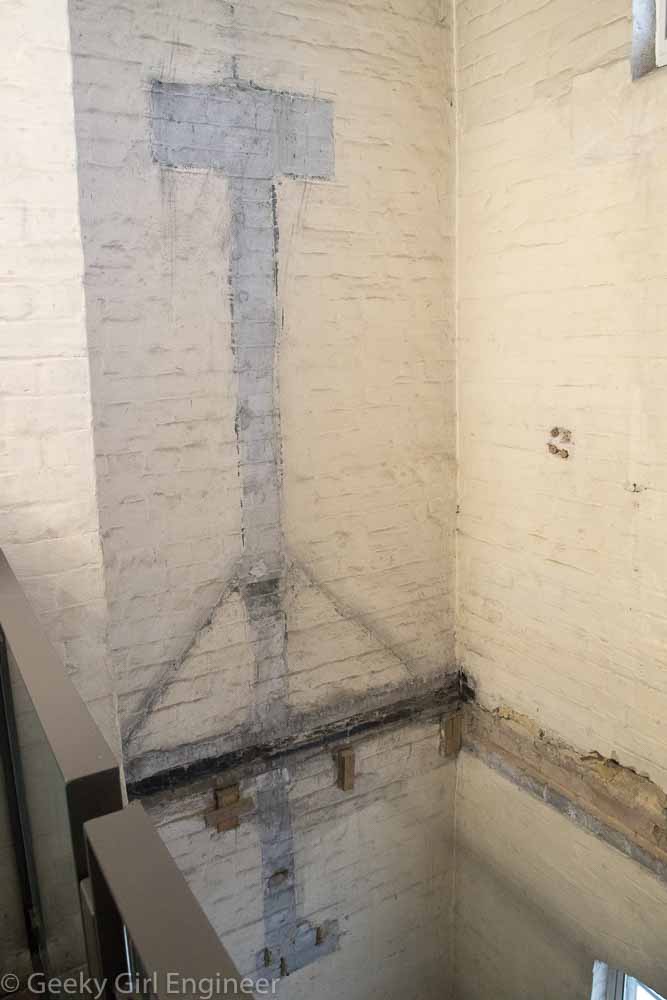
Gallows area. The outline of where the wood gallows were was left visible.

F.J. Horgan Water Treatment Plant

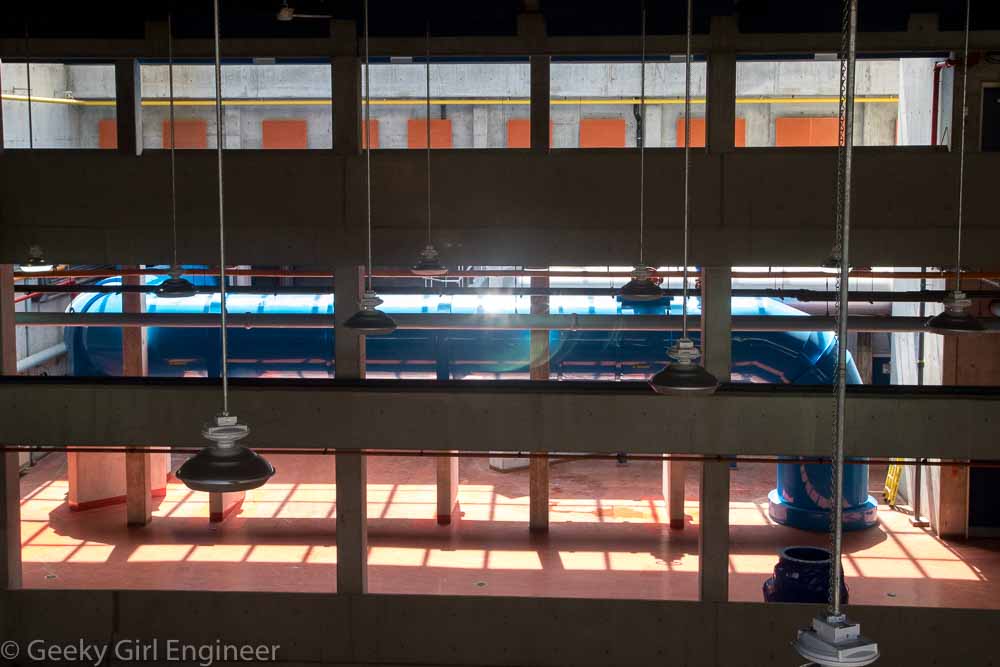
The F.J. Horgan Water Treatment Plant was one of my top two reasons for coming to Doors Open Toronto. Sadly, no wastewater treatment plants were open for the event, as I find them more interesting than water treatment plants. However, water treatment plants are still interesting. This plant was even more interesting than I initially thought it would be because I am fairly this is the first water treatment plant I have been to where they use ozone for the initial disinfectant. This is the second water treatment plant I have visited in Toronto. The first Doors Open Toronto I came to, I visited the absolutely magnificent R.C. Harris Water Treatment Plant. F.J. Horgan Water Treatment Plant is not as beautiful, but it is interesting none the less.

The plant’s water intake is from pipes in Lake Ontario over 2 km from shore. It is then pumped to the plant and then up from the pipes which are (I think) nine stories below the surface. The plant sits on cliffs high above the water surface. Ozone is added to the water. Ozone disinfects the water. The ozone is made at the treatment plant from liquid oxygen. Before the water leaves the tanks where is contacts ozone, sodium bisulfite is added to remove any left over ozone.

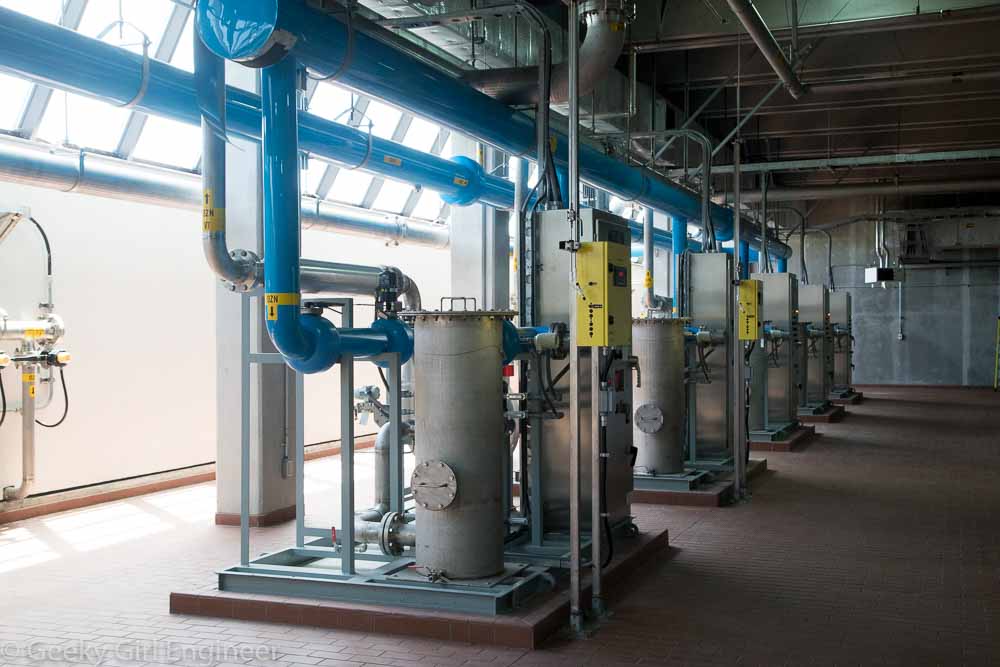
Ozone generation unit from liquid oxygen and electricity
Ozone is piped to water contact units

Coagulant is then added to the water. Coagulant causes certain ions and tiny particles to start to come together to make bigger particles, which are easier to filter out. The water is pumped to sediment filters. The filters have a lower sand layer topped with a carbon layer. The filter tanks are huge, but so are the pipes in the building.

Gigantic water pipe conveying water (I think) to the filter tanks
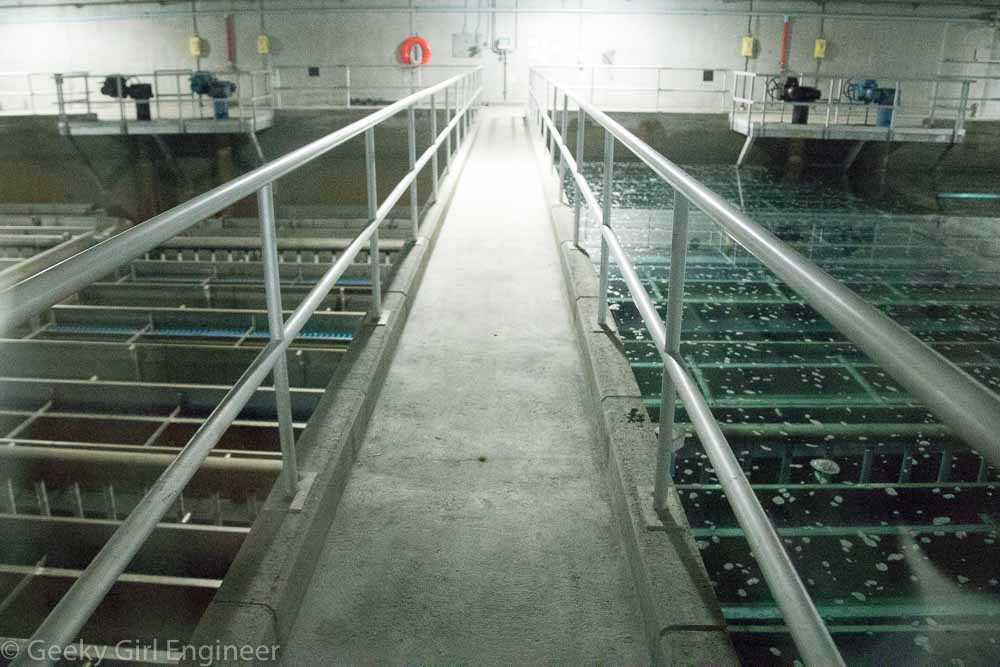
This is a horrible photo because is taken through glass with wire lining, but that is water in the filter tanks. The filters are at the bottom, and I think blue plastic thing is the trough where the backwash goes when the unit is backwashed.
Another horrible photo taken through glass, but on the left side is an empty filter tank, and on the right side is a filter tank with water.
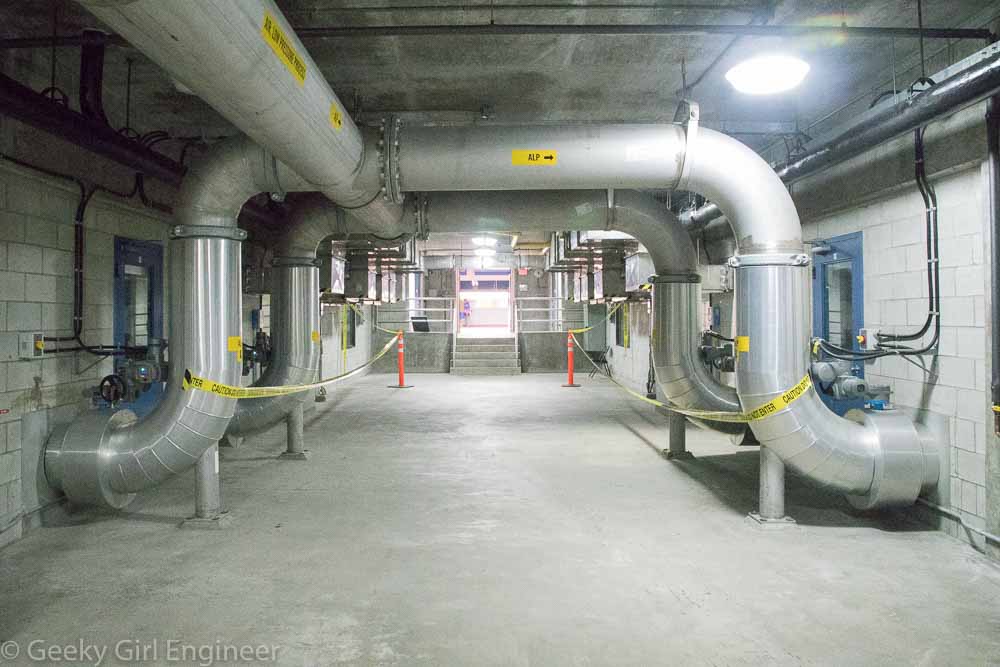
Low pressure air pipes in the filtration gallery
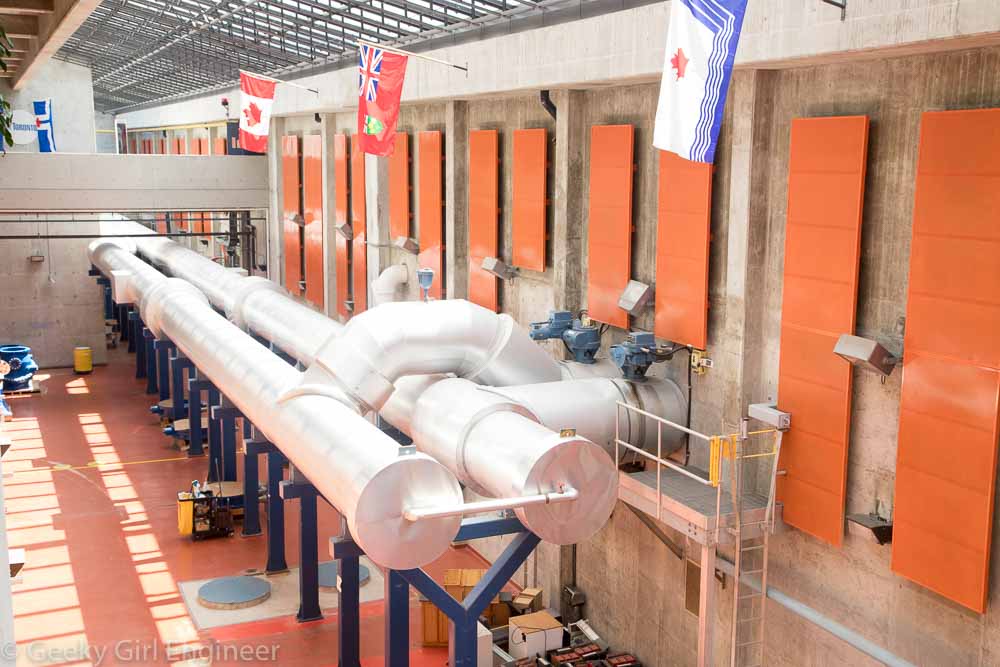
Gigantic air pipes running through the main part of the building

After the water has been cleaned, chlorine is added. The water has already been disinfected at this point, but a residual disinfectant is needed to kill any bacteria the water may encounter in the distribution system on its way to customers.

Bay Lower Subway Station

Another site I visited with Doors Open Toronto was an abandoned subway station. When the Bay Subway Station was built, there was an upper and lower level. According to the Doors Open Toronto website “When Line 2 officially opened in 1966, Bay Lower was in full use. Alternate trains used the Wye connection, which allowed customers to travel from Line 1 to Line 2 without changing trains. The TTC tested this system for six months and also tested the two separate subway lines for six months. Following testing, the TTC decided that two trains worked best and Bay Lower was closed.” If like me, you do not live in Toronto, that means very little or nothing. Having studied the Toronto subway map for a little bit of time, I think I now understands what it means, but to be perfectly honest, it sounds like it was a dumb idea from the start. Yes, yes, hindsight is 20/20, but it just seems overly complicated, and I know how long it took me just to understand New York City’s local versus express lines, so this seems like it might have made things easier for some but confused the heck out of others. It also sounds like something that carried not insignificant risks for train operation and train traffic control.

The lower level was not used for very long, but it has been used ever since by TTC for testing and training. It has also been used by the television and movie industry quite a bit for shooting scenes. The signs they had displayed seem to indicate that it has been a stand in for many U.S. city subway lines. Ever since I visited the lower level, I have been trying to think how many U.S. cities actually have a subway, as in trains that run underground. There are not that many, and furthermore, not many look like this station. Then again, the movie industry may not always care about things like that. But I digress.

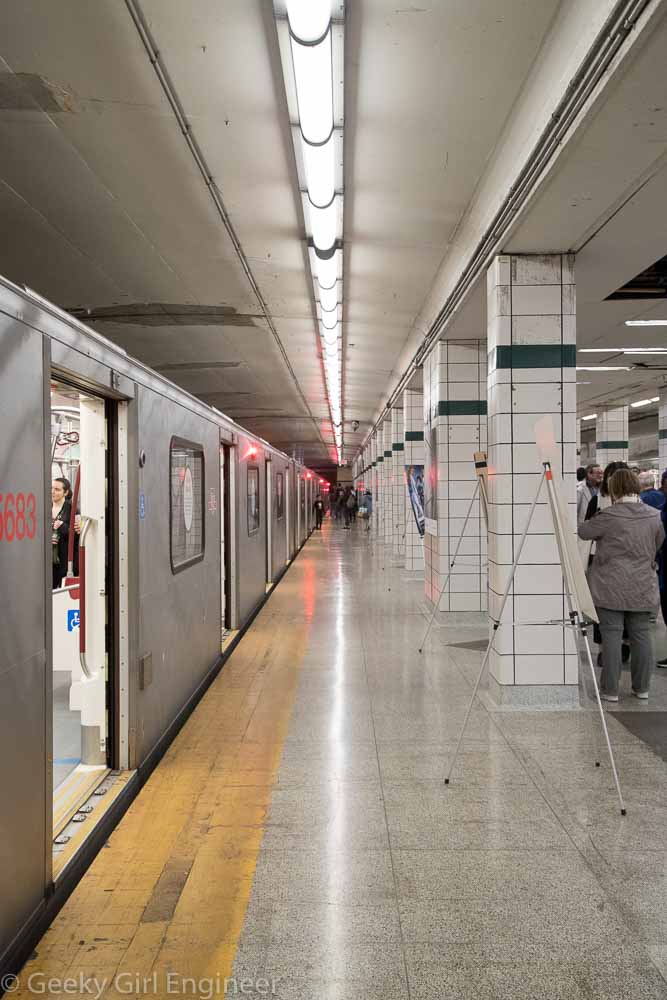
In any event, it was kind of neat to walk around the platform. They had a train on either track with all doors open, so you could walk around the trains. They also let people visit the conductor’s seat/booth/area/I don’t what it is called. Today I learned, when given the opportunity to visit this area, people both young and old, really, really, really like to honk the horn. How the employees watching everything were not developing headaches from the horns constantly going off in the confined station where the noise really bounces around, I have no idea.

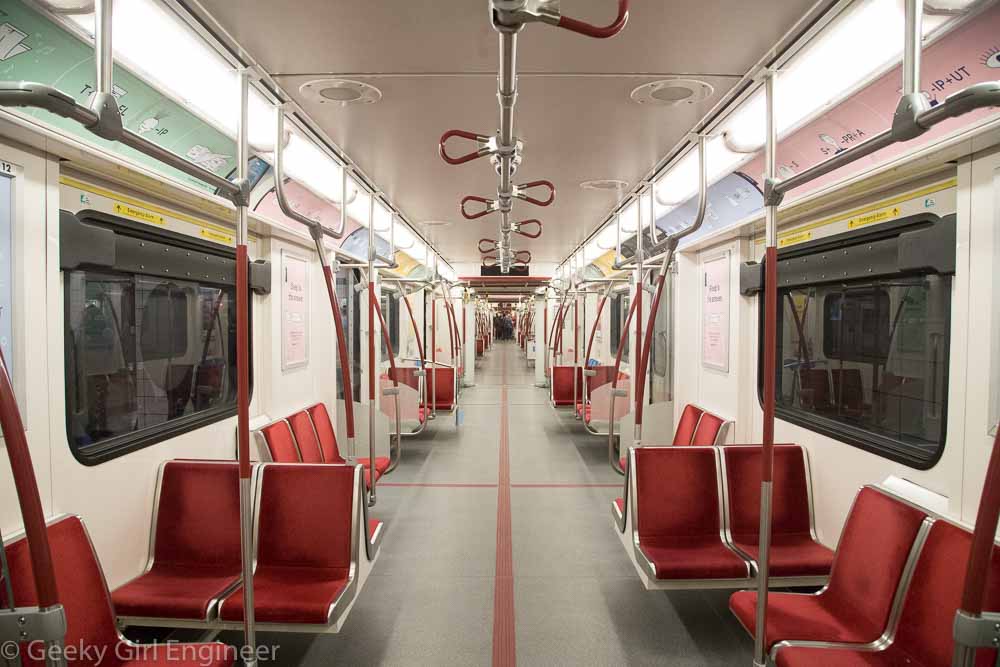
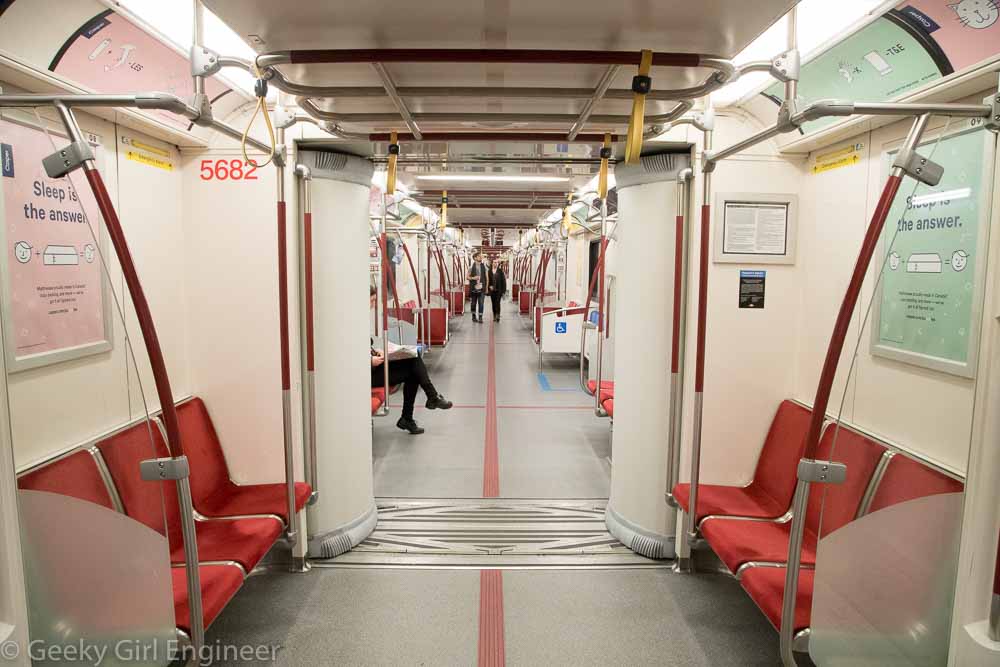
One final observation. I am rather fascinated by Toronto’s subway trains because the individual cars are all connected into one true train where you can walk very easily between all the cars. I don’t how many other systems have cars like this, but I was fascinated by it. I am most familiar with the Washington, D.C. and New York City subway systems where walking between cars requires going outside and is rather frowned upon or difficult. It would seem likely this would make it rather difficult for trains to be taken apart should only one or two cars need service, but I am not sure how often cars are taken apart and reconfigured on other systems where visually at least, it would appear to be easier.

Bay Lower Subway Station
One of the trains at the Bay Lower Subway Station. You can easily walk the entire length of the train.
One of the trains at the Bay Lower Subway Station. In the foreground is where two cars are joined, and you can walk in between.
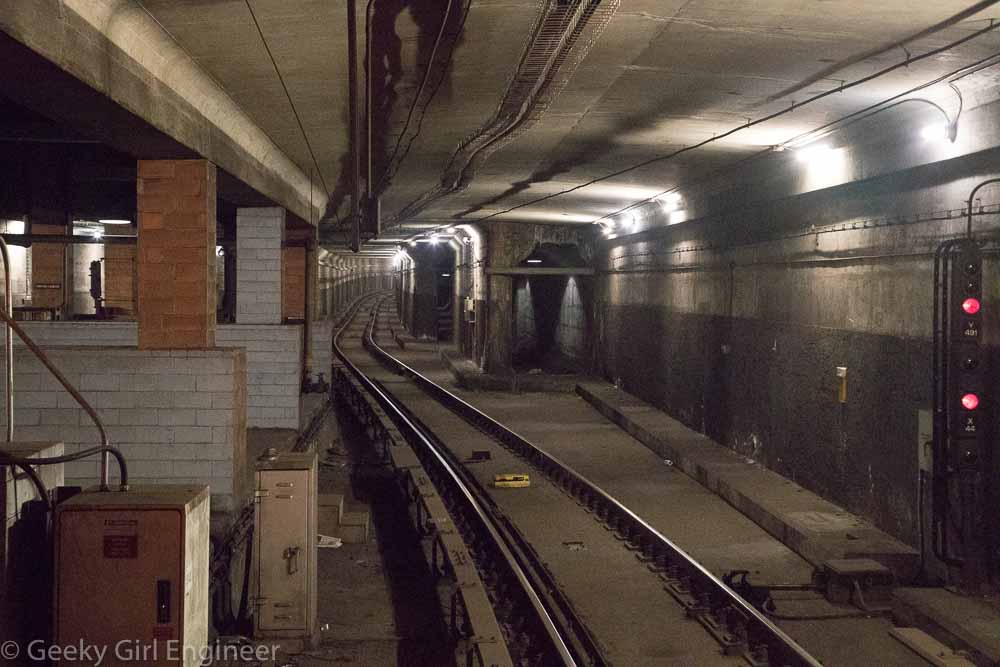
View from the end of the Bay Lower Subway Station platform into the tunnel.

City of Toronto Archives

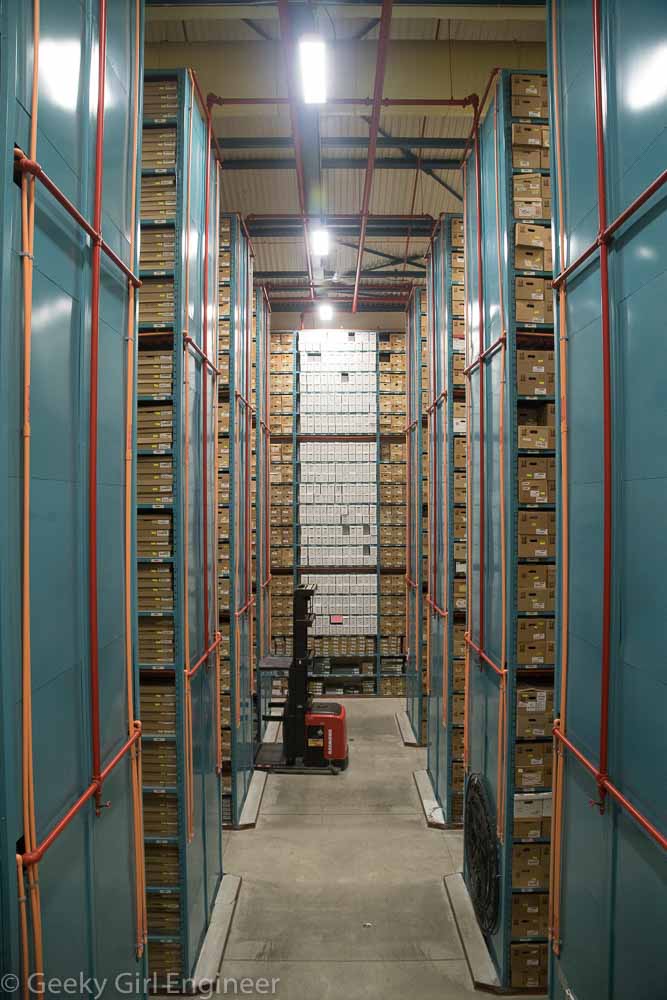
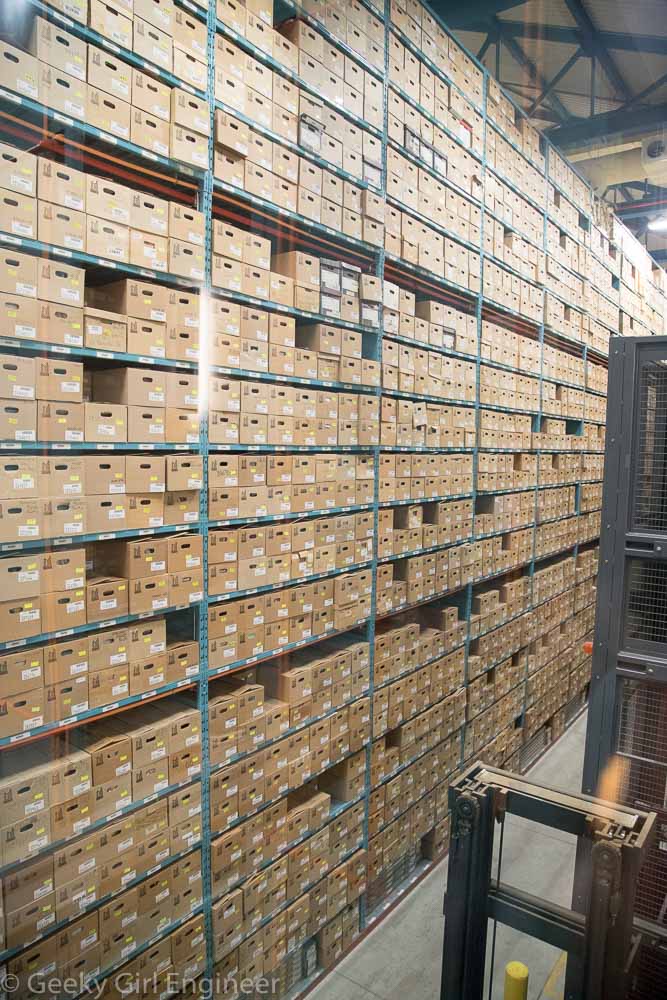
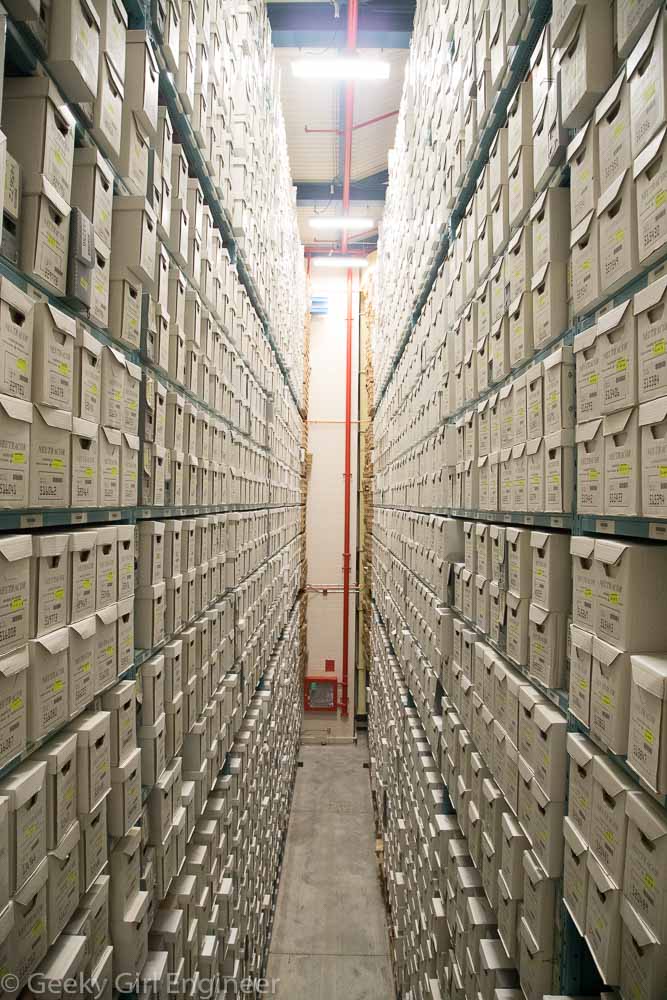
One of the places I visited for Doors Open Toronto was the City of Toronto Archives. The main reason I wanted to visit was a photo I had seen on the website, which once I got there was the viewing gallery. All the photos taken below were taken from there. It is a really neat area where you can look to see the stacks of archive boxes. Well, you can see some of the archives box because there are a LOT of archive boxes, and you can’t see them all. They are kept in a climate controlled area with fire protection. I honestly wanted to learn more about the engineering of the climate control and fire protection, but there didn’t seem to be anyway to ask.

However, while there, I ended up spending quite a bit of time looking at some photographs from their files. I also talked with man who worked with the archives about the restoration and digital scanning of archives. It was fascinating. They scan and also photograph archives depending on the piece. They also had a lot of information about vinegar syndrome, which sounds rather funny, but happens to cellulose acetate film and causes irreversible damage once it starts occurring. They keep cellulose acetate film in a freezer to try to prevent it.

City of Toronto Archives. The lift equipment in the middle is what employees use to retrieve the high boxes, which doesn’t sound the least bit scary.
City of Toronto Archives

Eglinton Maintenance and Storage Facility

I am in Toronto for Doors Open Toronto. When any city allows people to visit a rail yard or water or wastewater treatment plant, I will be there. One of the places that was on the top of my list to visit is the Eglinton Maintenance and Storage Facility. It houses the Crosstown Light Rail Vehicles where they are inspected, cleaned and maintained. It only opened in January 2019, which was evident because it is still very clean and looks barely used. It is a well designed facility that appears to have been designed with the human worker in mind.

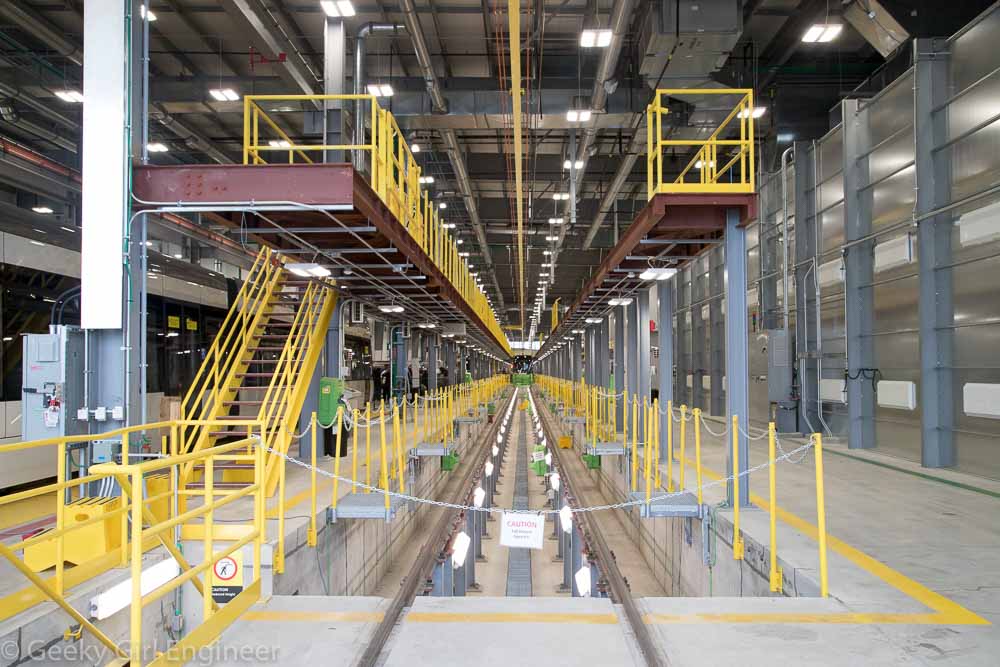
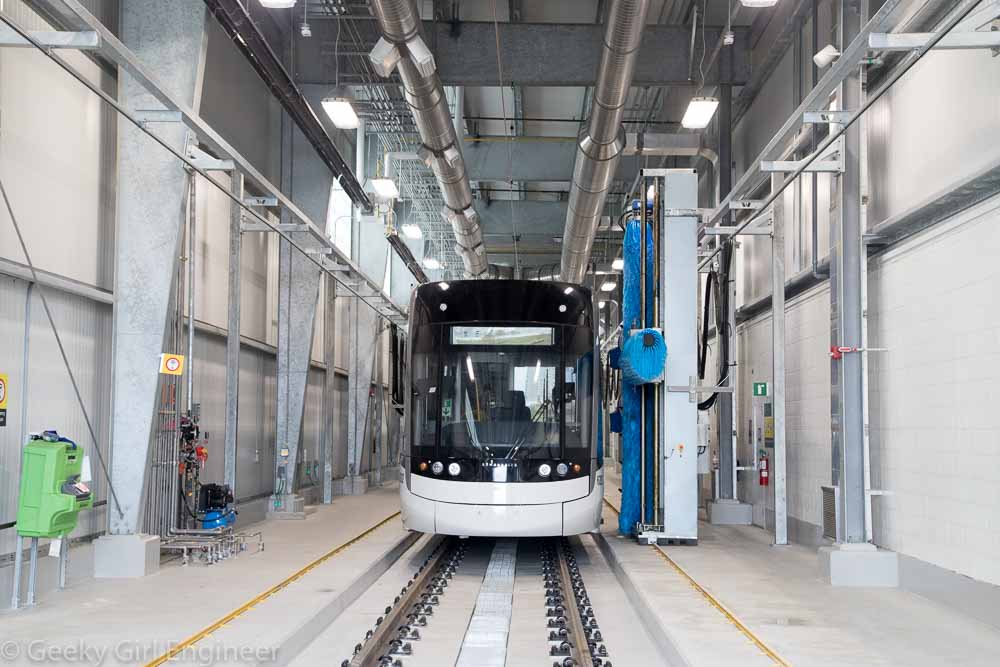
The facility has a train wash, paint booth, and numerous bay for maintenance. The maintenance areas have pit to work underneath the trains besides the platforms to work on the side or inside the trains, but it also has balconies so that the workers can get to the top of the trains.

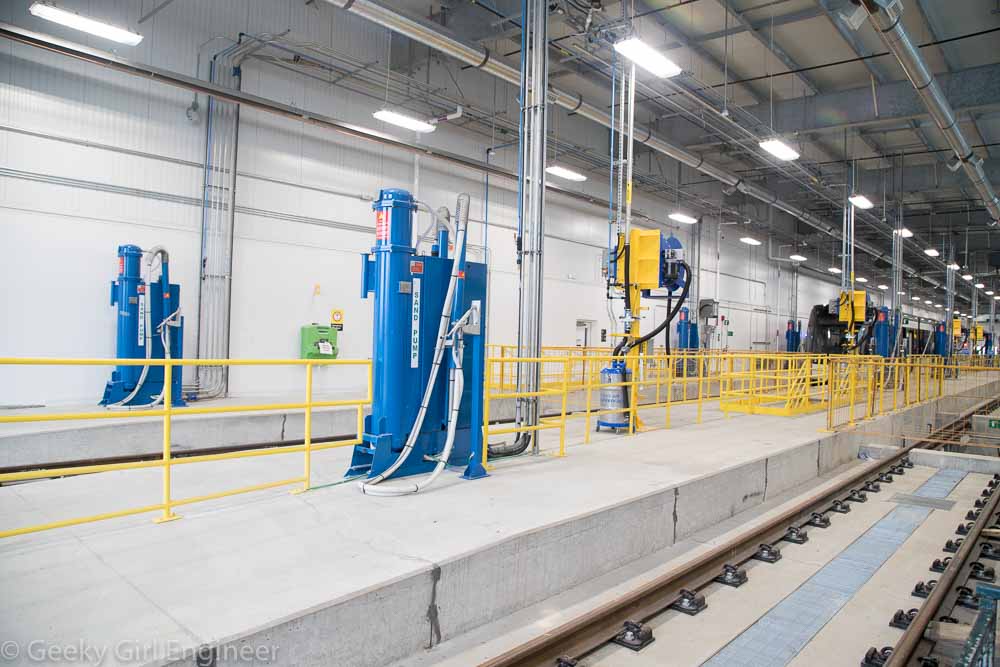
In one area, there are several sand pumps. The trains carry sand, and if the tracks are really wet or if there is snow or ice, then the driver sprays sand to increase traction on the tracks.
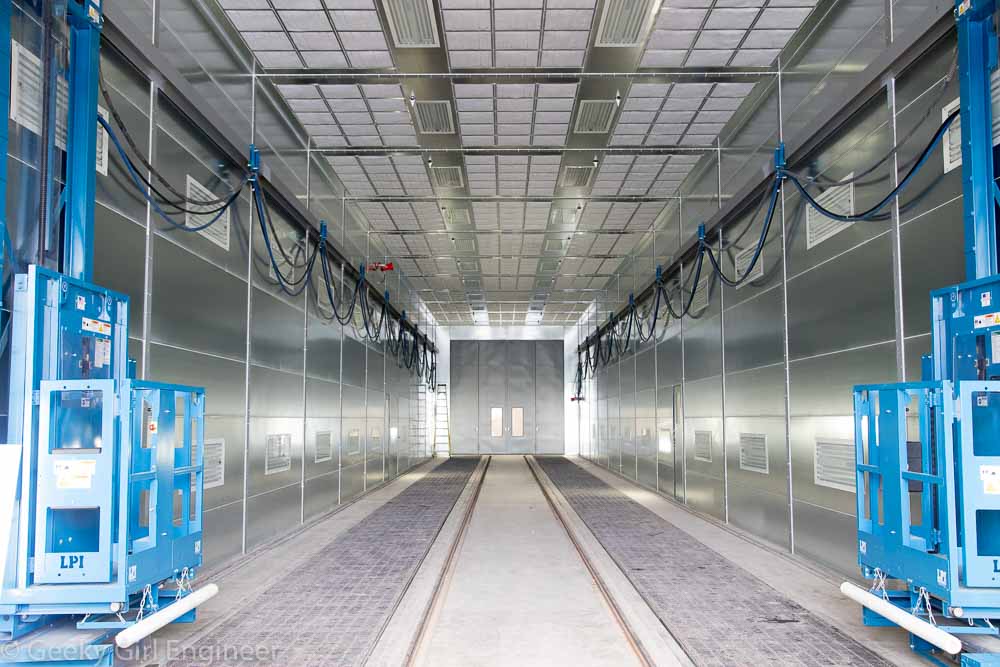
The paint booth where two workers can work, each on their own lift.
The large maintenance bay with balconies
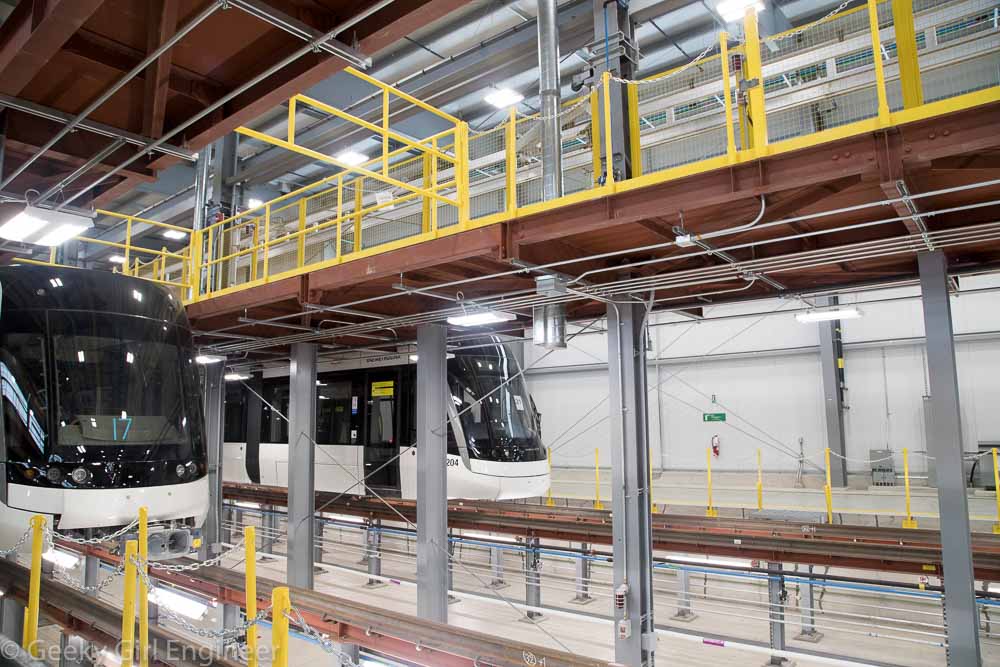
One of the trains in the maintenance bay
Trains in the maintenance bay
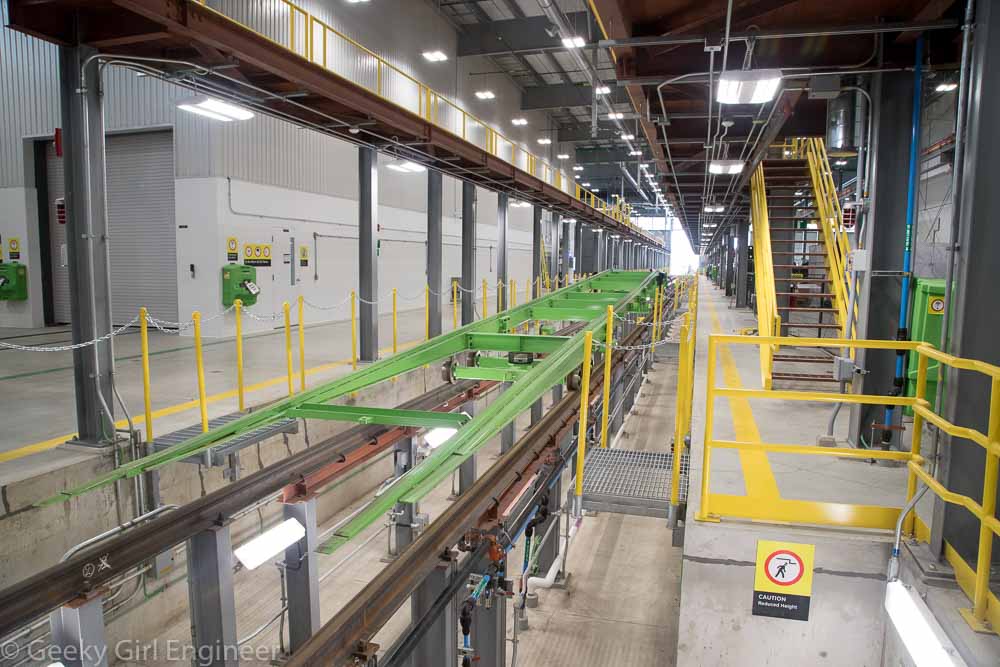
More of the maintenance bay. I did not find out what the green carriage is for.
Train wash area
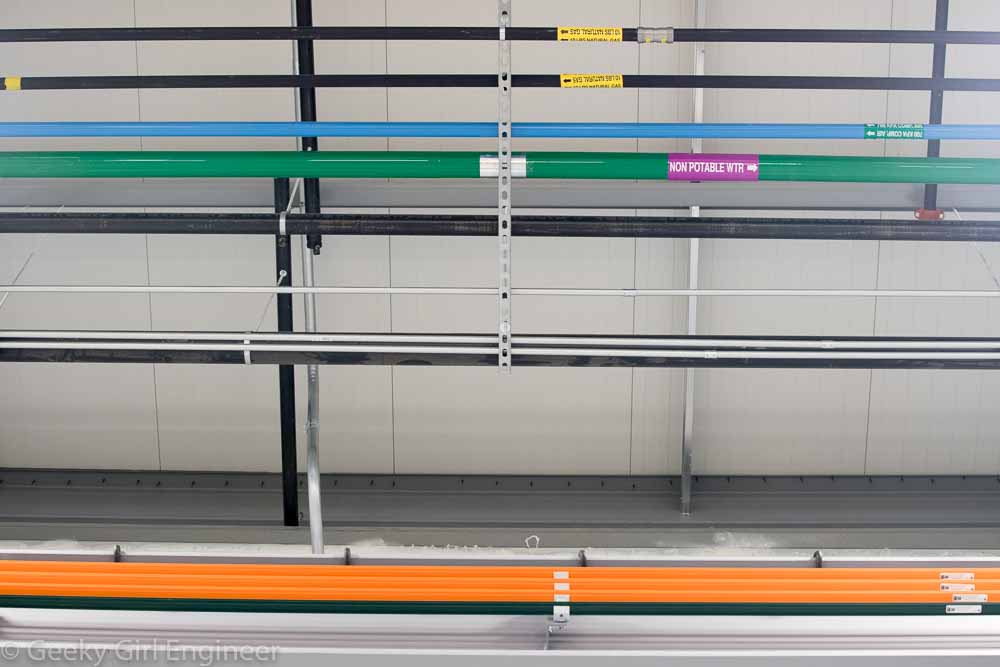
Nicely labeled and color coded pipes and conduits

Mother Clara Hale Bus Depot

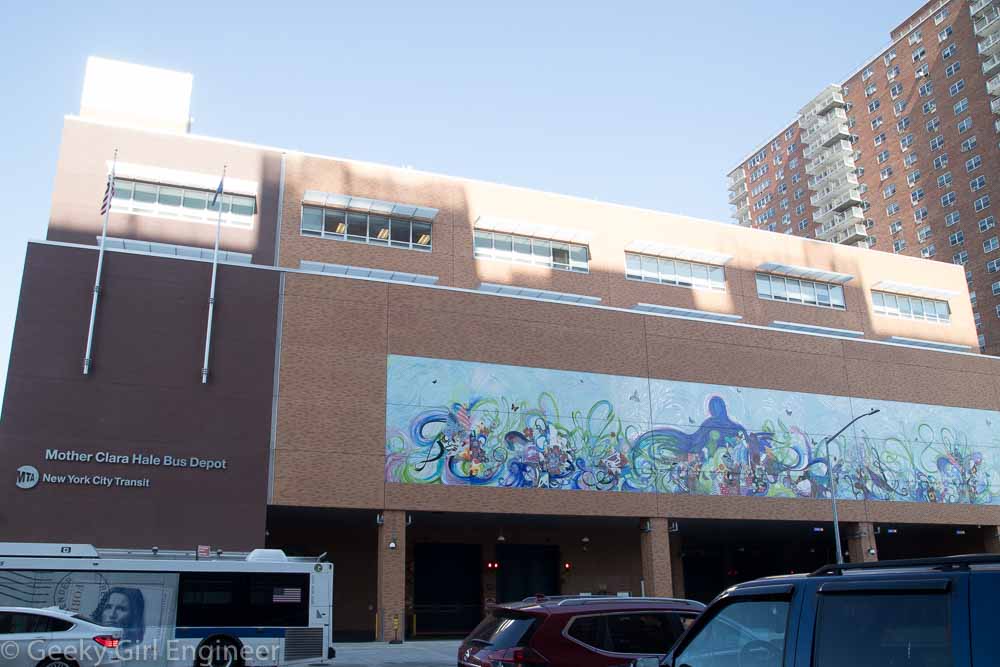
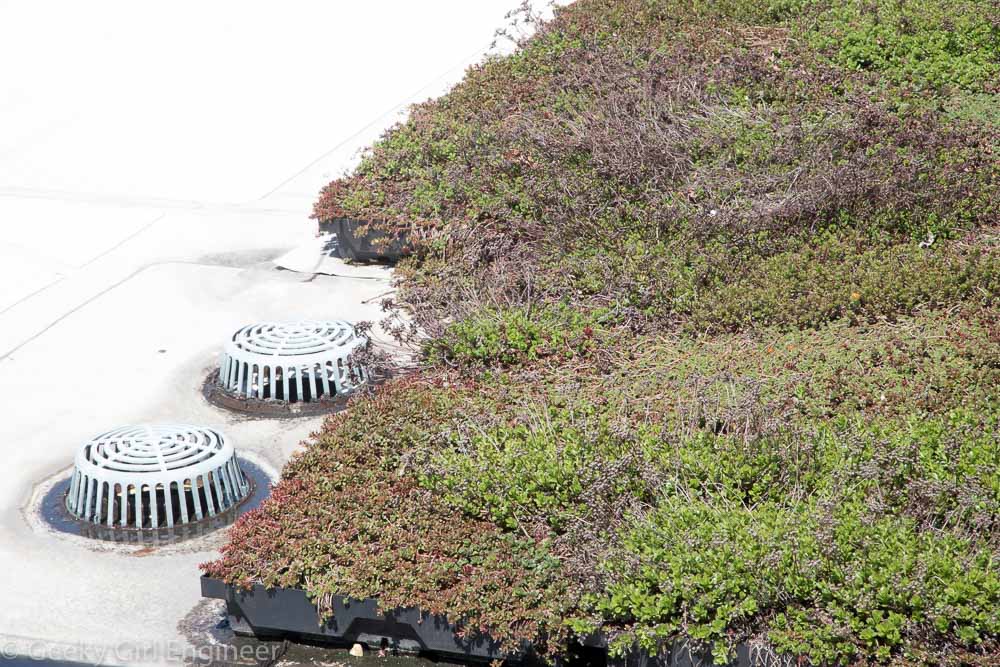
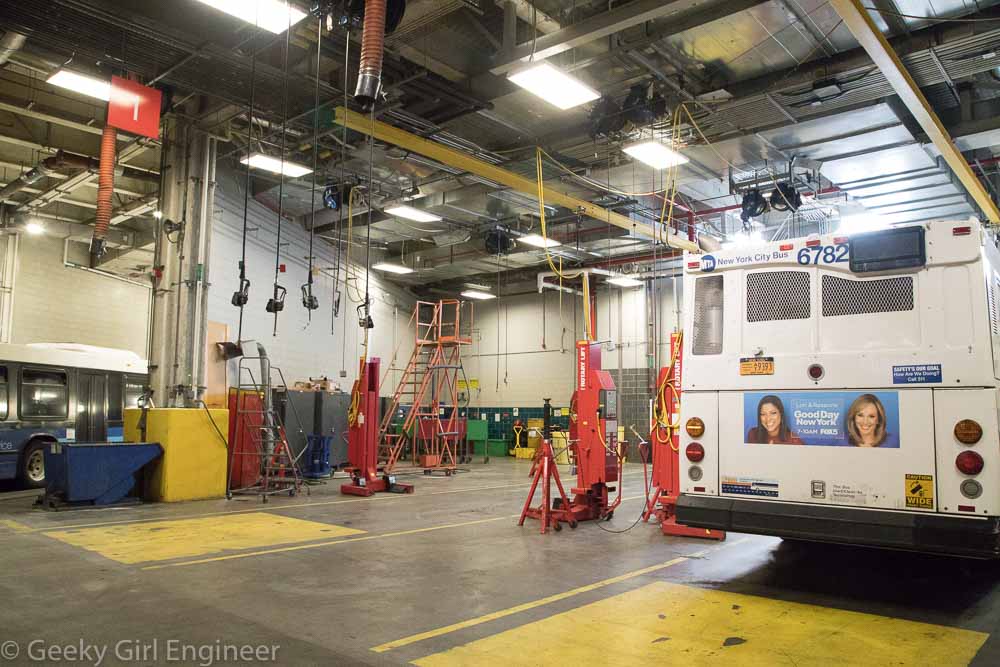
I recently got the opportunity to tour New York’s MTA’s Mother Clara Hale Bus Depot with the New York Transit Museum. It is the newest bus depot in New York, and it features many innovative and environmentally friendly design. It has a green roof. Stormwater from the roof in reused in the facility for bus wash. It has a thermal wall that absorbs heat in the winter. It is a really well designed facility, and it is huge. There are also many buses at the bus depot because of course the bus depot is for maintenance and repairs.


The front of the building featuring a gorgeous mosaic
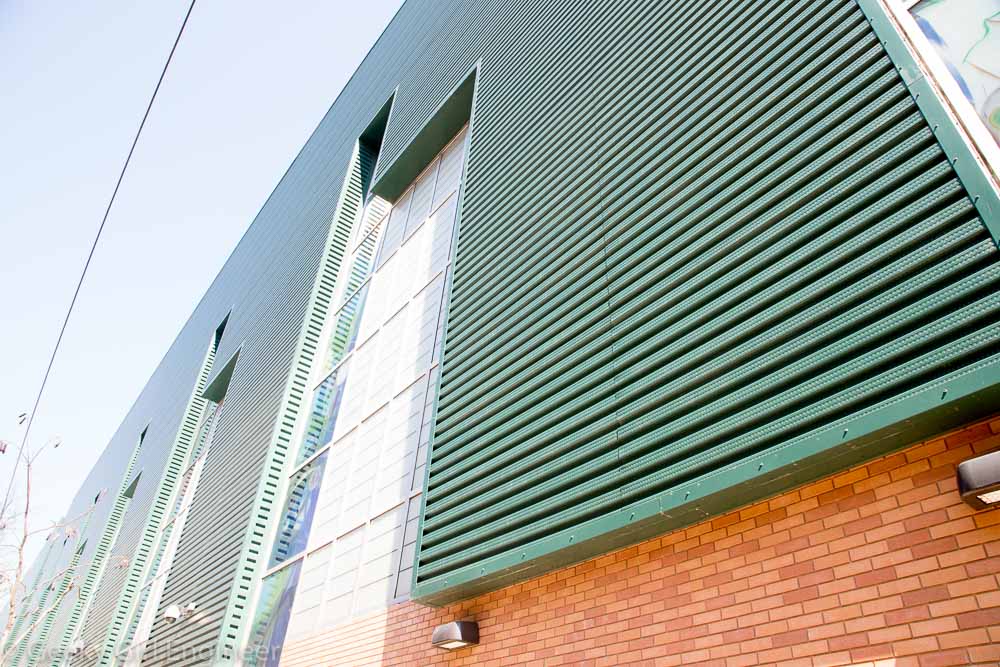
The green metal on the south absorbs solar energy to help heat the building.
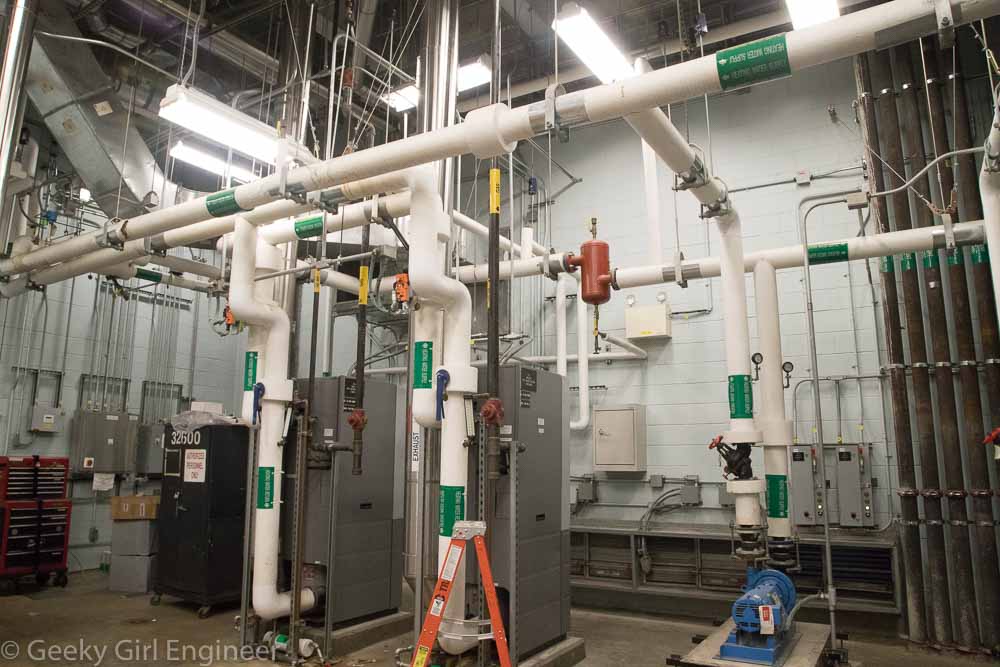
Heat exchangers for hot water
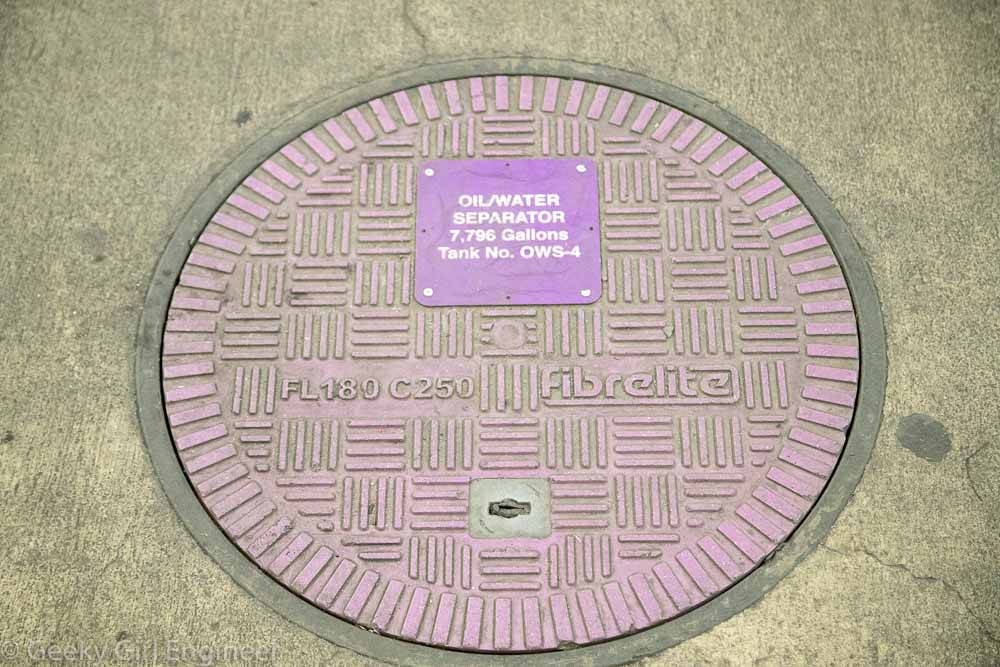
Access to oil/water separator
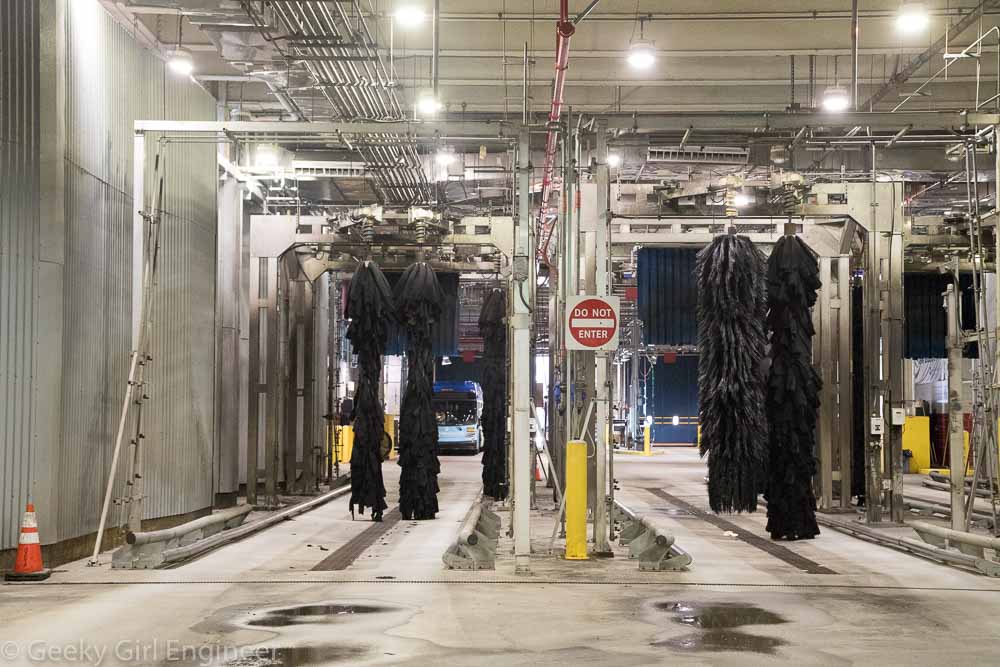
Bus wash using stormwater from the roof
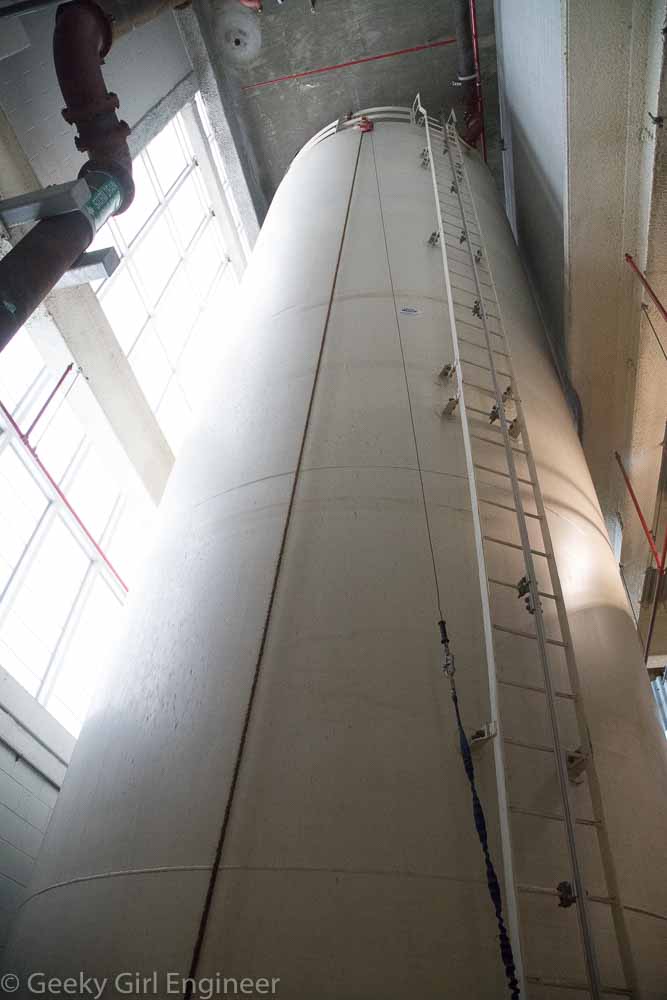
HUGE storage tank stores stormwater from roof
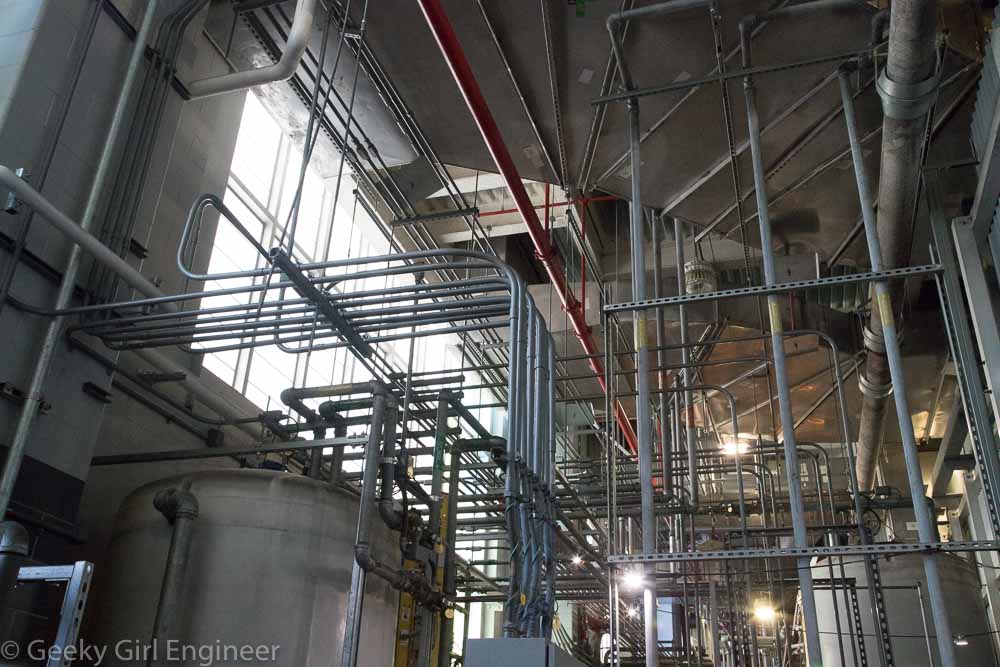
Lots and lots of piping and conduit in stormwater recycling area
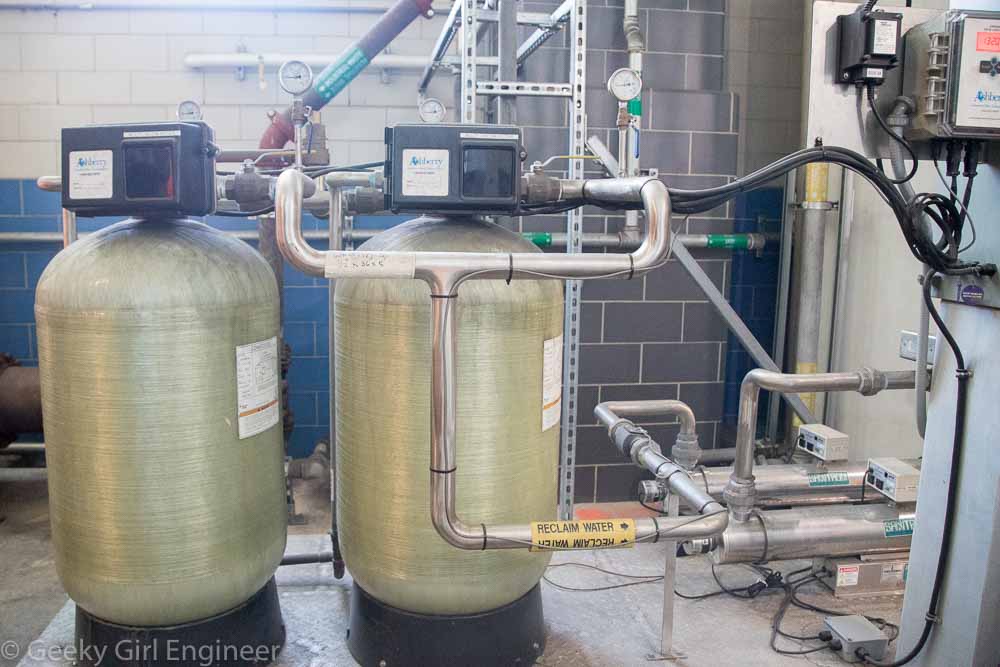
Stormwater cleaning tanks
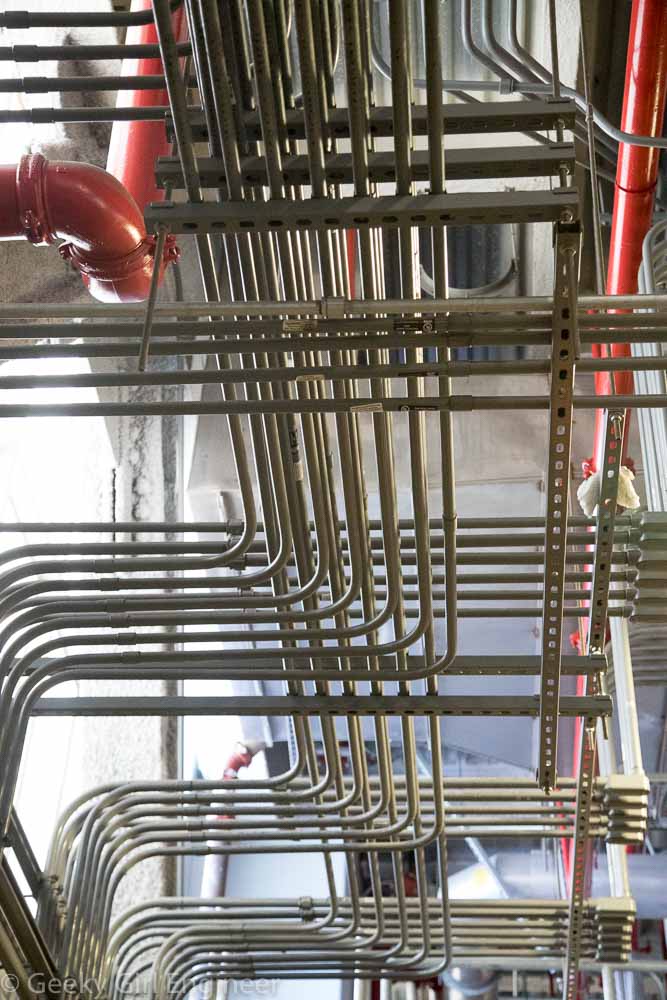
I have a thing for pipes and conduits. I just love the patterns.
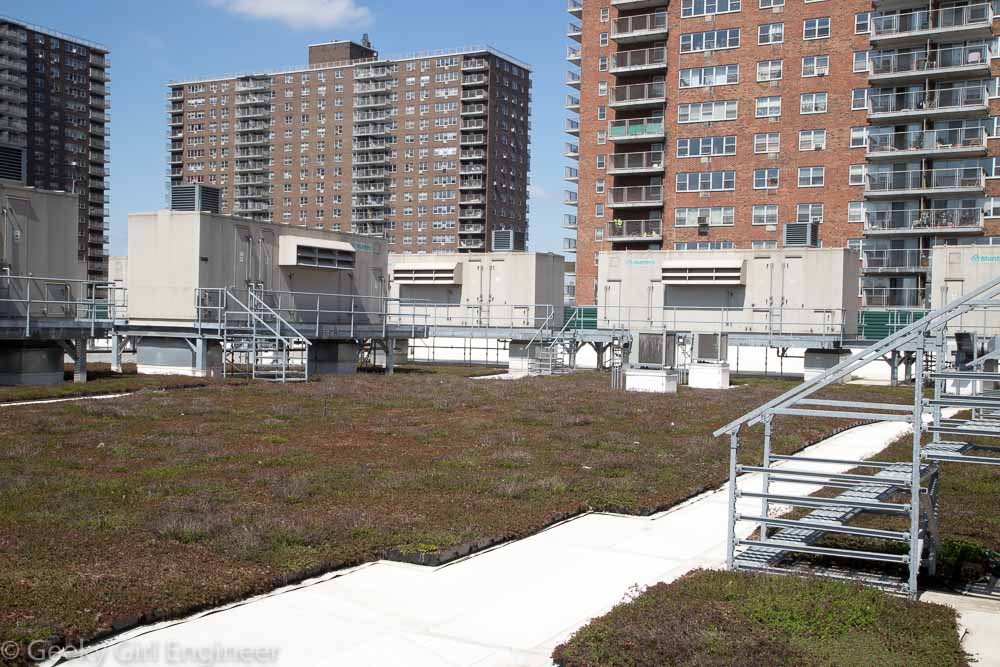
The green roof covered with plants
Plants on green roof absorb some of the stormwater, and stormwater runoff enters pipes to go to the storage tank.
Oh yes, there are buses at the bus depot, and they get maintenance and repairs.

Still Learning

I spent the better part of my childhood in suburbia Houston. I think I learned about the Civil War in the second year of U.S. history, which I think I took in 8th grade. Thus, I learned about the Civil War in the mid 1980’s in the South. I very specifically remember being taught that the Civil War was fought over state’s rights. Slavery was a component, but it was really about state’s rights. Decades later, when I was in my 30s, I was having a conversation with a couple of friends. I think the conversation was about federal versus nationalist governments but am not sure, but I remember stating what I had learned in school that the Civil War was fought over state’s rights. One of my friend’s looked at me surprised and said “you really are a Southerner.” I remember being surprised that others (most? any non-Southerner?) thought that the war was fought for a reason other than state’s rights, i.e. fought over slavery. Ironically, the friend was also from the South. It never occurred to me before that moment to question what I had been taught. I have never wished the South had won or anything to that effect. In fact I make fun of the South and am often embarrassed by it. I just had never learned something different. I was and am still learning history.

Growing up in Texas with all my relatives from various states of the South, there were just things that seemed normal to me that I never realized were offensive to others, in particular to African-Americans. Confederate flags are everywhere. Streets, parks, statues, etc. are dedicated to people of the Confederacy. Confederate Heros’ Day is a state holiday in Texas and celebrates Robert E. Lee’s birthday. [Other Southern states have similar.] Because Lee’s birthday is January 19, Confederate Hero’s Day very often falls on the same week as the federal holiday celebrating Martin Luther King, Jr. Day. I still am not sure if that is just weird, offensive, or amazingly ironic. It wasn’t until the events in Charlottesville and the recent push to get rid of things honoring Confederate leaders that I learned that these statues were not erected right after the Civil War but rather decades later during the Jim Crow era. I am still learning.

Years ago, I remember watching an episode of Law and Order. I very well may have been watching it in reruns on cable. I don’t know. I just remember that at some point during the episode either as graffiti or something (I’m fairly sure the word was not spoken), a word was used that I had never heard before. The episode was written such that the audience was supposed to know and understand what that word meant and be offended. I had to look it up online. The word is a Jewish epithet. I guess it is a good thing that I had never heard of the word because why would I want to be exposed to offensive language, but in a weird way, you almost have to know what is offensive to know to be offended by it. Do I want to learn what to be offended by?

As I have grown older, there have been numerous times when I learned that a word or saying or something was offensive to a group of people. I am embarrassed that I didn’t know initially, but I am grateful for anyone who appreciates that I didn’t know and is willing to educate me on it. I am still learning.

Several years back, in a private conversation with just one other person present, an older relative of mine used an ethnic slur to describe some people. I know, or hope, my relative did not mean to use a slur, and as soon as the term was used, I tried to explain that was a slur and please don’t use it again. As I recall, we got into an argument, and I was accused of being disrespectful because my relative didn’t realize the term was as charged as it is. I can remember trying to explain that I was sure that person didn’t mean to use a slur, but it was one, and please learn not to use it. I accept that many people didn’t know that certain words are slurs. To a certain degree, the older you get, the harder it can be to change your ways. Or maybe we just become more stubborn as we get older. Or maybe we are all still learning sometimes against our will.

About the only group of people I feel I have standing to have a “vote” as to what is and is not offensive is women. The use of the word girl can be used in an offensive or benign way depending on setting. [In my opinion, always offensive professionally but benign when discussing something among friends, like “going out with the girls”.] I would guess that there are things I would disagree with other women about as what is and is not offensive. There is a word that in my opinion is about the nastiest slur that can be used for a woman that on a few occasions I have heard someone say. I literally cringe when I hear it. This word does not start with a b. On the few occasions I have heard it, I try to have patience and calmly tell the man (on rare occasion a woman) never to use that word. If nothing else, it gives me empathy for other groups when slurs are used against them. For other groups of people, be it ethnic, religious, skin tone, gender identity, whatever, I let the members of that group decide what is and is not offensive. When I know something is offensive, I respect that and don’t use it. The more people I know, the more I learn. I can think of times in the past few years where I have learned the respectful way to call a person or group of people. I did not use an offensive term before, but I have learned how they want to be called. That is important to me and how I am still learning.

What is my point? We are all still learning. Before anyone gets onto their high horse and say someone should have known something, especially when discussing something decades into the past, they need to stop to consider when everyone else learned that thing. If a child is taught something one way, then the child will just assume that is the truth or the right way, until the child (or perhaps now adult) learns something different. Our environment shapes who we become, and sometimes we have to leave that initial environment to become something different or learn a different perspective. When one person learns “the truth” of some matter may be years or even decades after another person learns that same truth. We need to have patience with each other. We need to teach each other and learn from each other. An initial ignorance is forgivable. That’s why and how we learn. It is a refusal to learn where forgiveness can be difficult. So keep learning.